
⚓ At a glance
- Our boats
- Always private — one group per trip, up to 26 guests, never a mixed cattle-boat load
- Draft
- Shallow enough to reach skinny shell flats and dockless barrier islands
- Route
- Not fixed — flexes with the tide, weather and what your group wants to see
- Typical big tour boat
- 40+ passengers aboard, one published loop, confined to marked deep-water channels
- Best for
- Families, shellers and photographers who want an actual beach landing, not a drive-by
Why Boat Size Changes What Your Tour Actually Is
Every boat running out of Marco Island, Goodland and Naples answers to the same math: the bigger the hull and the more people aboard, the more water it needs under the keel. A 40-passenger tour boat with a couple of open decks is drawing several feet even sitting still at the dock, and that draft doesn’t care how badly your kids want to hop off on a sandbar — it simply cannot follow you into two or three feet of water without going aground. So those boats stick to Gordon Pass, the marked Intracoastal, and a handful of deep-water anchorages where the chart guarantees they won’t touch bottom. Our boats draw a fraction of that. It’s not a marketing line — it’s the reason a small private charter can nose right up onto a barrier island beach that has no dock, no marina and no way for a big commercial boat to ever get you there.
Where the Big Tour Boats Simply Can’t Go
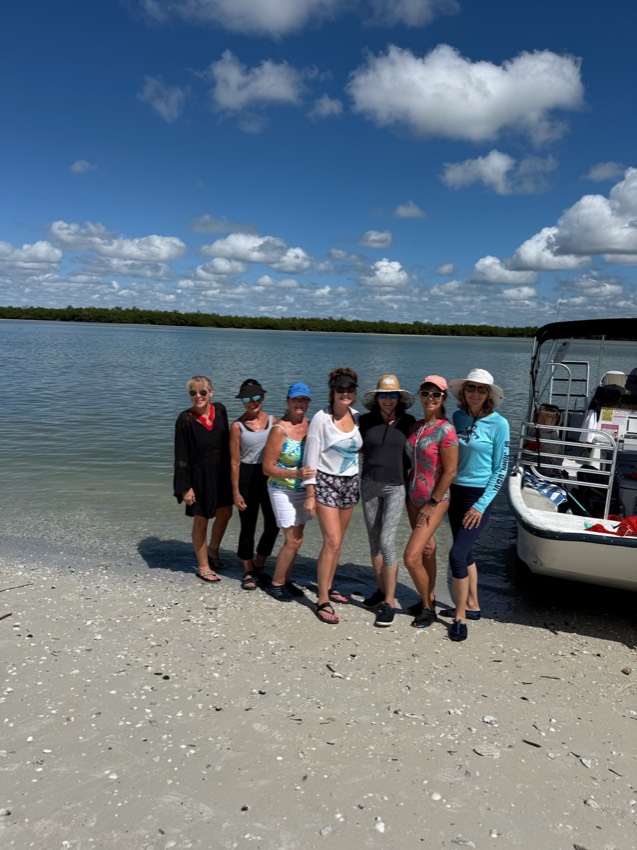
The Ten Thousand Islands are mostly roadless and mostly dockless on purpose — that’s what keeps them wild. Islands like Keewaydin, Kice and the sandbars around Cape Romano don’t have a pier for a 40-passenger boat to tie up to, so the big operators simply don’t stop there; they run their fixed loop through the channels and point the islands out from a few hundred yards offshore. A shallow-draft private boat can idle in, ease the bow onto the sand, and let your group actually walk the shell flats at low tide instead of looking at them through a window. The same goes for the skinny mangrove creeks near Rookery Bay, where a big hull simply won’t fit between the banks. If reaching real shell-collecting water — empty shells only, by Collier County rule — is the point of your trip, the boat’s draft matters more than almost anything else on the brochure. That’s the whole case for a shelling tour built around a small boat instead of a big one.
A Fixed Loop vs a Route That Flexes to You
Big tour boats publish a schedule because they have to — with 40-plus tickets sold, the route, the stops and the return time are locked in before anyone boards. That’s fine if you just want to see the water from a distance, but it means the boat can’t chase a dolphin pod that surfaces off to the side, can’t linger an extra twenty minutes because the shelling is good, and can’t push the timing back a few minutes for better light. A private captain works the opposite way: the plan for the day gets built around your group before you ever leave the dock, and it keeps adjusting while you’re out there. Dolphins working a pass? The captain slows down and lets you watch — without a guarantee, since sightings are never a sure thing out here, but with the freedom to actually try. Tide dropping fast on a good shell beach? You get more time there, not less. That flexibility is baked into a dolphin tour or sunset cruise that isn’t sharing its schedule with anyone else.
Strangers Aboard vs Just Your Group
There’s a real experience difference between standing at a rail with 35 people you’ve never met and having the whole boat to your own group. On a big tour boat, your photos usually have someone else’s family in the background, your kids are competing for a spot at the bow, and the captain is narrating to a crowd instead of answering your specific questions. Every Sand Dollar trip is private — one group per charter, up to 26 guests, and the boat and the captain’s attention belong to you for the whole trip. That matters most on a private charter where you actually want a say in the route, and it’s a big part of why families with young kids or grandparents with mobility needs tend to prefer it — nobody’s rushing anyone to make room for the next group waiting at the dock. It also changes the pace of the whole day: a private group can start a few minutes early or run a little long without throwing off a schedule built around dozens of other people’s plans.
How Sand Dollar Runs the Small-Group Model
We run every tour — shelling, dolphin-watching, sunset, tiki, fishing charters and private charters — the same way: shallow-draft boats, always private, captained by USCG-licensed captains who’ve read this water for years. That means the same boat that can idle into two feet of water off Kice Island can also run you comfortably out to open Gulf water for a sunset. It’s a different tradeoff than a big commercial fleet, and it’s worth being honest about: a large tour boat can be a perfectly good, efficient way to see the water from a distance, and if cost is the deciding factor for your family, our private-charter-vs-shared-boat breakdown lays that comparison out plainly. But if what you actually want is a beach landing on an island with no dock, a route that bends around what your group wants to see, and a boat that’s never shared with strangers, the smaller, shallow-draft private option is the one built for that job. It’s the same thinking behind every guide in our On the Water hub — the practical, honest answers for planning a trip out of Marco Island, Goodland or Naples.
| Small private boat (ours) | Typical big tour boat | |
|---|---|---|
| Group | Always private, one group per trip, up to 26 guests | 40+ passengers, mostly strangers |
| Draft | Shallow — reaches skinny flats and dockless islands | Deep — confined to marked channels |
| Route | Flexes to tide, wildlife and your group | Fixed, published loop |
| Beach landings | Yes — noses onto dockless barrier islands | Rare — usually a drive-by view |
| Captain’s focus | Your group’s questions and interests | Narrating to a full boat |