
📜 At a glance
- Company
- Deltona Corporation, founded by brothers Elliott, Frank & Robert Mackle
- Ground broken
- 1964, on what was then a mostly mangrove-fringed barrier island
- Signature move
- Dredged roughly 100 miles of finger canals to create waterfront lots
- Sales model
- Lots marketed and sold nationwide, often sight unseen, through mail-order campaigns
- Turning point
- 1970s federal wetlands-permit denials halted the final phases of dredging
- Legacy
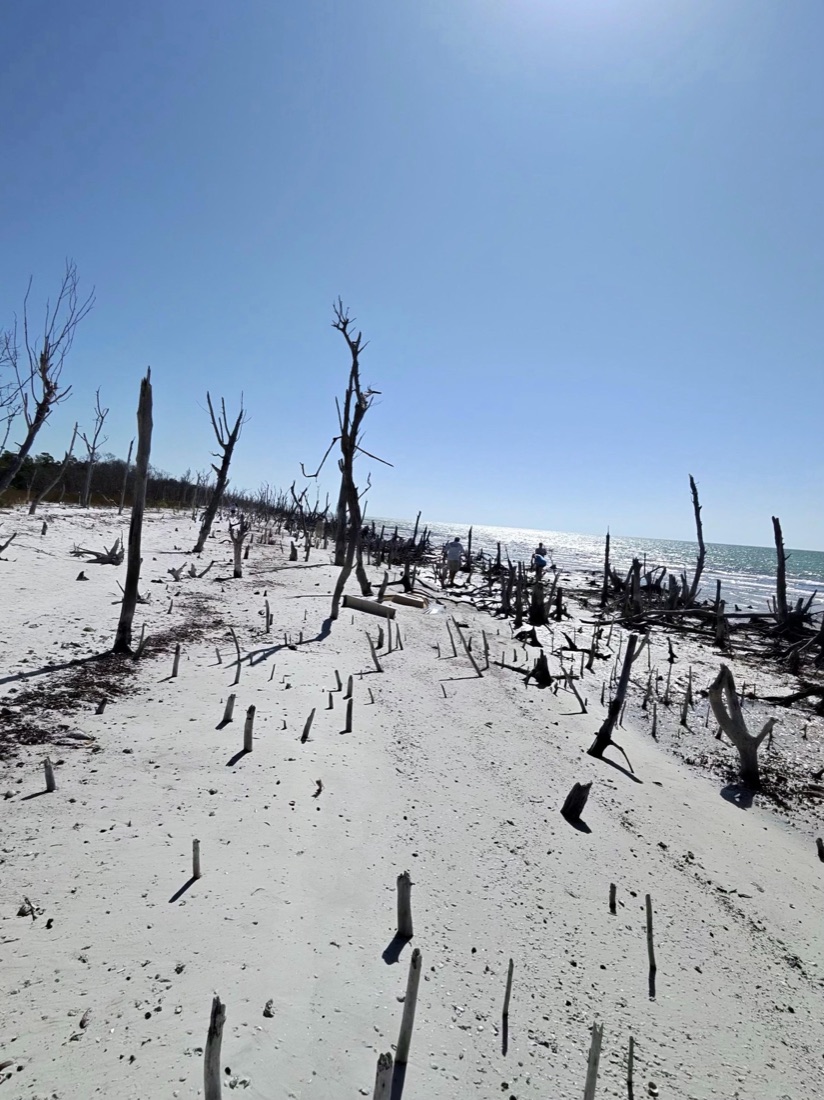
- The unbuilt mangroves now help anchor the Rookery Bay reserve
Who Were the Mackle Brothers?
Before Marco Island had a single finger canal, the Mackle name was already known across Florida. Elliott, Frank and Robert Mackle were the sons of a Miami building contractor, and by the 1950s the three brothers had built and sold entire towns from scratch — places like Port Charlotte, Port St. Lucie and Port Malabar — through a company called General Development Corporation. Their formula was blunt and effective: buy raw, unglamorous land, cut it into thousands of lots, and sell it to buyers who had never set foot in Florida, using national newspaper ads, free inspection-trip flights and a sales pitch built almost entirely on sunshine and water access. By the early 1960s that formula had made them some of the most prolific land developers in the country, and they were looking for one more project big enough to match it.
Marco Island fit the bill better than almost anywhere else on the Gulf. It was a genuine barrier island with deep water on its Gulf side, a scattering of small fishing and clam-packing families, and thousands of acres of mangrove flats that, to a 1960s developer’s eye, looked like raw material rather than habitat. In 1964 the brothers formed a new company, Deltona Corporation, specifically to take the island on, and the plan was audacious even by their own standards: transform tens of thousands of acres of mangrove flats into a fully platted, canal-laced city built to house tens of thousands of residents. You can read the island’s earlier chapters, including the Calusa mounds and Barron Collier’s own empire, on our Marco Island history page — the Mackles simply picked up where that older Florida left off.
How Deltona Built Modern Marco Island
Deltona’s engineers ran dredges through the tidal creeks and mangrove flats, pumping the spoil onto the adjacent land to raise it above flood level while simultaneously carving a canal along the property line of nearly every lot. The result, still visible from the air today, is the fishbone-shaped grid of roughly 100 miles of man-made waterway that gives almost every home on the island direct boat access to the Gulf. It’s the reason a short drive across Marco means crossing a bridge every few blocks, and the reason so many backyards end at a private dock instead of a fence.
Deltona sold the dream, not the dirt. Buyers in Ohio, Michigan and New York bought waterfront lots straight off full-page newspaper ads and glossy brochures, often sight unseen, then took a free fly-and-buy weekend to see what they’d actually purchased. It worked spectacularly: within a decade, Marco Island’s population and property values had climbed from a rounding error to a genuine Southwest Florida destination, and Deltona’s sales offices were moving lots faster than crews could finish the streets. Nearby Goodland, a couple of miles down the road, quietly sat out the transformation — its stilt houses and net-strewn yards are still the best surviving picture of the fishing village Marco itself used to be.
The Fight That Stopped the Bulldozers
Deltona’s master plan called for several more phases — additional islands and keys of canal-front lots pushed even deeper into the surrounding mangrove estuary. By the early 1970s, though, the ground had shifted under them. New federal wetlands law had just handed the Army Corps of Engineers real authority over dredge-and-fill permits, and a new generation of biologists was making the case that Ten Thousand Islands mangroves weren’t swampy nuisance land at all, but nursery habitat — the shallow, root-tangled water where snook, redfish and shrimp spend their first year of life. Conservation groups and state regulators pushed hard against the remaining permits, and for the first time, Deltona ran into a wall its sales brochures couldn’t talk its way around.
The Corps said no to Deltona’s remaining permits, and Deltona pushed back hard, arguing in federal court that denying the permits amounted to taking valuable land without paying for it. The company lost. The ruling, handed down in the early 1980s, became one of the era’s defining tests of how far government could go in protecting wetlands without triggering a constitutional taking — a case still cited in environmental-law classrooms today alongside the earliest Clean Water Act wetlands fights. For Marco Island, the practical result was simple and permanent: the dredges stopped a few thousand acres short of the original plan, and the unbuilt mangrove fringe never got a canal.
| Year | Milestone |
|---|---|
| 1964 | The Mackle brothers’ Deltona Corporation begins dredging Marco Island’s canal grid |
| 1965 to 1970 | National mail-order sales campaigns bring buyers from across the country sight unseen |
| Early 1970s | New federal wetlands rules tighten dredge-and-fill permitting in the Ten Thousand Islands |
| Mid-1970s | The Army Corps of Engineers denies permits for Deltona’s final build-out phases |
| Early 1980s | Federal courts reject Deltona’s takings claim in a landmark wetlands-law ruling |
| Today | The unbuilt mangroves help anchor the Rookery Bay National Estuarine Research Reserve |
What You Can See From the Water Today
That halted last phase turned out to be one of the better things that ever happened to this stretch of coast. Much of the mangrove wilderness Deltona never dredged helped anchor what later became the Rookery Bay reserve system, and today it’s one of the few places in Florida where you can motor out of a fully modern canal neighborhood and, within fifteen minutes, be threading tidal creeks that look almost exactly as they did before 1964. Our captains cross that line on pretty much every trip we run, and it’s usually the moment first-time visitors stop looking at their phones and start asking questions.
It’s genuinely one of the more interesting things to see on this coast, and it’s hard to appreciate from land. From a seawall you just see your own canal. From the water on a dolphin tour or sunset cruise, you watch the arrow-straight Deltona grid give way, cove by cove, to the tangled backcountry the courts ended up saving. Pair it with a stop through our Marco Island guide before or after your trip and the whole story clicks — two completely different visions of Florida, sitting a couple hundred yards apart, both still shaping what this island looks like today.