
📜 At a glance
- What it is
- A 2.45-acre Collier County preserve built atop an ancient Calusa shell mound
- Where
- 1831 Addison Court, in Marco Island’s Indian Hills neighborhood
- The mound
- A Calusa midden of oyster, surf clam & lightning whelk shell, dating roughly 700 to 1200 AD
- The homestead
- Whelk-shell terraces hand-built by Ernest & Gladys Otter in the mid-1950s
- Trail
- A short, roughly 0.1-mile loop — easy to walk in 15 to 20 minutes
- Cost
- Free, open daily; small lot & bike rack at the entrance
What Is Otter Mound Preserve?
Otter Mound Preserve sits at 1831 Addison Court, wedged into the Indian Hills neighborhood on the north end of Marco Island — a place you would drive right past if you did not know to look for the small parking area and bike rack tucked between the houses. At just under 2.45 acres, it is one of the smallest stops in Collier County’s Conservation Collier preserve system, and also one of the most layered: a genuine Calusa shell mound capped, centuries later, by a homesteader’s garden terraces built almost entirely out of whelk shell. Nothing else in the Marco Island history story lets you walk it in fifteen minutes flat, no boat, no tide chart, no planning required. Collier County started buying the land in 2004 and finished protecting it a few years later, then opened it to the public with a marked loop trail, benches and interpretive signage explaining exactly what you are standing on. It is free, it is open daily, and it takes about as long to see as it does to read this page. It is not the only mound-turned-homestead on the island, either — Horr’s Island tells a similar story a few miles south, pineapples instead of whelk shells. This whole corner of the island once fell under the old Caxambas settlement, the clam-camp neighborhood the mound looked out over long before Addison Court had a name.
The Calusa Mound Underneath
Long before Ernest and Gladys Otter ever set foot here, the ground under Otter Mound Preserve was already rising. The Calusa, the shell-building culture that ran this whole coast for centuries before European contact, piled up oyster, southern surf clam, lightning whelk and other shellfish here by the ton, generation after generation, until what started as a heap of discarded dinner shells became a mound tall enough to build a house on. Archaeologists date the midden to roughly 700 to 1200 AD, which puts it in the same broad era as the more famous shellworks scattered through the region’s shell mounds — this is simply the one that ended up in someone’s front yard instead of out on an uninhabited key. The alkaline shell soil did what it always does on this coast: it preserved things that would have rotted away anywhere else, which is part of why Marco Island keeps turning up Calusa artifacts in better condition than almost anywhere else in Florida. You are not looking at a recreation or a staged exhibit here. The rise and fall of the ground itself, under the gumbo limbo and the leaf litter, is the actual midden the Calusa built, layer on layer, without ever knowing it would end up as someone’s front yard.
The Otter Family’s Whelk-Shell Terraces
The preserve’s name has nothing to do with the animal. It is named for Ernest and Gladys Otter, the family who homesteaded on top of the mound and lived there until 1997. Sometime in the mid-1950s, Ernest Otter set about terracing the sloped, shell-rich ground for a garden, and instead of hauling in retaining-wall block, he built with what was already under his feet: thousands of whelk shells, hand-set into walls and stepped terraces that still line the trail today. It is an odd, almost accidental preservation story, a homesteading family repurposing an ancient shellworks for practical, unromantic reasons, and in doing so protecting the mound’s shape from decades of the erosion and development pressure that flattened most of Marco Island’s other mounds into house pads and parking lots. A weathered wooden outhouse from the homestead era still stands near the trail as the other physical reminder that people, not just Calusa fishermen, called this hill home. Look closely at the walls as you walk and you will spot the lightning whelk’s distinctive left-handed spiral worked in right alongside conch, horse conch and clam shell — a homesteader’s utility wall that happens to double as a shell identification lesson. It is easy to miss on a quick pass; slow down at the terraces near the trail’s midpoint and you will start picking individual shells out of the mortar.
Visiting: Trail, Parking & Rules
Otter Mound Preserve is open daily, typically from morning to early evening, and admission is free. Parking is limited to a handful of spaces plus a bike rack at the entrance, so this is very much a neighborhood-scale stop — go early or midday if you are bringing more than one car. The trail itself is a short, mulched loop of about a tenth of a mile, not paved and not wheelchair accessible, threading past interpretive signs, the old outhouse and the whelk-shell walls before looping back to the entrance under a canopy of gumbo limbo, strangler fig and cabbage palm. There are no restrooms on site. Leashed dogs are welcome. And because this is a protected archaeological site rather than a public beach, the empty-shell rule you would use out on Keewaydin or Kice does not apply here at all — nothing on the preserve, shell or otherwise, is yours to take home. Bring water, bring bug spray in the warmer months, and bring a little patience for the mosquitoes that tropical hardwood hammock habitat tends to produce. Give yourself fifteen to twenty unhurried minutes; most visitors are back at their car before that.
Why See the Rest by Boat
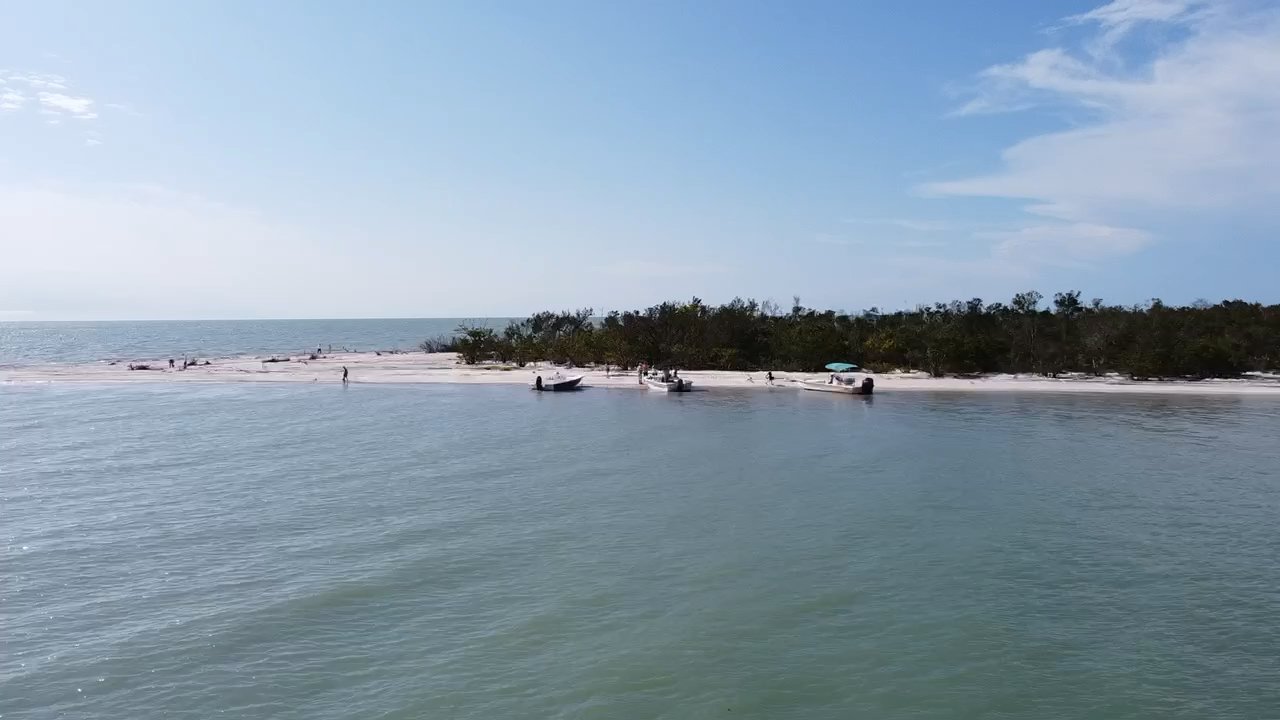
Otter Mound is the exception, not the rule. Almost every other Calusa shellworks along this coast, the mound keys buried in the backcountry, the untouched shell ridges that never got a homestead or a parking lot, sits inside the Ten Thousand Islands, reachable only by water. That is the real payoff of walking Otter Mound first: once you have seen up close what a capped, developed shell mound looks like, you start noticing the wild, uncapped ones from the boat, low green humps of mangrove and shell rising out of water that was open bay a thousand years ago. Our shelling tours run right through that backcountry, past mound islands the Calusa built and abandoned centuries before Otter Mound ever had a garden wall, and past barrier islands where the tide still turns up shell the way it always has. Pair the two: walk the Otter family’s terraces on land, then let one of our captains show you where the rest of that shell empire is still sitting, close to exactly as they left it. It is a short walk and a short boat ride that, together, cover more of Marco Island’s real history than most people see in a weekend here.
| Otter Mound Preserve | Ten Thousand Islands Mound Keys | |
|---|---|---|
| How you get there | Walk in from a residential street on Marco Island | Boat only, through backcountry channels |
| What’s there | A capped Calusa midden with pioneer whelk-shell terraces | Untouched shell ridges under mangrove, never built on |
| Time needed | 15 to 20 minutes on a 0.1-mile loop | A half day or more, tide-dependent |
| Facilities | Marked trail, benches, interpretive signs | None — wild and uninhabited |