⚓ At a glance
- Pontoon draft
- Just inches — built to idle over oyster bars and beach on sand
- Catamaran draft
- Deeper than a pontoon — twin hulls need real water beneath them
- Stability at rest
- Both are steady, but a pontoon's wide flat deck wins for standing, shell-sorting and stepping off the bow
- Ride in open chop
- A catamaran's twin hulls cut swell more smoothly than a flat pontoon bottom
- Best for our route
- Pontoon — shallow islands, mangrove creeks & beach landings
- Best for a catamaran
- Longer open-Gulf crossings we don't run out of Marco Island
What a Pontoon Boat Tour Delivers
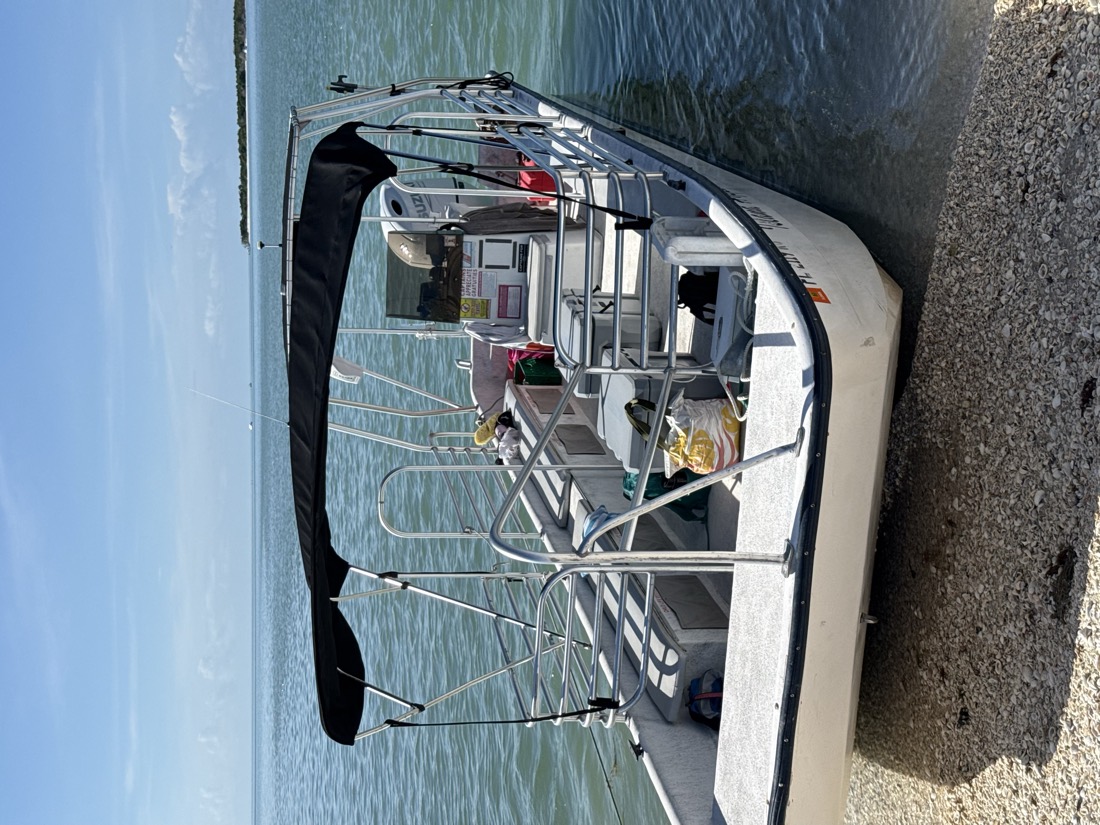
A pontoon boat rides on two or three long aluminum tubes instead of a single hull, which is exactly what lets it draw just inches of water rather than a foot or more. That shallow draft is the whole story: our captains can idle across skinny grass flats and oyster bars that would stop a deeper-draft boat cold, then bring the bow right up onto the sand at a barrier island without ever touching a dock. If a shelling stop is on the itinerary, that matters more than almost anything else about the boat.
The flat, wide deck is the other half of the equation. Because a pontoon doesn't lean or roll at rest the way a narrower-hulled boat can, it's genuinely easy to stand up, move around, hand a kid a shell to look at, or line up a photo without bracing yourself. Guests can spread out across an open deck instead of being wedged into fixed seating, and stepping off the bow onto the sand at a shelling stop feels closer to walking off a dock than climbing out of a boat. That combination — skinny-water access plus a stable, walk-around deck — is why pontoons are the workhorse of shallow, island-studded water like ours.
There's a quieter benefit too. A pontoon can idle down to a near-silent crawl over a grass flat without the hull slapping or the engine straining, which means less noise to spook whatever's working that flat — a wading bird, a redfish tailing in the shallows, a dolphin working a mullet school along the shoreline. That low, easy idle is part of why a pontoon works just as well for a wildlife-focused morning as it does for a shelling stop; the boat gets you close without announcing itself first.
What a Catamaran Tour Delivers
A catamaran flips the design: instead of one flat bottom or a single deep hull, it rides on two slender hulls set apart from each other, each one slicing its own path through the water. In open water with real swell running, that geometry pays off — the two hulls tend to ride flatter and absorb chop more smoothly than a flat-bottomed boat pounding straight across the same waves, which is why catamarans have a reputation as a comfortable ride offshore.
The tradeoff is draft. Those two hulls need real depth beneath them to do their job, so a catamaran generally draws more water than a pontoon's flat bottom does, even though it isn't a deep-draft boat by open-ocean standards. That rules out nosing onto a sandbar or ducking into a skinny mangrove creek the way a pontoon can; a catamaran wants to stay in marked channels and open bays where there's room underneath it. It's built for covering distance in open water comfortably, not for beaching on an island.
Catamarans also tend to run a split-level deck across the two hulls rather than one continuous open floor, and that layout works well when a boat is carrying a lot of people a long distance and wants separate zones for shade, seating and open rail space. It's a genuinely good design — just for a different kind of day than an island-hopping shelling trip, where the goal is getting the whole group off the boat and onto the sand as easily as possible rather than settling in for a longer open-water run.
Catamaran vs Pontoon, Side by Side
Lined up next to each other, the two hulls split cleanly by what kind of water they're built for and what kind of trip that water supports:
| Pontoon | Catamaran | |
|---|---|---|
| Draft | Very shallow — inches of water | Deeper — needs real water under both hulls |
| Beach landings | Yes — noses right onto sand | No — stays in channels and open bays |
| Ride in open chop | Can feel choppier in bigger swell | Rides flatter through open-water swell |
| Deck layout | Wide, flat, open walk-around deck | Split-level deck across twin hulls |
| Best water | Shallow bays, mangrove creeks, sandbars | Open bays, longer offshore crossings |
| Best for our route | Ten Thousand Islands island-hopping | Longer open-Gulf runs we don't operate |
Why We Run Pontoons Here
The Ten Thousand Islands aren't open ocean — they're a shifting maze of oyster bars, mangrove creeks and sandbars that rearrange themselves a little with every tide. A shelling stop on a boat-only island like Keewaydin or Kice only works if the captain can actually get the bow onto the beach, and that's a pontoon's whole job description. Our tours through the Ten Thousand Islands are built around exactly that kind of shallow-water access, from idling over a sandbar at low tide to sliding right up onto the sand for a shelling stop. Every one of those barrier islands — Keewaydin, Kice, and the stretch of coastline out past Cape Romano — sits behind a chain of oyster bars and grass flats that only a shallow-draft boat can cross without waiting on the tide, and our destinations guide covers what makes each one worth the stop.
Family comfort factors in just as much as access. Most of our routes work protected water inside the islands and passes rather than a long open-Gulf crossing, so the pontoon's flat, stable deck matters more day to day than a catamaran's smoother ride in swell we're rarely running through anyway. Kids can move around, stand at the bow, and step straight onto the sand without anyone bracing against a rolling deck, which is exactly the kind of low-drama boarding and unloading that keeps a family trip relaxed instead of stressful.
When a Catamaran Actually Makes Sense
To be fair to the other hull: if your day involves a genuinely long open-Gulf crossing with real swell running, a catamaran's twin-hull ride is the more comfortable choice, and that's a real advantage, not a marketing line. That's just not the itinerary we run. Our trips work the passes, sandbars and mangrove creeks close to Marco Island, Goodland and Naples, where beaching on an island and gliding over skinny water matter far more than smoothing out offshore swell that isn't part of the route.
If you're weighing a similar hull question for a more casual evening out, our pontoon vs tiki boat comparison covers that decision too. And if your group wants full control over the route — timing a shelling stop, a wildlife detour and a sunset run into one afternoon — a private charter on one of our pontoons lets you build that day around your crew instead of a fixed schedule. Either way, the honest verdict stands: for the shallow, island-dotted water we call home, the pontoon is the right tool for the job.