
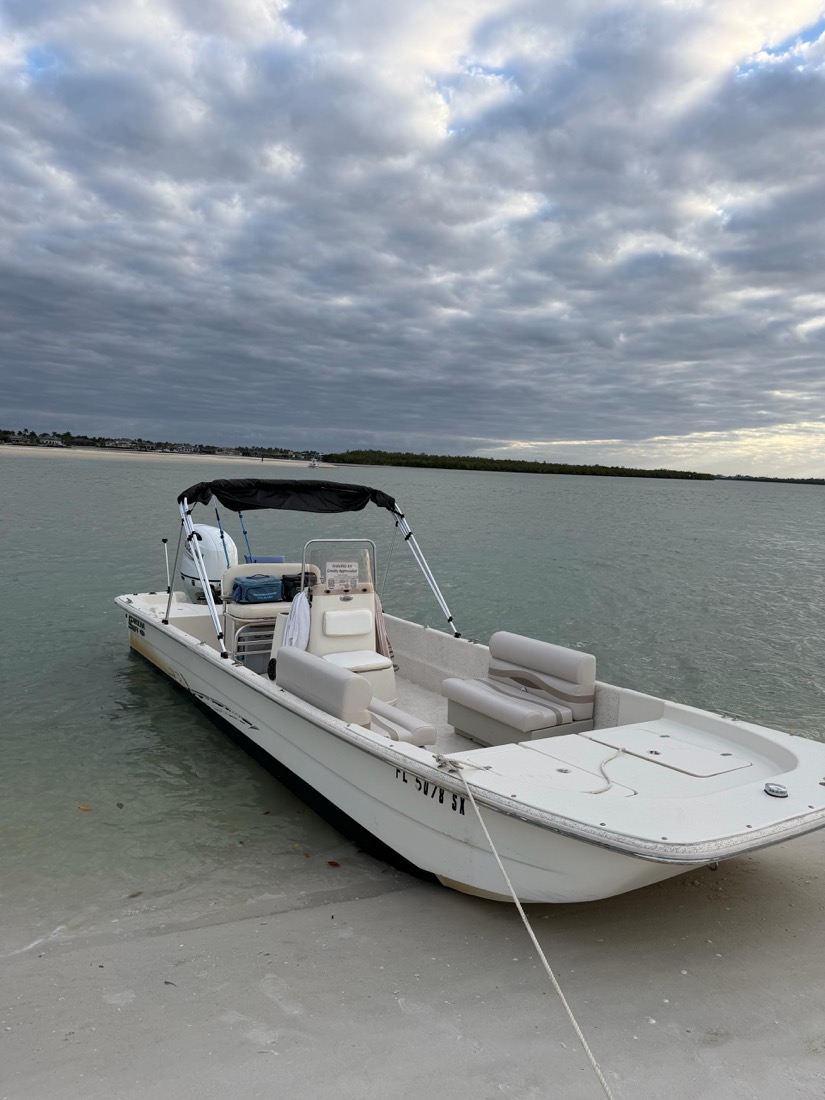
⚓ At a glance
- Front & back
- Bow is the front, stern is the back
- Left & right
- Port is left, starboard is right — always facing forward
- The rail you lean on
- The gunwale (rhymes with funnel) is the boat’s top edge
- Where the captain stands
- The helm, usually under a shade top called a bimini
- What lines tie to
- Cleats — metal fittings on the dock and the boat
- Why draft matters
- Draft is how shallow a boat can run — why we reach flats bigger boats can’t
Which Way Is Port? Boat Directions, Explained
The four directions you’ll hear most on a Sand Dollar trip are bow, stern, port and starboard, and none of them change no matter which way you happen to be facing. The bow is the front of the boat, the stern is the back. Port is the left side and starboard is the right — but here’s the trick that makes it useful: those sides are fixed as if you’re always facing the bow, so port stays port whether you’re up front or lounging back in the stern. Our captains lean on these words constantly, mostly to point things out fast. Hear a call of dolphin off the port bow on a dolphin tour and you’ll know instantly to look forward and left, not spin around guessing while the moment passes. It’s the quickest way for a captain running the Ten Thousand Islands to get a whole boat of guests looking at the same fin at once.
A few related words round it out. Forward and aft simply mean toward the bow or toward the stern, so a captain telling you to head aft just means walk back toward the stern. Amidships, or just midship, is the middle of the boat, generally the steadiest spot if there’s any chop running. None of this is complicated once you’ve heard it a time or two, and that’s really the whole point of this page — a two-minute vocabulary lesson so you’re not lost for the other two hours.
The Boat’s Body: Hull, Gunwale, Transom & Draft
The hull is the boat’s entire body — the part that actually touches the water, running from the pointed bow back to the flat or notched stern. Everything else on the boat sits on top of it. The gunwale (said GUN-el, and yes, the spelling throws almost everyone the first time) is the top edge of the hull running along both sides, the rail you’ll actually rest your arms on while you watch the mangroves go by. The transom is the flat panel across the stern where the outboard motor mounts; on most of the boats we run out of Marco Island and Goodland, it’s also where the swim platform and boarding ladder live, so it’s the part of the boat you’ll get to know best climbing on and off.
Draft is the one word that explains more about how we run trips through the Ten Thousand Islands than any other. It’s simply how much water a boat needs under it to float and move — a shallow draft means the hull barely dips below the surface. That’s the practical reason our captains can idle up onto sandbars and reach boat-only barrier islands that deeper-draft boats have to skip entirely, tides permitting. When a captain says a spot is too skinny to reach today, draft is almost always the reason why, and it’s also a big part of why a locally run, shallow-draft boat sees places the bigger charter fleets simply can’t.
Where the Captain Works: Helm, Console & Bimini
The helm is simply where the boat is steered from — the wheel, throttle and instruments all within reach of whoever’s running the boat. On most of our boats that’s a center console, a raised steering station set in the middle of the deck so the captain has a clear line of sight in every direction, which matters when you’re threading a narrow channel or watching for manatees near a mangrove shoreline. Every Sand Dollar trip runs with a USCG-licensed captain at that helm, which is a credential that actually means something on the water, not just someone who owns a boat and took a weekend course.
Above the console you’ll usually find the bimini top, the folding shade canopy that keeps the worst of the midday sun off the boat. It’s named for the Bahamian island, not any local spot, but it does exactly the job you’d want under Florida glare. Ask your captain to angle it if the sun’s coming in low; that’s a completely normal request, not an interruption, and most captains will already be reaching for it before you ask.
Tying Up and Moving: Cleats, Lines & Wake
A cleat is the metal T-shaped fitting bolted to the dock and to the boat itself, and it’s what dock lines get tied to when we come alongside. You’ll spot them at the bow, the stern and usually amidships too, and if a deckhand asks you to hold a line for a second while they finish tying off, that’s completely normal — just hold steady and don’t pull. Speaking of lines, on a boat a rope is basically always called a line once it’s got a job to do, whether that’s a dock line, an anchor line, or a fishing line on a fishing charter.
Wake is the trail of disturbed water a boat leaves behind it, and it’s one of the few boat words with a real rule attached to it. No-wake zones exist near marinas, manatee areas and narrow channels for a reason, and our captains slow down in them without needing to be asked. If you’re ever wondering why a boat that could clearly go faster is puttering along at a crawl, that’s why. It’s also, honestly, one of the more peaceful stretches of any trip, a good excuse to just watch the mangroves drift by before we open it back up out past Gordon Pass.
| Term | Plain-English meaning | Why it matters to you |
|---|---|---|
| Bow | The front of the boat | Where the captain points to show you what’s ahead |
| Stern | The back of the boat | Where the swim platform and motor usually are |
| Port | Left side, facing forward | Fixed — doesn’t change if you turn around |
| Starboard | Right side, facing forward | Same rule as port, just the other way |
| Hull | The boat’s whole body in the water | Its shape and draft decide where we can go |
| Gunwale | The top edge you lean on | The rail between you and the water |
| Transom | Flat panel across the stern | Usually where you’ll board and exit |
| Helm | Where the boat is steered from | Your captain’s station — wheel and throttle |
| Bimini | Folding shade canopy | Ask your captain to angle it for sun relief |
| Cleat | Metal fitting lines tie to | What you might be asked to hold a line near |
| Draft | How much water the hull needs to float | Why we reach flats other boats can’t |
| Wake | The trail of water behind the boat | Why we slow down in no-wake zones |
None of these words are complicated, and nobody’s handing out a quiz — but knowing a bow from a stern turns you from a passenger into someone who’s actually along for the ride. If you want the next layer, our navigation words glossary covers channel markers, tides and the language for finding your way through the islands. If you’d rather have the whole boat and crew’s attention on your group alone so nobody feels shy asking questions, a private charter is the easiest way to do that. And back on our On the Water hub, you’ll find every glossary and know-how page like this one, grouped in one place.