
⚓ At a glance
- Pontoon / tiki boat
- Flat, wide, shaded — the most stable ride, great for families and slow cruising
- Center console
- Open, fast, shallow-draft — built for speed and covering distance
- Catamaran
- Twin-hull, very stable — common on large commercial tour boats, not small charters
- What we run
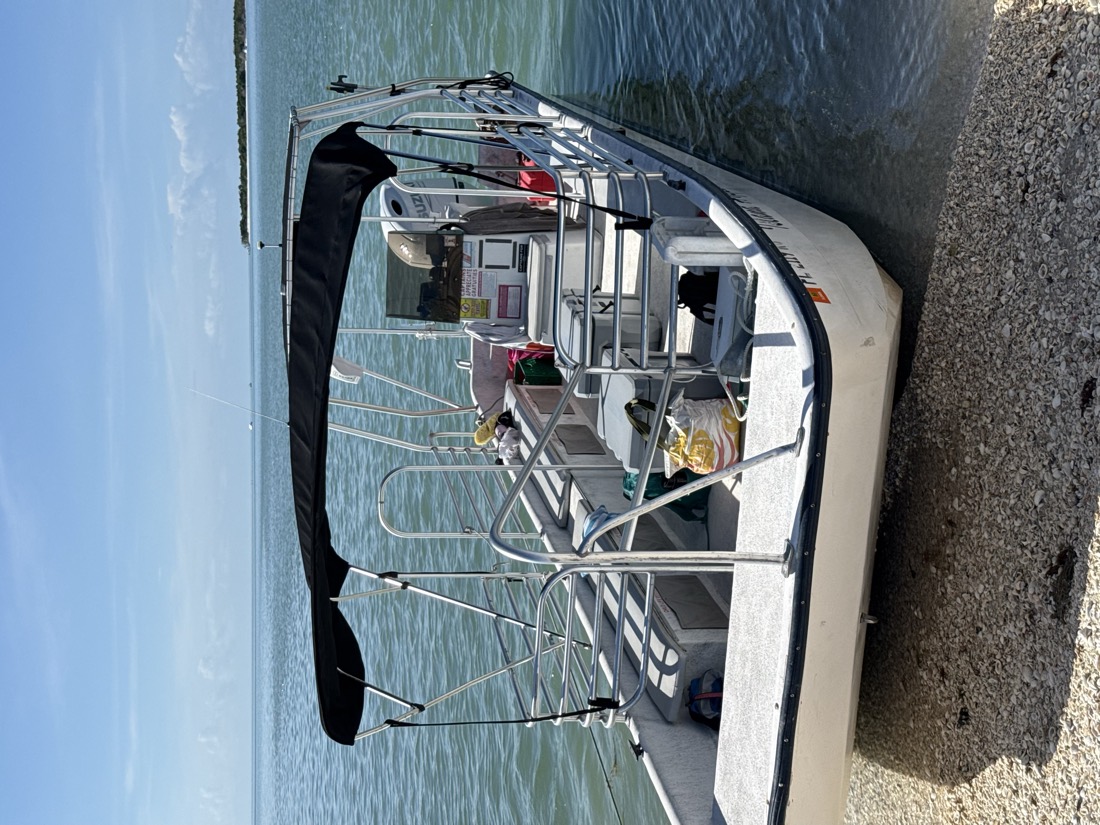
- A shaded tiki-style boat (up to 26 guests, 39½-inch rails) and a nimble center console
- Best for seasickness
- The flattest, widest hull moving slowest — pontoon/tiki style
- Booking
- Every Sand Dollar tour is private — your group only, matched to the right boat
What's the Real Difference Between a Pontoon, Center Console and Catamaran?
When you're picking a boat tour around Marco Island and Naples, you'll see all three hull types on the water, and each one is built to trade something for something else. A pontoon or tiki boat rides on two or three sealed aluminum tubes lashed under a flat deck — that width and buoyancy is what makes it feel like a floating porch instead of a boat. A center console strips the cabin away entirely so the helm sits in the middle of an open, planing hull built to get up on plane and cover water fast. A catamaran splits the hull into two separate pontoons of its own, and that twin-hull spread is what gives big commercial tour boats their steady, barge-like footing even with a crowd aboard. None of the three is simply "better" — the right one depends on whether you're chasing stability, shade, speed or sheer group size, and it's worth knowing the difference before you book rather than finding out on the dock. A lot of guests assume every boat tour looks the same in photos, then get surprised when the boat that shows up doesn't match what they pictured. Knowing which hull you're getting, and why, takes that surprise out of the equation. For the full rundown on getting ready for your day, our on-the-water know-how covers everything from seasickness to what to wear.
Pontoon & Tiki Boats: Built for Stability and Shade
A pontoon boat's flat, wide deck and low center of gravity make it the most forgiving ride on the water. It doesn't heel over in a turn and it barely rocks at idle, which is exactly why it's the boat you want if anyone aboard gets queasy or nervous about tipping. Add a shade canopy — that's what turns a plain pontoon into a "tiki boat" — and you've got a platform built for slow, comfortable cruising: watching for dolphins, easing along a mangrove shoreline, or letting kids move around safely instead of staying belted into a seat the whole trip. The wide, flat deck also makes boarding easier for grandparents or anyone with mobility concerns, since there's no steep step down and no narrow walkway to navigate, and the high rails give everyone something solid to hold onto while they move around. It's also simply a sociable layout: bench seating around the perimeter means the whole group can see and talk to each other instead of sitting in a single-file line, which matters on a family trip or a small celebration. The tradeoff is speed and rough-water handling: a pontoon's flat bottom slaps in chop and isn't built to outrun weather, so tiki boats stick to protected water and calmer days, which happens to describe most of the back-bay routes we run here in the Ten Thousand Islands anyway.
Center Console Boats: Built for Speed and Shallow-Water Reach
A center console flips the pontoon's priorities entirely. The open, self-bailing hull and forward-mounted console are built to get up on plane fast and stay drier in a chop, which matters when you're covering real distance across open water. Because the hull draws less water than a deep-V cruiser and the console sits centered rather than tucked aft, a good captain can work a center console into skinnier backcountry cuts and skirt sandbars that a bigger boat would have to go around — useful for reaching remote shell islands or working a tide line on a fishing charter. The open deck also means 360-degree access all the way around the boat, which is exactly what you want when you're fighting a fish or working a line rather than watching from a fixed bench. What you give up is the shade and the wide, sprawling lounging deck: everyone's standing or perched on a bolster seat rather than stretched out, and there's no canopy between you and the Florida sun, so sunscreen and a hat matter more on this hull type than any other. It's a livelier ride too — you'll feel more of the water underneath you, which some guests love and others would rather trade for a smoother, shadier afternoon.
Catamarans: Stable Platforms for Big Groups
A catamaran's twin hulls spread the boat's width and buoyancy wide, which is what lets large commercial tour boats carry big passenger loads without feeling tender or top-heavy. You'll see this hull style most often on the bigger sightseeing and dinner-cruise vessels built to carry dozens of guests at once, not on small private charters. That extra deck space also means room for a full bar, multiple seating levels or a dance floor on the largest catamarans, which is exactly the kind of scale they're designed around. That stability is real, but a catamaran is also a heavier, more expensive, more complex platform to operate and dock, which is part of why you mostly find them running high-capacity commercial routes rather than intimate group trips. If you're picturing a private, personal tour with just your own group aboard, a catamaran generally isn't the boat you're being offered anyway — pontoons, tiki boats and center consoles are the hull types actually built for that scale, and they're a lot easier for a small crew to maneuver into a tight dock or a shallow anchorage besides.
How Sand Dollar Matches You to the Right Boat
We don't run a catamaran, and we're upfront about that — it's simply not the right tool for a small, private group. What we run is a shaded, family-friendly tiki-style boat that holds up to 26 guests behind 39½-inch rails, built for exactly the slow, stable, shade-covered cruising a tiki tour or sunset run calls for, plus a nimble center console for guests who want to cover more water or reach skinnier cuts. Every trip on our boats is private — your group only, never mixed with strangers — so your captain can actually match the boat and the route to who's aboard: grandparents who need a stable, easy-boarding deck, a toddler who needs shade and room to move, or anglers who want the console's speed and reach. That's a real advantage over a big shared catamaran cruise, where you're one of dozens of passengers on a fixed route with a fixed schedule and no say in the boat. If you're weighing a pontoon against a tritoon for your own boat rather than a tour, our tritoon vs. pontoon breakdown digs into that specific comparison. Tell us your group size and what matters most to you when you book, and we'll put you on the hull built for your day, whether that's a slow shaded cruise out to watch the sunset or a quicker run out to the shell islands at first light.
| Hull type | Stability | Speed | Shade | Best for |
|---|---|---|---|---|
| Pontoon / tiki boat | Highest — flat, wide, low center of gravity | Slower, best in protected water | Yes, under a canopy | Families, seasickness-prone guests, slow cruising |
| Center console | Good underway, less at idle | Fast, planes up quickly | None | Fishing, covering distance, shallow backcountry cuts |
| Catamaran | Very high — wide twin-hull footprint | Moderate, built for capacity not speed | Varies by boat | Large commercial groups, sightseeing/dinner cruises |