
🐬 At a glance
- Species
- Lontra canadensis, the North American river otter
- Habitat here
- Brackish mangrove creeks & tidal marsh around Rookery Bay and the Ten Thousand Islands
- Best time
- Early morning or late afternoon, cooler months, on quiet backwaters
- Tell-tale sign
- A rolling, porpoising swim — then gone under in seconds
- Sightings
- Wild & genuinely lucky — never guaranteed, always a highlight
Do river otters really live in Florida?
Most people book a Marco Island boat tour expecting dolphins, maybe a manatee if the water's warm enough — otters rarely make anyone's list, and that's exactly why a sighting sticks with you. North American river otters (Lontra canadensis) are genuine, wild residents of Florida, and unlike the freshwater-only otters you might picture from a nature documentary, Florida's population is comfortable ranging straight into brackish and lightly salty water. That's precisely what fills the mangrove-lined creeks behind Rookery Bay and threading through the Ten Thousand Islands. They den in root tangles and undercut banks, hunt fish, crabs and the occasional oyster along the bottom, and move in loose family groups — a mother and a couple of nearly-grown pups is the most common sighting our captains describe. Rookery Bay itself exists to protect exactly this kind of habitat, one of the larger undeveloped mangrove estuaries left on the Gulf coast, and that protection is a big part of why otters, wading birds and juvenile fish still thrive in its creeks instead of getting squeezed out by development. So yes — otters in Florida are real, and some of the best water for finding one sits a short run from Marco Island.
Where to spot them near Marco Island
Otters skip the open Gulf and the busy passes entirely — they want quiet, current-broken water with plenty of structure to hide in. That points toward the narrow backwater creeks off Goodland, the mangrove tunnels weaving through the mangrove ecosystem behind Rookery Bay, and the mouths of small tidal creeks well off the main channel. Oyster bars matter too: otters use exposed bars at low tide as feeding platforms and lookout points, so a slow pass along a bar edge on a falling tide is worth the extra few minutes. None of these spots are fixed on a map, and that's the nature of it — otters range, and the creek that held a family last month might be quiet this week while they work a different stretch of the same backwater system. That's also why a captain who runs these creeks regularly, reading fresh slide marks and scat instead of chasing one known spot, gives you a real shot instead of a long shot. It's the same hushed, low-traffic water our private charters favor, precisely because a smaller group and a quieter idle give any wild animal, otters included, a reason to stay in view instead of vanishing into a root tangle.
Slides, scat and signs to watch for
Even when the otters themselves stay hidden, they leave a paper trail. Look for a smooth, muddy chute worn into a bank — a "slide" otters use over and over to belly-flop into the water, often right beside a den entrance tucked into a root mass. On exposed oyster bars and prominent points, keep an eye out for small piles of scat packed with fish scales and crab shell, a sure sign otters are working that stretch of creek regularly even if you don't see one that morning. Fresh sign is the real giveaway: a slide with wet, recently disturbed mud, or scat that hasn't dried and crumbled yet, means otters worked that bank within the last day or two, and it's worth idling past slowly instead of running through. On the water itself, watch for a rolling, porpoising swim pattern — the back arcing above the surface every few feet, very different from a dolphin's single tall dorsal fin or a wading bird holding still. Our captains usually spot the wake first, a small fast V cutting along a bank, gone under a mangrove root before the camera's even up. That's a real otter sighting, and it's over almost as fast as it starts.
Best time of day and season
River otters are most active at dawn and dusk, which lines up well with a quiet early-morning backwater run before the day's boat traffic picks up. Cooler months, roughly November through March, tend to improve the odds too — not because otters disappear in summer, but because calmer water and fewer afternoon storms mean more time gliding slow creeks instead of running for shelter. Tide matters just as much as the clock. A falling tide that exposes oyster bars and mudflats concentrates the crabs and small fish otters hunt into a smaller, more workable area, which is why a bar edge on an outgoing tide tends to out-produce the same spot at high, flooded water. Pair a falling tide with early morning light and you've stacked the best odds the backwater can offer — still no promise, but as good as it gets. That's also the window when the same creeks tend to carry manatees, wading birds and other wildlife, so a slow winter morning through Rookery Bay's tidal creeks tends to turn up more of everything, otters included. Our captains treat every one of these sightings as a genuine highlight worth cutting the engine for.
Otter or something else? Quick ID guide
From a moving boat, a fast dark shape breaking the surface could be almost anything, and on Ten Thousand Islands water it usually is. Bottlenose dolphins, manatees and even a diving anhinga can all read as "something just came up" out of the corner of your eye. The otter's tell is the porpoising roll: a small, quick arc, often repeated several times in a row as the group moves along a bank, paired with a long tapering tail and no dorsal fin at all — a very different silhouette from the bobcats that hunt the same banks on land. Here's how to sort out what actually broke the surface:
| Animal | How it moves | Key tell | Where you'll likely see it |
|---|---|---|---|
| River otter | Porpoises in a rolling arc, then vanishes | Long tapering tail, no dorsal fin, travels in a family group | Quiet backwater creeks & oyster bars |
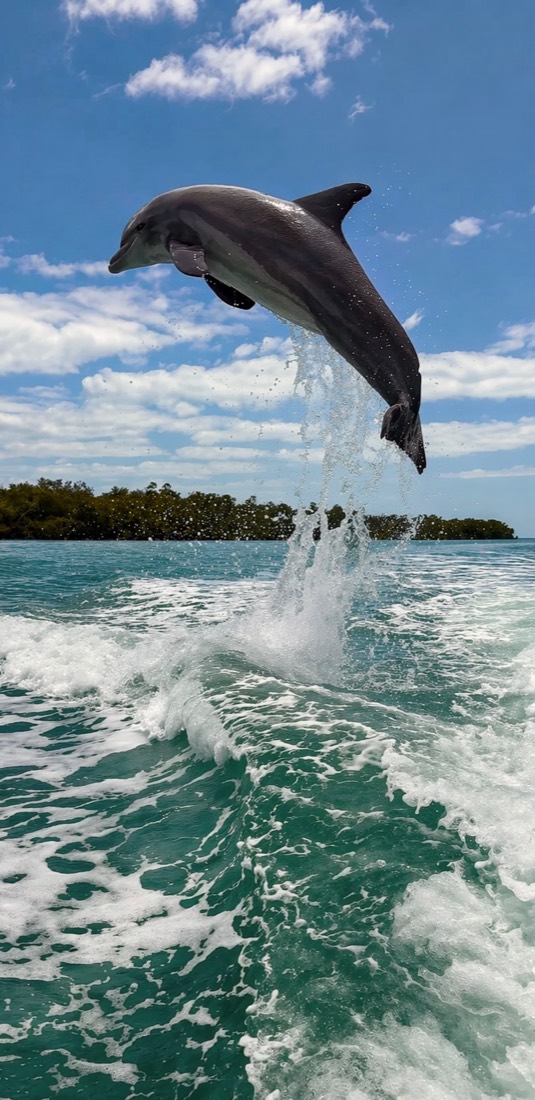
| Bottlenose dolphin | Arcs with a tall dorsal fin | Curved dorsal fin, often surfaces in open water | Passes & deeper Gulf-side channels |
| Manatee | Slow roll, snout up for air | Paddle-shaped tail, no dorsal fin, very unhurried | Warmer creeks in the cooler months, seagrass flats |
| Anhinga or cormorant | Swims low with body submerged | Snake-like neck held above the waterline | Perched on mangrove roots between dives |
Whatever breaks the surface first, the water it happens in is the real draw. Otters, dolphins and manatees all share the same sheltered creeks and oyster-bar edges that make the Ten Thousand Islands one of the richest backwaters on the Gulf coast. If you want the best realistic odds at a quiet-water encounter, otter included, a slow morning run through the right habitat is the move. Explore the full Wildlife Guide or book a Dolphin & Wildlife Tour and let a captain who reads this water put you in the right creek at the right hour.