
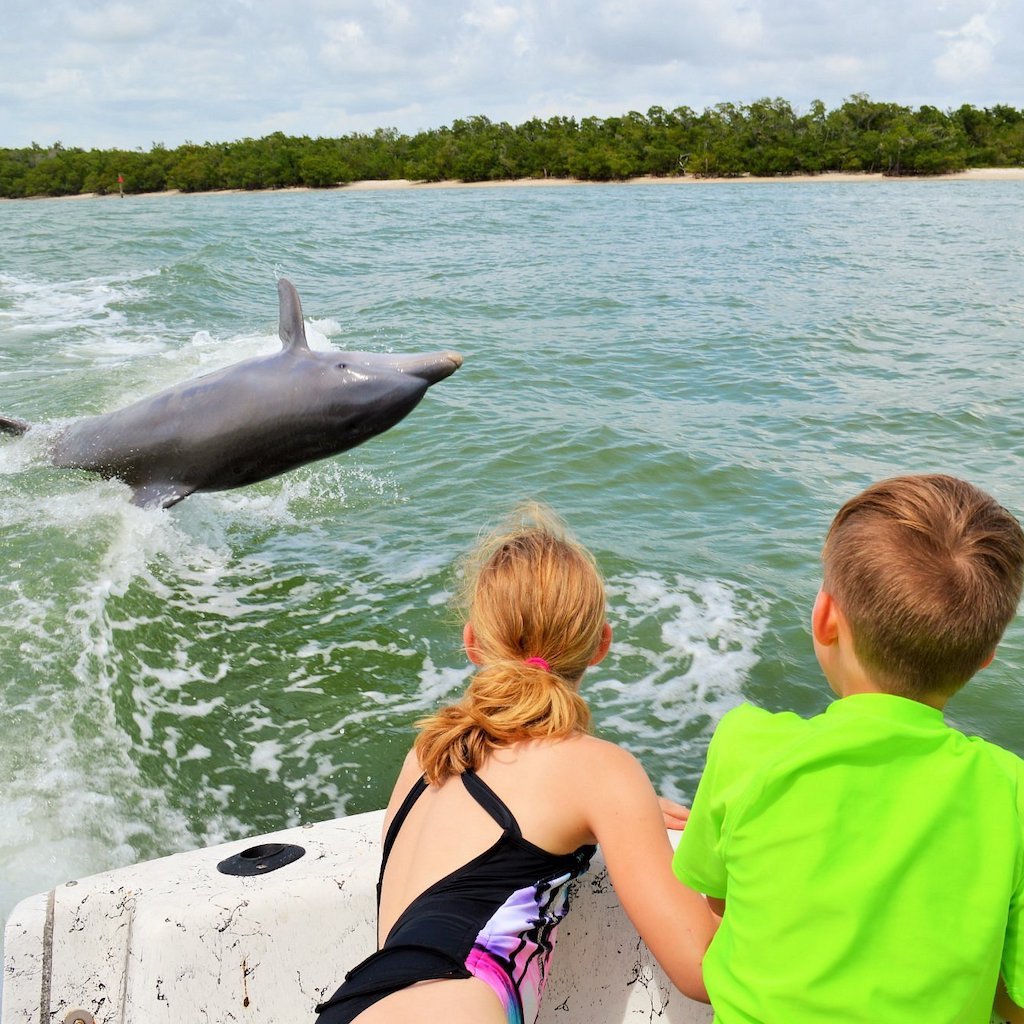
Long before a guest spots a fin, our captains are already scanning the surface for the tell that something’s working underneath it — a smear of slick, glassy water across an otherwise rippled bay, a sudden shower of bait skipping sideways, or three or four birds stacking low and fast over one spot. Any single sign is worth easing off the throttle. Two of them together near Gordon Pass and we’re already cutting the engine, because that combination usually means dolphins are pushing a school of mullet against the shoreline while birds work whatever gets pushed to the surface.
Positioning matters as much as spotting. Instead of motoring straight at a sighting, which just pushes the animal on ahead of you, we idle up-current on the outgoing tide and let the current drift the boat into position at its own pace. That’s how a bottlenose dolphin ends up choosing to ride our bow rather than being chased into it. We often see calves tucked close on a mother’s flank in that same drift, which is exactly why we hold well off and let the pair come to us instead of the other way around.
Manatees ask for the opposite approach. Once the water drops into the mid-60s, usually sometime around November, they stop scattering across the open bay and gather into the warmer, sheltered pockets of Rookery Bay, where we shut down and drift rather than idle. A mud boil rising off the bottom near a seawall or a spring is often the only clue one’s beneath the surface before it comes up to breathe. We never guarantee a manatee morning — some weeks the water never drops enough to push them in — but that mud-boil clue is the difference between finding them and floating right past.
Birds tell us just as much if we slow down enough to notice them. A single wading bird working a mangrove edge is routine; a mixed flock stacking over the same mud flat on a dropping tide means the whole buffet just opened, and that’s when we cut the motor and drift in on the trolling battery instead. It’s usually the pink flash of a roseate spoonbill sweeping its bill through the shallows that gets the whole boat reaching for cameras, though we never promise which bird shows up on a given afternoon.
None of this is a guarantee, and we say so before we ever leave the dock. Wild animals move on their own schedule, not ours, and the most honest thing a captain can tell you is what we usually see this time of year, not what we’ll definitely find today. What we can promise is captains who stay alert to every sign the whole way out, and who’ll cut the engine the moment it’s worth cutting.