
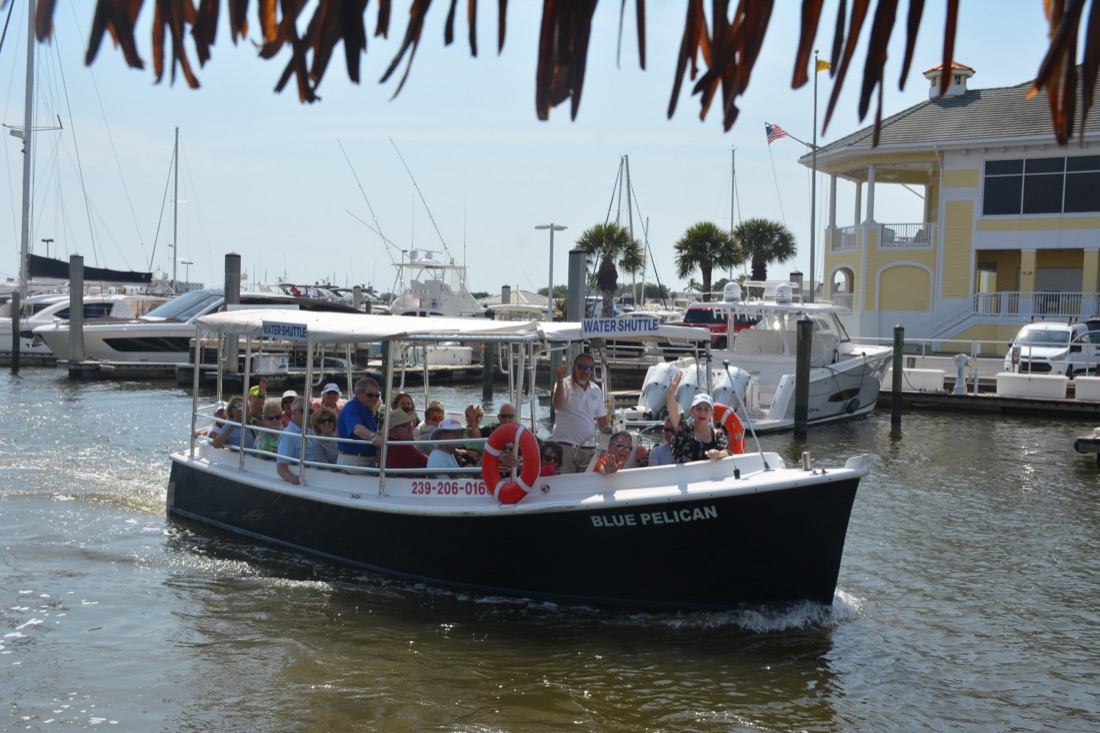
Pick your docks
Start with your pickup and drop-off — a marina, a dockside restaurant, a waterfront home or an event venue on Naples Bay or the Gordon River. If a spot has water access, we can usually reach it; just confirm with us.
Nail the timing
Decide your departure (and return, if it’s a round trip), and build in a little buffer for a relaxed ride. We coordinate dock-to-dock service around your schedule — dinner reservation, event start, whatever you’re working toward.
Booking it
Tell us the docks, the timing and your group size, and we’ll match the right boat and confirm the plan. For multiple stops or flexible timing, a private shuttle is the way to go.
From the Helm: Timing a Naples dock-to-dock run around the bay’s idle-speed zones
Naples Bay reads like open water on the chart, but a long stretch of any dock-to-dock run crawls through posted idle-speed zones near the bridges, and that’s the detail a straight-line map never shows. When we plan a run for you, the first call isn’t the fastest route on paper — it’s how much of that route sits inside a manatee zone at idle. A ride that looks like fifteen minutes can run closer to twenty-five once the slow water is added in, so we build that cushion into the schedule before you ever step off the dock.
The other variable is what the tide is doing under the fixed bridge near the Gordon River. Clearance there doesn’t shift with the tide table’s printed numbers, and on a big moon tide the water can climb high enough that we’d rather nudge a pickup by twenty minutes than ease up to that span with less headroom than we like. Most days it’s a non-issue on the bay side, but a strong incoming tide around a full moon is the one condition that moves your pickup time on our end, not the guest’s.
We also plan for which side of the hull needs to sit against the dock at pickup — at a spot like Naples City Dock, a following current can mean backing the stern in rather than coming alongside bow-first. A captain will radio ahead when the wind or an outgoing current changes that approach, and that quiet call is the reason your ride shows up on the correct side of the dock instead of circling for a second try while you’re standing there with your bags. It also decides which line the mate has ready first, bow or stern, so the moment we touch the dock somebody’s already stepping off with a cleat in hand instead of fumbling for one.
If your dock-to-dock ride is part of a longer evening — dinner at a waterfront spot, then back to your slip after dark — we’ll often route the return through the open middle of the bay instead of hugging a lit seawall, simply because running lights read cleaner against dark water than against a shoreline full of restaurant signs. That’s the same reasoning behind our water shuttle routes after dark — the calmest line home usually beats the shortest one once the sun’s down.
None of this changes what you experience as a guest — you still step aboard, settle in, and step off closer to where you’re headed than the road would get you. What changes is everything happening at the helm before that first line comes off the cleat: the tide check, the bridge math, the radio call to the next dock. That’s the quiet work behind a ride that looks effortless, and it’s the same care we put into a full private charter when the trip is the whole afternoon instead of one hop across the bay.