
🐋 Manatee viewing at a glance
- Best months
- Mid-November through March (and year-round on the flats)
- Why winter
- Manatees seek warm water when the Gulf cools below ~68°F
- Where
- Calm back bays, slow-zone canals, Ten Thousand Islands grass flats
- The rule
- Viewing only — never touch or feed (Florida law)
- Often joined by
- Dolphins, ospreys & roseate spoonbills
Where manatees hang out near Naples
Manatees are slow grazers that like warm, calm, sheltered water. Around Naples and Marco that means the quiet back bays, the slow-zone canals, and the shallow seagrass flats of the Ten Thousand Islands where they feed. Our captains know which sheltered spots they’ve been frequenting, and our manatee tours are built around them.
The best time of year to see manatees
The cooler months — roughly late fall through early spring — are the most reliable. When Gulf temperatures drop, manatees seek out warmer water and gather in sheltered basins and near warmer inflows, making them easier to find. That said, we spot them on the flats and in the back bays year-round.
How we view them responsibly
Manatees are protected, and we take that seriously. Our trips are viewing-only: we idle in slowly, keep our distance, and never touch or feed them. It’s the law, and it keeps the animals safe and wild — and honestly, watching a 1,000-pound giant drift past the boat is plenty magical without disturbing it.
What else you’ll see
The same calm waters that draw manatees are full of other life, so a manatee trip usually becomes a full wildlife cruise — wild dolphins surfing the wake, ospreys and pelicans overhead, and wading birds like herons and roseate spoonbills in the shallows. See our guide to wildlife around Naples Bay for the full cast.
From the Helm: How we read manatee sign in the canals off Isles of Capri
Ask us at the rail what that ring of dead-calm water near the seawall was, and most days our answer starts with a shrug: probably a manatee, rolling under to breathe. You won’t always see the animal first — you’ll see the sign. A perfect circle of glassy water opens on an otherwise rippled surface, holds for a few seconds, and fades. Guests call it a boil; we call it a footprint. Once you know to look for that flat spot instead of a grey shape, you start finding manatees on your own, well before we ever cut the engine to confirm it.
We run the canals off Isles of Capri for this more than open bay, because the geometry works in the manatees’ favor. Seawalls hold the sun’s heat overnight, culverts push a trickle of fresher water in after rain, and the current barely moves compared to a pass. On a cold morning that combination beats a big open flat every time. We idle in slow, cut back to a crawl well before the first canal mouth, and let the boat drift rather than motor through — noise and wake are the two things most likely to send a resting manatee back under.
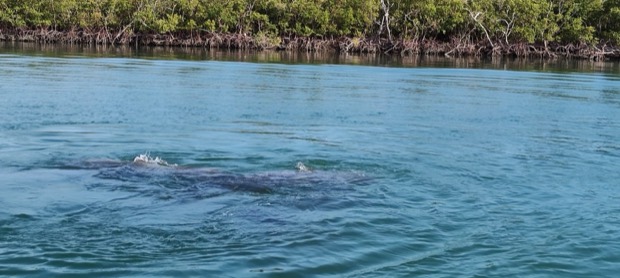
At the surface, a resting manatee rarely looks like the postcard version. It’s a grey-brown shape the color of the bottom, barely breaking the water, nostrils flexing open and shut every few minutes to breathe. First-timers scan for a whole animal and miss it twice before they see it. We’ll point at the exact ripple, wait, and let you find the shape yourself — it’s a better moment than us just calling it out. Calves surface tucked close against a parent, rolling up almost in unison, which is usually the tell that you’re looking at a mother and calf pair.
The question we hear most at the dock isn’t where the manatees are — it’s whether we’re guaranteed to see one. We’re always honest that we’re not; they move on their own schedule, and we just improve the odds. The mornings after a hard cold front, when the Gulf itself has dropped a few degrees overnight, tend to be our best bet, because that’s when the canals hold noticeably more animals than the open bay. Outside those cold snaps, sightings get more scattered, and we’ll shift our search toward deeper, slower water instead of assuming the same spots will produce.
Manatees are just one reason we keep our eyes on the water even between stops. A slow morning built around wildlife works well paired with our dolphin tours, since the same calm-water read that finds a manatee often turns up a pod working the same stretch of bay. If you want the fuller picture of what else surfaces around Naples and Marco Island through the seasons, our wildlife guide covers the rest of the cast — herons, rays, and the birds that work the same shallows manatees favor.