
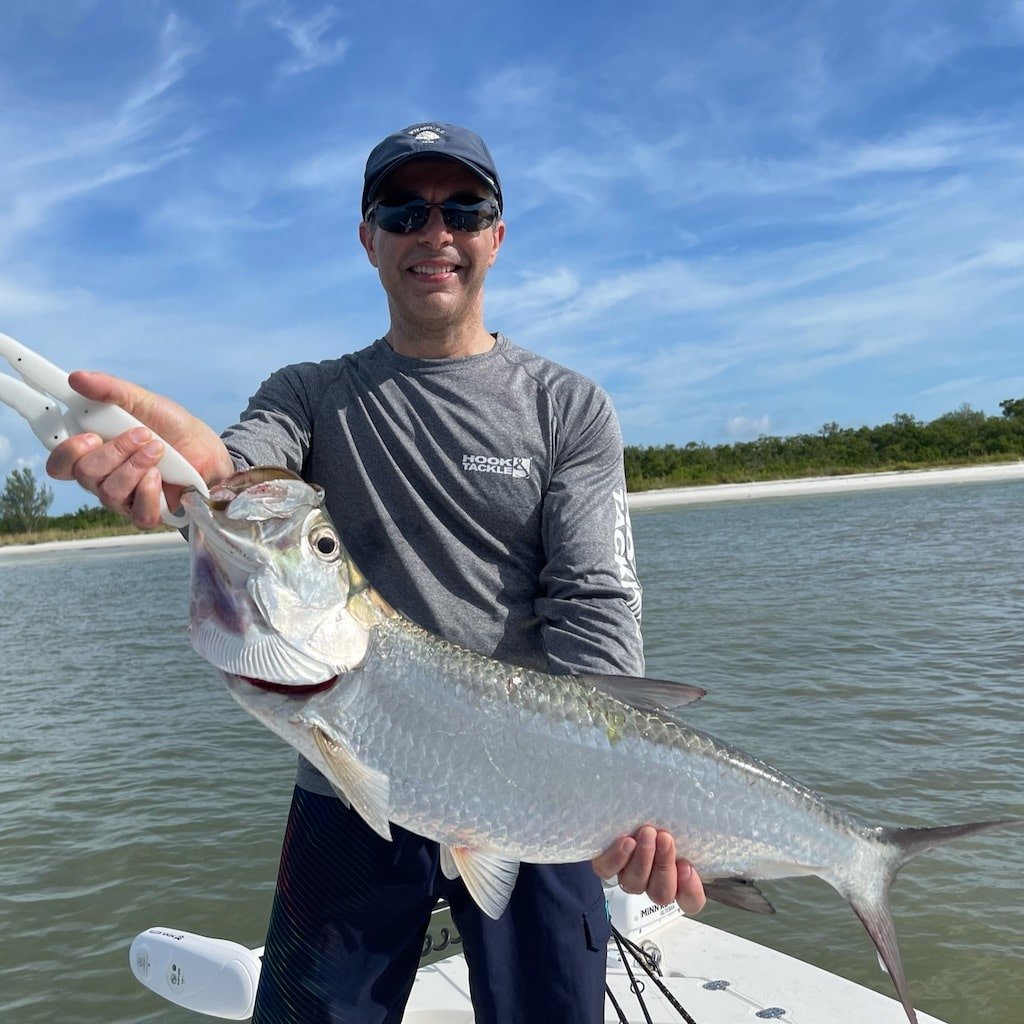
🎣 At a glance
- Look for
- Deep body, yellow belly, blunt steep head, dark spot near the gill
- Behavior
- Travels in fast, marauding schools that blitz bait
- Where
- Backcountry creeks, Naples Bay, passes & channel edges
- Best season
- Explosive summer schooling blitzes
- Table fish?
- No — sport-only; the draw is the fight, not the fillet
- Rules
- Regulated/seasonal — your captain handles licensing
How to identify a jack crevalle
A jack crevalle has a build you won't mistake once you've seen one: a deep, slab-sided body, a blunt and steeply sloped forehead, and a bright yellow wash across the belly and lower fins. There's usually a dark spot near the gill cover and another at the base of the pectoral fin. Everything about the shape says power — this is a fish made to bulldoze, with a broad tail that lets it dig and circle and refuse to quit.
Don't confuse the jack's blunt-headed bulldog look with the sleek torpedo profile of a Spanish mackerel or the long lean lines of a king mackerel. Jacks are all shoulders and stubbornness, and that body is exactly why they pull so disproportionately hard.
Where & when we find them
Jack crevalle are backcountry and bay marauders. We find them roaming the creeks and shorelines of the backcountry, prowling Naples Bay, and patrolling the passes and channel edges where bait stacks up. They travel in schools and they hunt as a pack, herding bait against a shoreline or into a corner and then crashing it. When that happens the surface looks like it's boiling — a sudden eruption of fleeing baitfish with jacks slashing underneath.
Summer is when the schooling blitzes get truly explosive, and there's nothing subtle about finding them: you see the chaos, you run to it, you cast into it. It's a highlight of our backwater trips, and the same Naples Bay water that holds jacks is full of the wildlife you'd see on a dolphin tour — sometimes the dolphins are working the very same bait school.
The fight & why we chase them
Let's be honest about what a jack crevalle is and isn't. It is not a table fish — the meat is dark and strong, so jacks are a sport-only catch that we release. What it is, is maybe the hardest pull pound-for-pound in our entire backcountry. When a jack eats, it doesn't run and tire; it digs down and circles, turning its deep body sideways against you, and it simply does not give up. Anglers who've fought big offshore fish are routinely stunned by how hard a backcountry jack pulls.
That's exactly why we love putting one on first-timers and kids who want a fish that fights back — it's an unforgettable tug-of-war on a family fishing charter. We handle and release them carefully, and a licensed charter's vessel license covers every paying guest, so no one aboard needs an individual license. If you want a fight you'll feel in your shoulders, our captains know where the jacks are blitzing.
From the Helm: Chasing summer jack crevalle blitzes at the Marco River mouth
The first sign a guest usually gets is the sound before the sight — a ragged pop and splash off the bow that turns every head on the boat before anyone has spotted the actual commotion. Our captains cut the engine early and coast the last stretch toward the mouth of the Marco River, because jack crevalle blitzes collapse the moment a hull noise reaches them, and you only get one clean run at a school that is actively busting bait on top of the water.
We hand guests a topwater walking bait or a heavy white bucktail rather than anything delicate, since jacks are not leader-shy the way snapper are — they are reacting to commotion and profile, not finesse. Thirty-pound fluorocarbon and a stout medium-heavy rod are non-negotiable; anything lighter gets straightened or snapped in the first hard run, and we would rather guests land the fish than lose gear to a school that has already moved on by the time you re-tie a knot. We also favor a single inline hook over a stock treble whenever we can swap one in, since a jack thrashes hard boat-side and one hook point is a faster, safer release for a fish we are putting straight back.
Once one is hooked, the whole school often follows the fighting fish right up to the boat, so we keep extra rods rigged and ready to hand off, because that first jack is rarely the only bite you get in that window. The pull itself is the entire point — a flat-out, drag-burning run that has kids bracing their feet against the gunwale and adults grinning the way they do not for prettier fish. We handle jacks quickly at the rail and release nearly all of them; they are a sport fish here, not a dinner plan.
If the river mouth is dead calm and birds are working instead of bait showers, we will shift a half-mile to open flats where jacks tend to run down mullet schools in open water rather than pin them against a bank. Wind direction matters more than most guests expect: a light morning breeze out of the east keeps the water glassy enough to spot surface commotion from thirty yards out, while a chopped-up bay on a blustery day can hide a blitz happening right under the hull.
It is the same brute-force appeal that draws anglers to king mackerel offshore, just inshore and in shallower water, which is why we often build a jack morning into a broader fishing charter instead of a standalone trip, so there is always a backup target the moment a school scatters for open water. Guests who came expecting a quiet morning almost always leave asking when the next blitz season starts.