
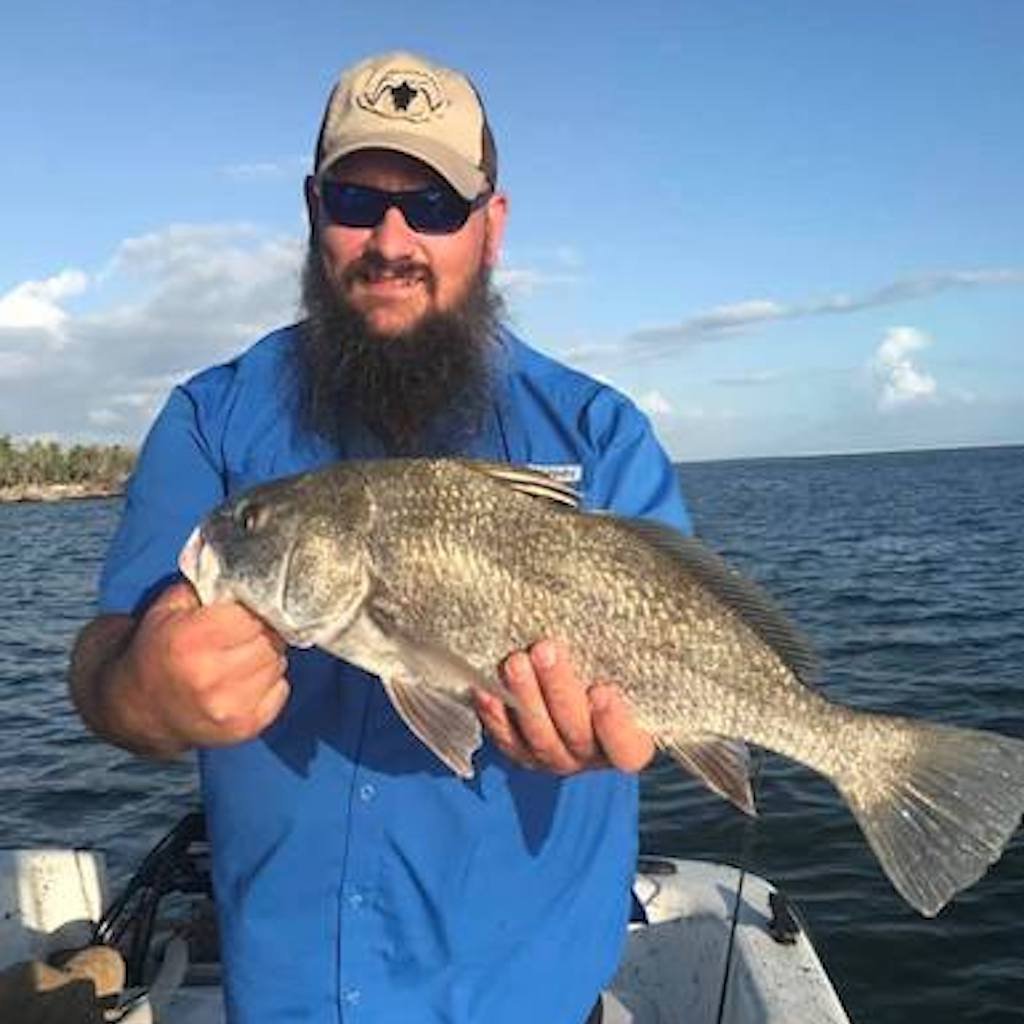
🎣 At a glance
- Also called
- Kingfish; big ones are “smokers”
- Look for
- Long, sleek silver body; no bold gold spots; dipped lateral line
- Behavior
- Fast migratory speedster that haunts nearshore wrecks
- Signature
- Blistering first run that smokes the reel
- How we fish
- Trolling or live-baiting offshore of the Ten Thousand Islands
- Rules
- Regulated/seasonal — your captain handles licensing and limits
How to identify a king mackerel
A king mackerel is a long, sleek, streamlined fish, iron-silver above fading to bright silver on the belly, built entirely for speed. The clearest way to separate it from its smaller relative is size and spots: a Spanish mackerel wears bright yellow-gold spots, while a king is largely unmarked, and a king grows far larger. Look closely and a king's lateral line takes a sharp downward dip below the second dorsal fin — the surest tell on smaller fish that could go either way.
Like all the mackerels, a kingfish carries a set of sharp teeth, so you handle them carefully at the boat. Everything about the fish — the forked tail, the torpedo body, the cold silver sheen — says open-water sprinter rather than the structure-hugging build of a grouper.
Where & when we find them
King mackerel are a nearshore-to-offshore migratory fish, and timing is everything. They show up in numbers during their seasonal migrations, haunting the nearshore wrecks and structure off Naples and ranging out into deeper water offshore of the Ten Thousand Islands. When a wave of kings moves through, the same wreck that was quiet one week comes alive the next. This is a fishery built around being in the right place when the migration is on.
We track those windows on our Naples fishing calendar, and kings often share the nearshore structure we work on our wreck and reef trips. It's a different, faster game than easing through the backcountry creeks — this is open water, moving baits, and the constant hope that the next strike is a smoker.
What it takes to catch one
The two classic ways to fool a king are trolling and live-baiting. We'll either pull lures and baits at speed past the structure where kings hold, or drift a lively baitfish in the strike zone and wait. Either way, the eat is unmistakable: the rod slams down and the reel screams as the fish makes its trademark first run, sometimes peeling off a startling amount of line before you even get a hand on the rod. That run is the whole reason people chase them.
Because of those teeth, a bite-resistant leader is a must to avoid getting cut off. Kings are regulated and seasonal, so we keep what's legal that day and release the rest, and as always a licensed charter's vessel license covers every paying guest — no individual license needed, your captain handles it all. If a screaming run on a sleek silver missile sounds like your kind of morning, our fishing charters can build a nearshore trip around the wrecks when the kings are running.
From the Helm: Trolling the color change beyond the Ten Thousand Islands after a north wind
A north wind behind a passing front is often the trigger our captains watch for with king mackerel, because it pushes the cooler green water out and lets cleaner blue-green water push in past the barrier islands, and kings tend to stack right along that seam. We run out past the Ten Thousand Islands looking for that visible color change — sometimes a hard line, sometimes just a gradual shift in clarity — and troll the edge of it rather than committing to either side alone.
We run a spread of planers and spoons at trolling speed first to cover water and find the school, then switch to a slow-trolled live bait — a threadfin or a big pilchard on a stinger rig — once we have marked fish, because kings will often follow a spoon without eating it but crush a struggling live bait almost instantly. Wire or heavy fluorocarbon leader is mandatory; kings carry a mouth full of razor teeth that shears through anything lighter in one head-shake.
There is no subtlety to a king strike — the reel screams before you have even registered the rod bending, and thirty or forty yards of line can disappear in that first run alone. We tell first-timers to keep their thumb well clear of the spool and just hang on; trying to muscle a kingfish through that opening run is the fastest way to pull a hook or snap light gear at the worst possible moment.
When the color change is not holding fish, we look instead for diving birds or scattered bait pods over the nearshore wrecks, since kings will often park under working birds the same way tuna do farther offshore. It is a faster-paced, more run-and-gun morning than our inshore trips, with more time on plane between stops and less time anchored in one place watching a rod tip. A building sea out of the southwest usually means we shorten the spread and slow the troll rather than push through chop that’s bouncing baits out of the strike zone.
Landing one is its own small production: that same mouthful of teeth that shears through leader is just as happy to open a hand, so we lead a green fish to the transom with a gaff or long-handled net rather than bare hands, and we keep the boga grip ready before the fish is anywhere near the gunwale. Kings are a regulated, seasonal fish here, so we release plenty and keep only what the day’s rules allow.
If you would rather explore the barrier islands and passes we run past instead of the open water beyond them, our destination guides cover that same stretch from the shoreline side, and either way we build the day around one of our fishing charters, timed to whichever wind direction is actually going to let us run offshore that morning.
| Condition | Our approach |
|---|---|
| Clear water, scattered fish | Spoon and planer spread to cover ground |
| Marked school, working birds | Slow-trolled live bait on wire |
| Flat calm, no visible signs | Idle the nearshore wrecks and watch the sounder |