
🎣 At a glance
- Scientific name
- Mugil cephalus
- Common names
- Striped mullet, black mullet
- Typical size
- 12–18 in, occasionally larger
- Diet
- Algae, detritus & plankton — a grazer, not a predator
- How they’re caught
- Cast net — rarely hook and line
- Local claim to fame
- Goodland’s historic mullet-fishing identity
Why do mullet jump?
It’s the first thing every guest notices on a Ten Thousand Islands charter: a flash of silver, a full-body twist in mid-air, and a smack back down flat on the water — then it happens again a few feet away, and again, until half the school seems to be airborne at once. Our captains get asked why almost every trip, and the honest answer is that ichthyologists still argue about it.
The leading theory involves oxygen. Striped mullet spend a lot of time in shallow, mud-bottom backwaters and canals where dissolved oxygen can run thin, especially on hot, still afternoons, and a mullet has a modified gut that lets it gulp a little air at the surface to supplement what its gills pull from the water. A second theory is parasite removal — breaking the surface with force may help shake loose gill parasites or clinging mud that a mullet can’t reach any other way. The third, and the one our mates lean toward most on the water, is predator evasion: a jumping mullet can break a tarpon or jack crevalle’s lock on it mid-strike, or simply startle whatever’s hunting from below. Researchers have tested each idea and none has been ruled out on its own — it’s entirely possible mullet jump for all three reasons depending on the moment, and that unresolved mystery is part of what makes them fun to watch from the rail.
What we can tell you from years of running these backwaters is the pattern of it. A single startled jump usually means a predator just made a move underneath, while a whole school popping in waves, almost lazily, over several minutes tends to line up with low-oxygen water on a hot, still afternoon. You’ll see both on the same trip, sometimes within the same ten minutes, which is exactly why the scientific literature hasn’t landed on a single tidy explanation.
Meet the striped mullet
The striped mullet (Mugil cephalus) is one of the most common fish in the passes, canals and mangrove shallows around Marco Island, Goodland and Naples, and one of the least understood by visitors. They run 12 to 18 inches on average, with a blunt head, blue-gray back and faint silver stripes running down each flank — the feature that gives them their name. You’ll usually spot them in tight, nervous schools rolling the surface of a canal or working the edge of a mangrove shoreline, sometimes so dense the water looks like it’s boiling.
What sets a mullet apart from nearly every gamefish on our fish hub is its diet. Snook, redfish and trout are predators that key in on live bait or a well-worked lure. Striped mullet are grazers — they feed on algae, diatoms and detritus scraped off pilings, seawalls and mud flats, and they’ve evolved a muscular, gizzard-like stomach to grind that material down, more like a fish version of a cow’s rumen than a bass’s gut. That’s the real reason a mullet won’t strike your bait no matter how well you present it: it isn’t built to chase anything, let alone a hook.
You’ll sometimes hear the striped mullet confused with the silver mullet, a smaller, more offshore-oriented cousin that schools along open beaches rather than working canals and mangrove creeks. Both jump, both travel in dense schools, and both are grazers — but it’s the striped mullet you’ll see rolling right beside a dock in Goodland or Isles of Capri, close enough to watch its stripes catch the light before it goes airborne again.
Goodland: a mullet-fishing village
Long before Marco Island had a bridge or a resort, Goodland was a working fishing village tucked into the backwaters of the Ten Thousand Islands, and mullet were the reason it existed. Net boats worked the passes and bays for schools of striped mullet, prized both for smoked mullet — still a genuine Gulf Coast staple — and for roe, the fish’s egg sacs, which historically fetched a real premium for export. That heritage is still visible in the fish houses and net boats along Goodland’s harbor today.
Every January, Goodland leans into that identity with its Mullet Festival, a genuinely old-Florida weekend of live music, local food and boat traffic that has nothing to do with the interstate side of Marco Island. It’s a good reminder that this unassuming, plant-eating baitfish isn’t a footnote out here — it built a town.
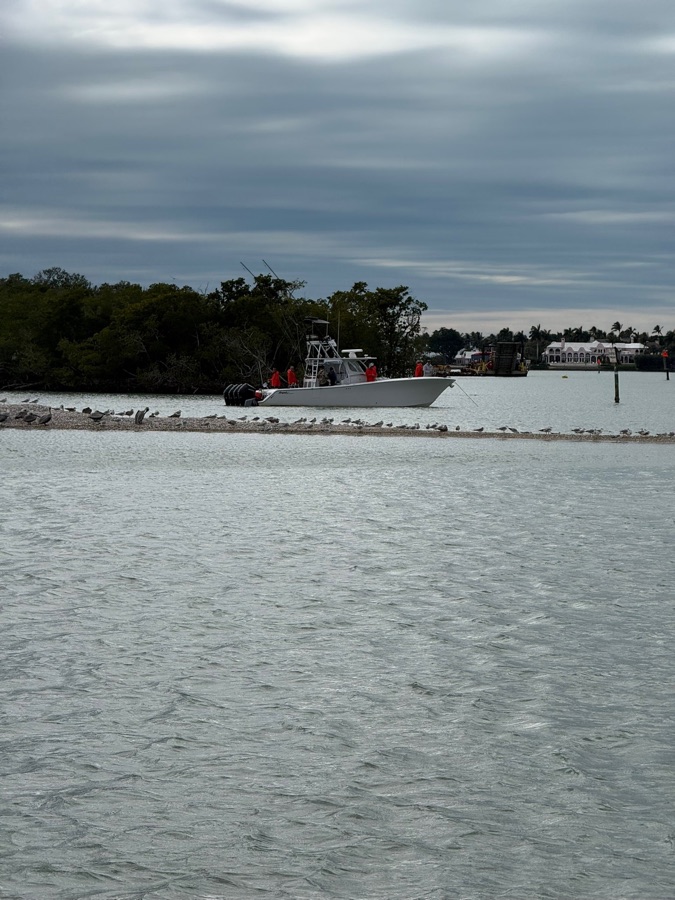
When our charters idle out of Goodland, you’re passing through a working waterfront that still runs on the same tides and the same fish that built it a century ago. That’s a different kind of Florida than the beachfront high-rises a few minutes north, and it’s worth knowing the story behind the mullet boats tied up at the docks before you ever see one jump.
The mullet run: what follows the silver wave
Come fall, striped mullet school up by the tens of thousands and move down the coast in the migration known locally as the mullet run — we’ve broken down the timing and tides in our full mullet run guide. The run itself isn’t about catching mullet. It’s about everything that shows up to eat them. Snook stack along the beaches and passes, tarpon roll behind the schools, and jack crevalle and Spanish mackerel crash the surface in open water — it’s some of the most explosive hook-and-line fishing of the entire year in the Ten Thousand Islands, and it only happens because the mullet are running.
None of those gamefish are targeting the mullet by accident. A moving school of striped mullet is a moving buffet, and predators will track it for miles along a beach or through a pass, which is exactly why captains around here watch for nervous, jumping bait long before they ever see the fish underneath. If you’re planning a trip specifically to fish the run, the tide and timing details matter far more than they do for most other Naples and Marco Island fishing — another reason we keep that guide separate from this one.
| Predator | Behavior during the run | Where to look |
|---|---|---|
| Snook | Stages along beaches & passes to ambush schools | Gordon Pass, beach troughs |
| Tarpon | Rolls behind and through the school, catch-and-release only | Passes & nearshore |
| Jack crevalle | Busts bait on the surface in aggressive, visible packs | Open bays, passes |
| Spanish mackerel | Slashes through pods of mullet near the surface | Nearshore & passes |
| Redfish | Works the edges of the school from below | Backwaters, mangrove edges |
Can you catch a mullet on a rod?
Occasionally, yes — patient anglers with tiny gold hooks and a dough or bread bait can pick one off here and there, but that’s not how mullet fishing has ever really worked on this coast. The traditional tool is a cast net thrown over a school in skinny water, which is exactly how Goodland built its living for generations. On a Sand Dollar fishing charter, we’re rarely after the mullet themselves — we’re using them, live or cut into chunks, to draw a strike from the gamefish that do hit a hook. If you want the deeper breakdown of when live mullet beats an artificial lure, our live bait vs. lures guide covers it.
So the next time you see a school of mullet start jumping nervously around the boat, take it as a tip, not a distraction — it’s often the first sign your captain reads that something with teeth is working underneath.