
🎣 At a glance
- Targets
- Tailing redfish & cruising snook (also trout)
- Best conditions
- Low tide, sun overhead, light wind, clear water
- The skill
- Spot the fish, lead it, don't spook it
- Must-have
- Polarized sunglasses to see into the water
- Style
- Quiet poling — hunting, not blind-casting
What sight fishing is
Most inshore fishing is a bit of a guessing game — you cast to likely water and wait. Sight fishing removes the guessing. You move slowly across a shallow flat, eyes scanning, until you actually see the fish: a copper redfish tail tipped up as it roots for crabs, a long shadow easing along a sandy trough, a wake pushing across the grass. Then it's a one-shot hunt — place the cast ahead of the fish, let it find your offering, and watch it eat. The visual part is the whole thrill. You're not waiting on a bite in the dark; you're watching it happen.
It's the natural next step after you've fished the inshore bays and want a more hands-on, hunting style. It rewards patience and a good cast over brute force.
Spotting tailing reds and cruising snook
The flats give the fish away if you know the tells. Redfish tail: on a low, calm tide they nose down into the grass to root for crabs and shrimp, and their tails break the surface, sometimes with a flash of blue on the tip. Look for that wave-against-the-grain motion. Snook cruise: on a sandy or light-bottom edge, a snook shows as a long dark torpedo with a telltale black lateral line, often easing slowly until something spooks or feeds it. Trout and even small sharks and rays give themselves away too. The single most important piece of gear is a good pair of polarized sunglasses — they cut the surface glare and let you see down into the water, which is what makes the whole technique work. Sun overhead and at your back helps enormously.
| Sign | What it is | Your move |
|---|---|---|
| Tail waving over grass | Tailing redfish feeding | Lead it gently, don't line the fish |
| Long dark torpedo on sand | Cruising snook | Cast ahead, let it intercept |
| Pushing wake on the flat | Moving fish (red or snook) | Get ahead of the wake |
| Nervous, scattering bait | A predator working below | Cast into the edge of the chaos |
Poling, casting and the eat
Sight fishing is a stealth game. We pole the flat with a push pole rather than running the motor, because a poled boat is silent and the fish in skinny water are jumpy — a slammed hatch or a heavy footfall sends them flying. When a fish is spotted, the cast has to land ahead of it and to the side, never right on its head, so the fish swims into your bait or lure naturally. Then comes the hardest part: waiting for the eat instead of yanking. You watch the fish turn, follow, and inhale it — and only then come tight. It takes a little coaching, which is exactly why a guide pays off; your captain spots the fish from up on the platform, calls the distance and angle like a clock, and talks you through the shot. A licensed charter covers every guest, and the right tide and clean water make all the difference — see our tide guide for timing the low-water window.
From the Helm: Poling Round Key at Grey Light: Why Wind Decides the Whole Game
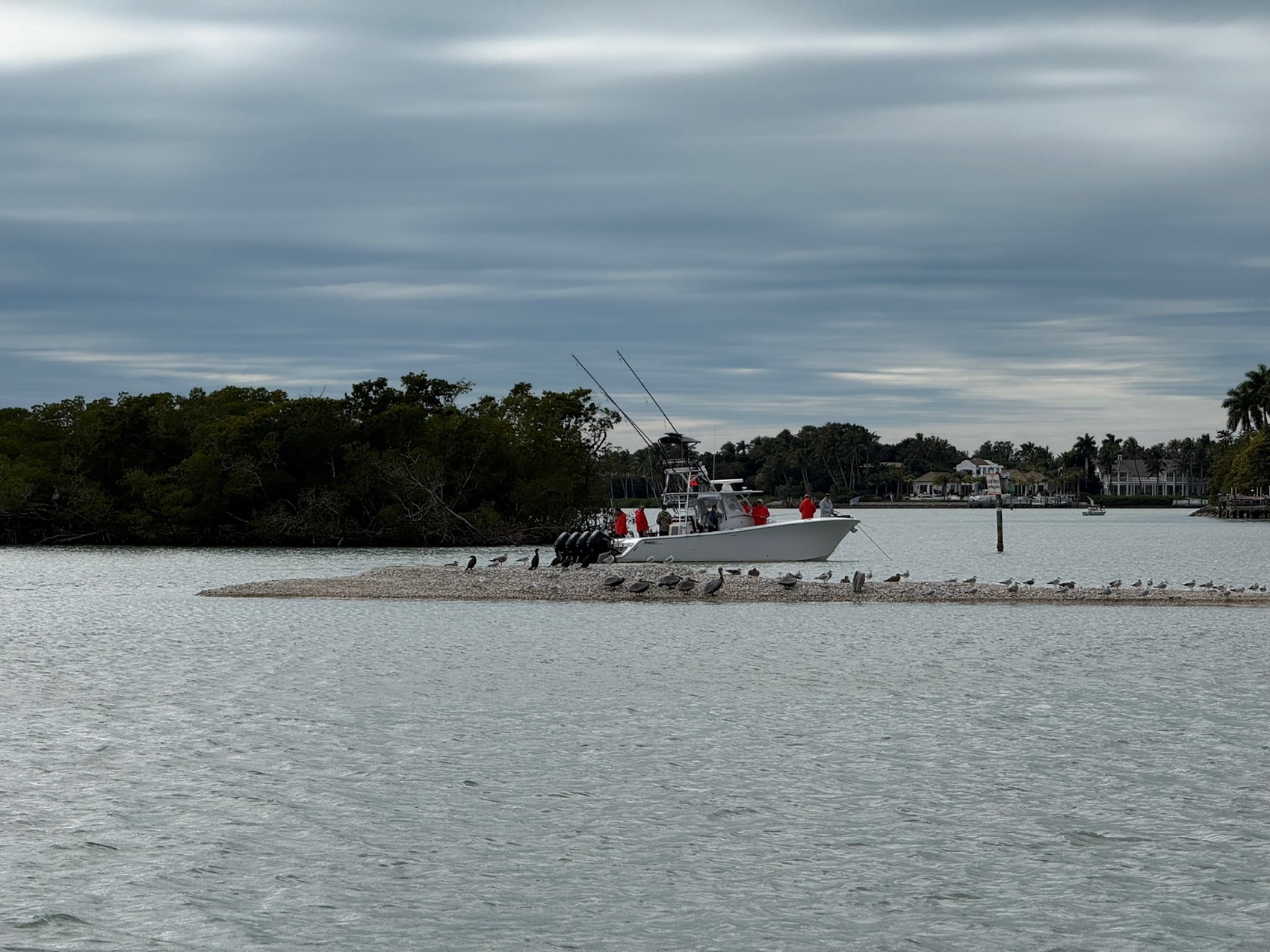
We’re usually up on the platform before the color’s even come into the sky, poling onto a flat off Round Key while the water still sits flat as a tabletop. That stillness matters more than almost anything else in this game — we’re not casting yet, just standing quiet, scanning for the faint push of nervous water or a tail breaking the surface tension against the grass.
Whether we even attempt this style of fishing at all depends on wind before anything else that morning. Under about ten knots the surface stays glassy enough to spot fish from thirty yards out; push past that and the chop scatters the light so badly that we’ll scrap the plan and go blind-casting structure instead, because hunting fish you can’t see isn’t sight fishing anymore, it’s guessing. A hard cold snap pulls fish off the flat entirely, so water temperature gets checked right alongside the wind.
Who’s aboard changes the plan too. A guest comfortable putting a jig or fly exactly where it needs to land gets a longer pole and a longer cast at a wary fish; a first-timer gets a shorter run and closer, easier targets, because a rushed or inaccurate cast at distance spooks a fish faster than any wrong color line ever will.
Season plays into the same call. Cooler months push us toward the darker grass flats that hold the day’s warmth a little longer, since fish sit tighter and tail less on a cold morning; through the warm season we’ll work the open sand potholes at first light before the higher sun flattens the glare and makes every fish look like a shadow on a shadow.
When the tide floods too high or the wind fills in mid-morning and kills our visibility on the open flat, plan B is ducking into the creek mouths lining the mangroves, where fish still show themselves pushing against a contrasting sand or shell bottom even without the same glassy conditions.
What surprises most guests is how much this hunt depends on where the sun sits, not just the wind. We’ll idle to keep the light coming over your shoulder rather than in your eyes, because good visibility into the water depends on that angle as much as anything else — guests assume it’s all about spotting fish, but half the job is just keeping the glare out of the way first. Ready to try it? A snook or redfish flats trip books through the same fishing charters page as every other run we offer, and either species can turn up on the same drift if the tide and light line up right.