🏝️ At a glance
- Tooth capital
- Venice — “Shark Tooth Capital of the World”
- Best beaches
- Caspersen, Venice, Manasota Key, Casey Key
- Naples / Marco
- Shells, not teeth — honest truth
- Color clue
- Black/gray = fossil; white/tan = modern
- Tool
- A “Florida snow shovel” sifter helps up north
Venice is the real tooth country
Roughly two hours up the coast from us, Venice has earned the nickname “Shark Tooth Capital of the World,” and it's not marketing fluff. A fossil-rich layer sits just offshore, and the surf grinds it up and spits black, mineralized teeth onto the sand. Caspersen Beach, just south of the Venice pier, is the local favorite because it's natural and un-renourished, so the teeth haven't been buried under trucked-in sand. Bring a sifter — the locals call it a “Florida snow shovel” — and work the shell hash at the waterline. Manasota Key and Casey Key just to the north and south of Venice fish from the same fossil bed and are well worth the side trip.
Why you won't find many in Naples or Marco
Here's the honest part, because it's what makes this page worth trusting: the beaches around Marco Island and Naples are not tooth beaches. We don't sit on the same exposed fossil layer Venice does, so while you might luck into the occasional small tooth, you won't be filling a vial. What we do have is some of the finest shelling on the Gulf — whelks, conchs, scallops, the works. If teeth are your obsession, treat Venice as a planned day trip and keep Naples for the shells. Trying to make Marco a shark-tooth beach is a recipe for a disappointing afternoon, and we'd rather tell you up front. For the full coastal picture, see our Southwest Florida shelling roundup.
Fossil vs. modern: read the color
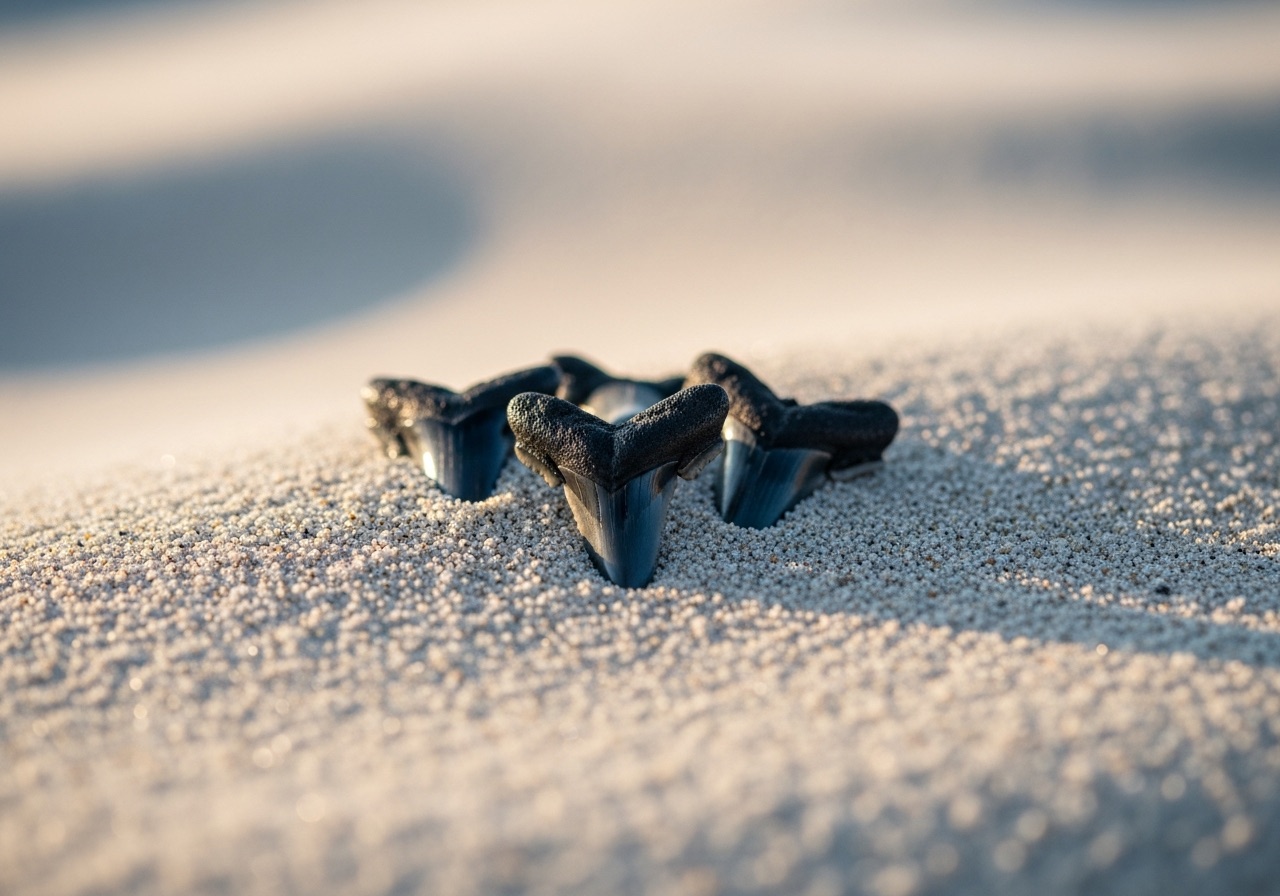
Most teeth people get excited about are fossils, and the giveaway is color. A tooth that's been buried in mineral-rich sediment for thousands of years turns black, dark gray, or brown as it absorbs minerals — that's the classic fossil look. A bright white or tan tooth is modern, shed by a living shark recently. Both are fun finds; the dark ones just carry the deep-time story. Down here, fossil teeth occasionally turn up mixed into our shell hash, and they're a nice bonus rather than the headline — you can read more in our beach-finds note on fossil shark teeth.
| Beach area | Best for | Worth the drive for teeth? |
|---|---|---|
| Caspersen / Venice | Fossil shark teeth | Yes — the capital |
| Manasota Key | Teeth & some shells | Yes |
| Casey Key | Teeth, quieter | Yes |
| Marco Island / Naples | Shells (whelks, conchs) | No — come here for shells |
The smart local play
Plan it like a local would: spend a tooth-hunting day up at Caspersen, then come home to the islands for the shelling, which is genuinely world-class right here. On our shelling tours out of Marco and Goodland we run to boat-only flats where whole whelks, conchs and the occasional fossil tooth turn up in the same scoop. You get the best of both worlds — the teeth up north, the un-picked shells down here — and nobody's overpromising you a beach that doesn't deliver.
From the Helm: Why our Gullivan Bay oyster bars rarely give up a shark tooth
Someone asks about shark teeth on nearly every trip, usually holding up a phone with a photo of a handful someone found somewhere up the coast. Our captains give the same answer every time: this water can produce one, but it’s genuinely rare, and we’d rather set that expectation at the dock than let someone spend a whole morning staring at sand hoping for something this coast doesn’t specialize in. What we tell people instead is where a stray tooth actually has turned up, and why it’s a different kind of ground than the fossil beds farther up the state.
The closest thing we have to a tooth spot sits along the exposed oyster bars inside Gullivan Bay, where tidal current has spent decades grinding up old shell hash and whatever else settled into it. Our captains ease the boat along the edge of the bar rather than over the top of it — oyster shell will chew up a hull in a hurry — and let guests step onto the exposed rock and grit at the base rather than the softer sand beyond it.
What you’re looking for there is a small black fleck sitting flat against gray shell hash, easy to walk right past if you’re scanning for anything shiny or white. A genuine fossil tooth reads black and mineralized, heavier than it looks for its size; the pale, chalky fragments guests usually pick up first are almost always broken shell instead. We tell people not to feel discouraged by a pocketful of shell hash — that’s the honest, ordinary yield most mornings on this bar.
If a guest is serious about a real tooth hunt rather than a long-shot bonus, we say so plainly and point them toward the coast that’s actually built for it, rather than let them spend a charter chasing odds this water doesn’t offer. What our oyster bars and back-bay grounds do reliably produce is everything this coast is genuinely built for instead — whelks, conchs, olives, and the occasional junonia after the right front rolls through, all of it empty shell by the time it reaches the bucket. We’d rather send someone toward better tooth water than stretch our own strength into something it isn’t.
That honesty is the whole reason to book with captains who work this specific water every week instead of a generic charter anywhere on the Gulf. A shelling tour out of Marco or Goodland won’t promise you a shark tooth, but it will put you on ground built for the shells this coast is genuinely known for; our shelling beaches guide has the fuller rundown of where those actually pile up.