
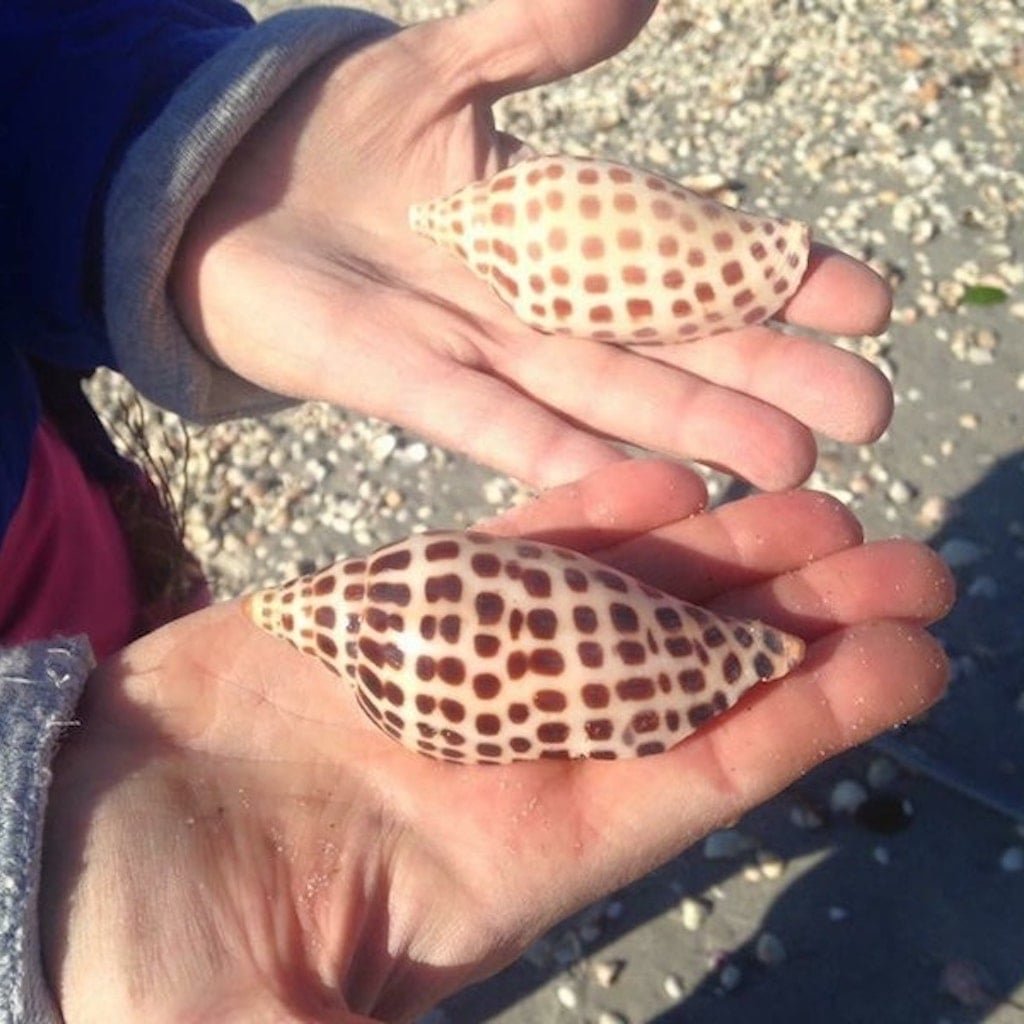
🐚 At a glance
- Scientific name
- Carditamera floridana
- Family
- Carditidae (the cardita clams)
- Size
- Usually under 1 in, occasionally to 1.25 in
- Tell-tale
- 15–20 beaded radial ribs on an elongated, boat-shaped shell
- Color
- Cream to white base, mottled with chestnut brown
- Where & when
- Drift lines at Keewaydin, Kice & the Caxambas spits, any dropping tide
What Exactly Is a Broad-Ribbed Cardita?
The broad-ribbed cardita (Carditamera floridana) is a small saltwater clam in the family Carditidae, a group of ribbed, heart-shaped bivalves that live tucked into shallow sand and rubble bottoms along the Gulf coast. It’s not flashy and it’s not rare — it’s the shell equivalent of the friend who shows up to every single beach day. Adults rarely grow past an inch, with a trigonal, slightly elongated shape that most people describe as boat-shaped or almost D-shaped when you set it flat on a table, flatter edge down and the hinge riding up top.
Like most clams, the cardita lives as two matching valves hinged together, buried just below the surface where it filters plankton from the passing tide. When storms, wind shifts, or a strong outgoing tide rework the sandbars around the barrier islands, thousands of them wash loose at once and pile into the wrack line — which is exactly why you’ll find drifts of them on almost every trip through the bivalve family of Gulf shells.
How to Identify It in Your Bucket
Pick one up and run your thumb across the outside — that’s the fastest tell. A broad-ribbed cardita carries 15 to 20 strong radial ribs, and each rib is studded with small, evenly spaced beads, almost like a strand of stitching sewn into the shell. No other common Gulf clam in this size range has ribs that pronounced. The color is the second giveaway: a cream or off-white base overlaid with chestnut-brown mottling, sometimes in solid patches, sometimes in streaks that radiate out from the hinge like a fan.
Flip it over and you’ll usually see a clean white or faintly purple-tinged interior, with small interlocking teeth at the hinge — proof it’s a true bivalve and not a univalve snail shell that just happens to be curved. If you’re working through a bucket with your kids, this is the shell to start with: because you’ll find so many, you can practice matching left and right valves by hinge shape and rib count before moving on to trickier pairs. It’s a favorite warm-up ID in our shelling with kids guide, precisely because there’s no pressure to get it right on the first try — you’ll have forty more chances in the same handful of sand.
| Shell | Rib texture | Typical size | Color pattern |
|---|---|---|---|
| Broad-ribbed cardita | 15–20 strongly beaded ribs | Under 1 in | Cream base, chestnut mottling |
| Calico clam | Smooth to faintly ribbed | 0.5–1 in | Maroon checkerboard squares |
| Jewel box shell | Frilly, leaf-like flanges, not beads | 1–2 in | White, sometimes rose-tinted |
Where They Turn Up in the Ten Thousand Islands
Broad-ribbed carditas live just offshore in shallow sand and shell rubble, which means the best place to find them washed up is anywhere that sand gets reworked by current — and in this stretch of the Gulf, that’s the boat-only barrier islands. Keewaydin, Kice, and the spits off Caxambas Pass all build long, ropy drift lines after a moving tide, and cardita shells are usually the single most numerous thing in them, mixed in with coquinas, tellins, and the occasional lightning whelk. Cape Romano’s exposed sandbars, reshaped again and again since Hurricane Ian toppled the old dome houses there, turn up heavy drifts of them too.
Timing matters more than location. A dropping tide exposes fresh drift lines close to the water’s edge, and a morning low after a winter cold front tends to turn up the thickest windrows of shell. You don’t need a rare-species radar for this one — just walk the last hour of any outgoing tide and you’ll start crunching them underfoot. As with every shell you pick up in Collier and Lee counties, take home empty shells only; live shells, sand dollars, and starfish stay in the water by law, and a cardita with its animal still inside will feel heavier and often still be closed tight.
Why “Common” Is a Feature, Not a Bug
It’s tempting to toss the fiftieth cardita back and go hunting for something rarer, but there’s a real case for keeping a few. Abundance is what makes a shell a great teaching tool. Because you can find dozens in a single stretch of beach, a cardita lets a new sheller or a six-year-old practice the actual skill of identification — counting ribs, checking for beading, matching color pattern — on low-stakes shell after low-stakes shell, instead of getting one shot at a single fragile find. Our captains lean on exactly this shell to teach the habit of really looking at what’s in your hand before deciding it’s “just another clam.”
That habit pays off fast. Once you can call a cardita on sight — rib count, bead texture, chestnut mottling — you start noticing the subtler differences between it and its bivalve neighbors, which is the same skill that eventually lets you spot a genuine rarity like a junonia sitting in a pile of ordinary shells. Common shells build the eye that finds uncommon ones.
Its Starring Role in Shell Crafts
Uniform size, sturdy ribs, and a built-in pattern make the broad-ribbed cardita one of the most popular shells in local craft baskets. The beaded ribs catch paint and glue well, the small size means dozens fit into a single wreath or shadow box without overwhelming it, and the natural chestnut mottling already looks intentional, so crafters barely need to embellish it. You’ll see them glued into mirror frames, strung into wind chimes, and scattered as filler texture around a centerpiece shell like a horse conch or a lightning whelk.
If you’re collecting for a project, empty valves are all you need — and they’re easy to tell apart from a live one on the beach, since an empty cardita is light, dry, and usually already gaping open at the hinge. Rinse off the sand, let it dry fully in the sun for a day or two, and it’s ready for the glue gun. It’s a satisfying first project precisely because you never have to ration the material — there’s always another handful waiting in the next drift line on your next shelling tour.