
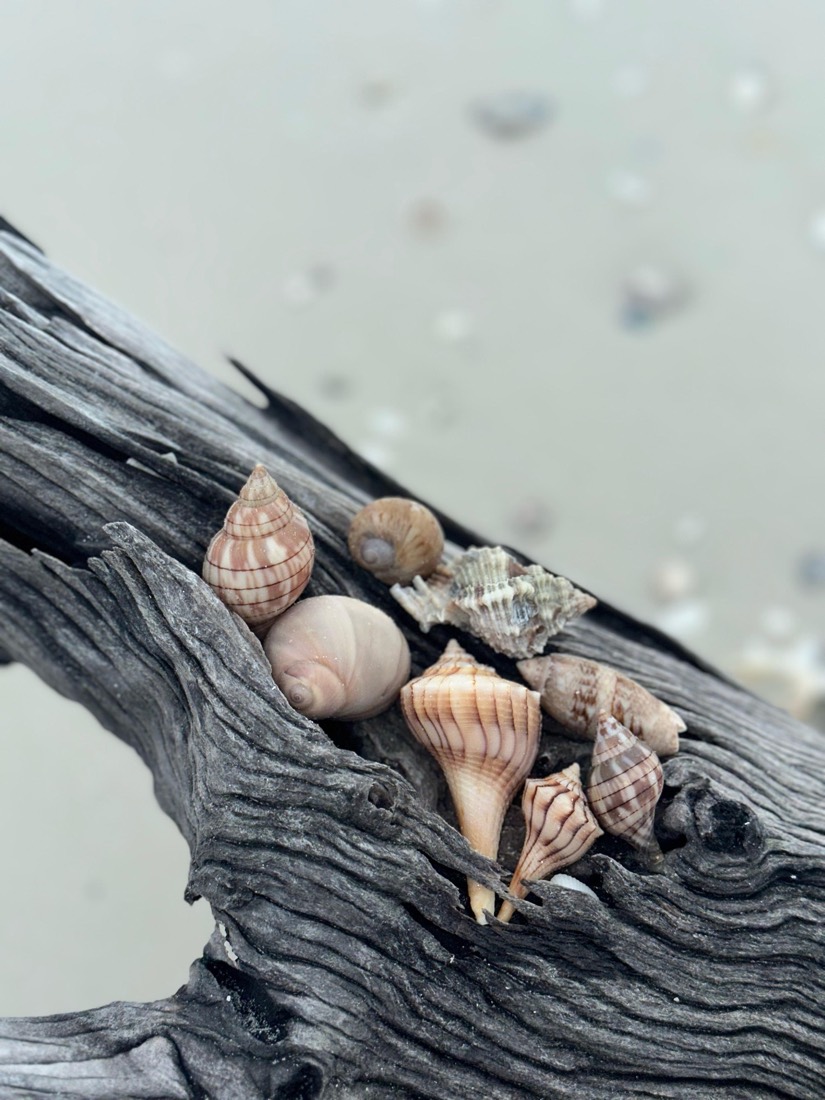
A guest holds up something small, spiraled and sun-bleached and asks a familiar question: "is this actually something?" Before we answer, we are already looking at three things — the shape of the opening, the thickness of the shell in hand, and where exactly on the beach it turned up. A shell sitting fresh in the wrack line at a spot like Second Chance, still damp and unbleached, tells a different story than the same species found bleached white and worn smooth twenty feet up in the dry sand above the last high tide.
Position on the beach matters as much as the shell itself. The wrack line — that ragged strip of debris the last tide left behind — is where the freshest, least-battered material tends to sit, because the water dropped it there on its way back out. Higher up, in sand that only floods on the biggest tides, shells have usually been baking and tumbling for weeks or months, which is why they look chalky and thin-edged rather than glossy. We teach guests to work that line first, then work upward, rather than wandering the whole beach at random.
We also handle things differently depending on how fresh they look. A shell that still has color and shine to it gets picked up carefully and turned over completely before anyone decides what it is, because color fades fast once something has been sitting in the sun. Anything that still looks like it might have an animal inside goes right back exactly where it was found — we only ever keep empty shells here, and that rule holds on every beach in Collier and Lee County, no exceptions, no matter how good the find looks.
In the hand, the real tell is usually weight and thickness before it is color. A shell that feels surprisingly heavy for its size, with a thick, glossy lip, is almost always something worth a second look rather than a common bleached-out fragment. That’s exactly why we have guests dip a questionable piece straight back into the shallows before deciding — a shell that looks dull and chalky dry can turn glassy and show its true pattern the second it’s under water again, which changes the identification completely.
None of this turns up a guaranteed find, and we would rather say that plainly than promise something the tide has not delivered yet. What it does is speed up the guessing once you are standing over something in the sand. Cross-reference what you pick up with our shelling beaches guide for where these patterns hold best, or come learn to work the wrack line firsthand on one of our shelling tours out through the islands.