
🐬 At a glance
- Scientific name
- Crocodylus acutus
- Status
- Threatened & federally protected (downlisted from endangered in 2007)
- Population
- A recovered few thousand — the only wild American crocodiles in the U.S.
- Range near us
- Mostly south of Marco, from the Everglades & Ten Thousand Islands to Florida Bay
- Tell-tale
- Gray-green, tapered V-shaped snout, a visible lower tooth
- Rule
- Wild & protected — never approach or feed one
What is the American crocodile?
The American crocodile (Crocodylus acutus) is Florida's other big reptile — the one most visitors never expect to hear is real. Unlike the American alligator you already know from every golf-course pond in the state, this is a true crocodile: gray-green to olive, with a longer, more tapered, V-shaped snout instead of the alligator's broad U. Look close — from a very respectful distance — and you'll often spot the fourth tooth on the lower jaw sticking up outside the closed mouth, a classic crocodile giveaway that alligators don't share.
They also handle salt differently. American crocodiles have specialized glands that let them tolerate brackish and full-strength seawater for long stretches, which is exactly why they favor the mangrove-lined estuaries, tidal creeks and coastal ponds of the far southern Ten Thousand Islands and Everglades rather than the freshwater sloughs and marshes alligators prefer. Adults can reach well over ten feet, though most individuals people actually encounter run smaller. They're also famously shy — built to avoid people, not seek them out. That combination of camouflage color, quiet habits and a strong preference for tucked-away mangrove backwaters is exactly why so many longtime Florida residents go their whole lives without ever knowingly seeing one.
Where American crocodiles live near Marco Island
South Florida is the only place in the entire United States with a wild, breeding population of American crocodiles, and it's concentrated well south of us: the Ten Thousand Islands down through Everglades National Park, the backwaters around Everglades City, Chokoloskee, Turner River and Halfway Creek, and on to Flamingo, Cape Sable and Florida Bay. That stretch of undeveloped mangrove coastline is essentially the species' entire U.S. range, and the water we run out of Marco Island and Goodland sits right at its northern edge.
That's an important distinction to be honest about: this isn't Everglades-brochure territory where a sighting is a given. Crocodiles are genuinely uncommon on our routes specifically because Marco is near the northern limit of where they concentrate, and because they're so good at staying out of sight among mangrove roots and backwater creeks. If you want to understand the bigger picture of this coastline — the maze of islands, passes and mangrove tunnels that makes this habitat possible in the first place — our Ten Thousand Islands charter routes are the closest thing to a field guide you can ride in.
Crocodile vs. alligator: how to tell them apart
The Ten Thousand Islands and greater Everglades region hold a rare distinction: it's one of the only places on Earth where alligators and crocodiles share the same water. Both are ancient, both are protected, and from a moving boat they can look similar at a glance — a dark shape and a pair of eyes just above the surface. Once you know what to look for, though, the differences are easy to spot.
| Feature | American Crocodile | American Alligator |
|---|---|---|
| Snout shape | Long, narrow, tapered V | Broad, rounded U |
| Color | Gray-green to olive | Blackish-gray |
| Visible tooth | Lower 4th tooth shows when mouth is closed | Teeth mostly hidden when mouth is closed |
| Preferred water | Brackish & saltwater mangrove estuaries | Freshwater marshes, sloughs & ponds |
| Where near us | Rare; mostly south of Marco toward the Everglades | Common in freshwater canals & inland wetlands |
If you want the deeper dive — behavior, temperament, and more on why this overlap zone exists at all — our full alligator vs. crocodile guide breaks it down feature by feature.
From endangered to recovering: a real comeback
The American crocodile's story in Florida is a genuine conservation success, and it's worth knowing before you write the species off as either mythical or doomed. Habitat loss and unregulated hunting for hides pushed the population to the brink by the 1970s, when only a couple hundred were thought to survive in the wild statewide. Federal protection, plus the slow work of preserving the mangrove estuaries they depend on, let the population climb back to a few thousand today — enough that the U.S. Fish & Wildlife Service downlisted the species from endangered to threatened in 2007. It remains federally protected either way.
That recovery is tied directly to places like the water we run. Every mile of intact mangrove shoreline in the Ten Thousand Islands and around Rookery Bay is nursery habitat, nesting habitat, or both — for crocodiles and for the other quietly rare species that share this coast, like the endangered smalltooth sawfish. You'll find more of this coast's rare and protected residents in our full Wildlife Guide.
Could you actually see one on a tour?
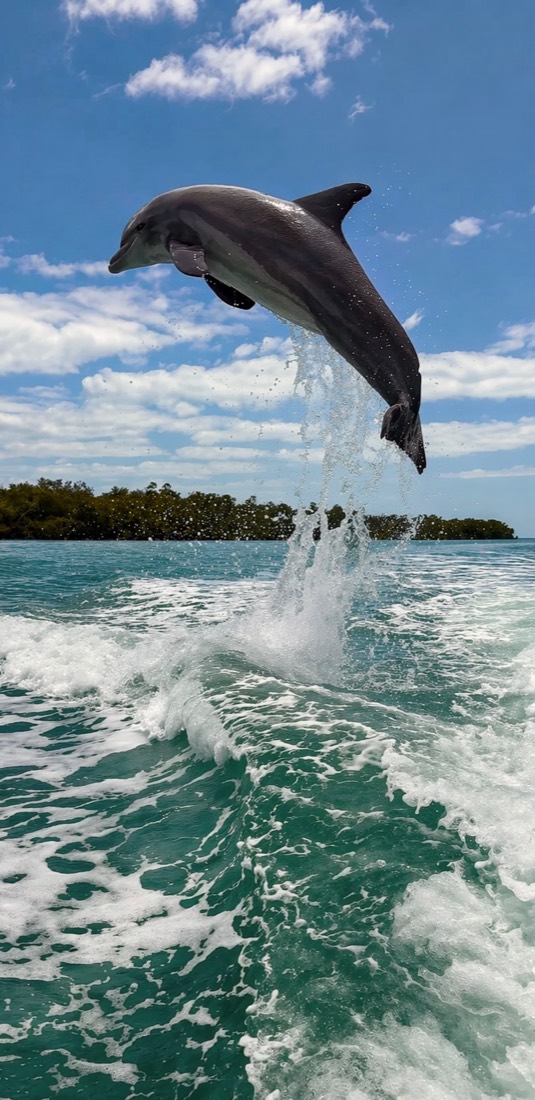
Here's the honest answer, not the brochure one: on our Marco Island and Goodland routes, an American crocodile sighting is possible but genuinely rare. You're far more likely to see an alligator if you're running a freshwater canal, or nothing scaly at all beyond a curious dolphin. We're not going to tell you a crocodile is waiting around every mangrove point, because it isn't — the more reliable crocodile country is farther south, toward Everglades City, Chokoloskee and the boundary of Everglades National Park.
What you're realistically watching for on any given trip is a low, log-like shape drifting at the surface, or a pair of eyes and the ridge of a snout barely breaking the waterline near a quiet mangrove bank — usually right at dawn or dusk when the animal is moving. If your captain does spot one, expect a respectful distance and an idle motor, not a close approach; these are wild, protected animals, not attractions, and they've earned every bit of the comeback described above by staying wary of people. Our dolphin & wildlife tours run through exactly this kind of backwater country, with dolphins guaranteed to be the star of the show and anything rarer treated as the bonus it is. Bring binoculars, keep your voice down through the quiet mangrove stretches, and let your captain do the looking — that's how the rare sightings actually happen.