
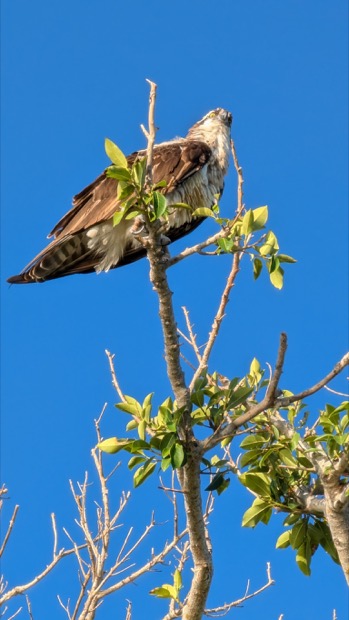
🐬 At a glance
- Species
- Florida burrowing owl (Athene cunicularia floridana)
- Size
- About 9 in tall, on unusually long, bare legs
- Active
- Diurnal — visible standing at the burrow entrance in daylight
- Where
- Sandy vacant lots in Marco Island's residential neighborhoods, away from the beach
- Protection
- Burrows are staked, roped off and legally protected — view from the street only
- Best viewed
- Early morning or late afternoon, year-round
Where to find burrowing owls on Marco Island
Marco Island's checkerboard of neighborhoods holds one of Florida's better burrowing-owl populations, and you don't need to leave dry land to see it. When the island was first platted decades ago, developers laid out far more residential lots than were ever built on, and a lot of that sandy, sparsely vegetated ground sat empty for years. Florida burrowing owls, which dig their own burrows rather than nesting in trees or cavities like most owls, found those vacant lots ideal — open sightlines to watch for predators, soft sand that's easy to excavate, and almost no cover for a hawk to hide in.
Walk the interior residential streets away from the Gulf-front condos and you'll start noticing the burrows: a small mound of excavated sand, sometimes a short wooden or PVC perch stuck in the ground beside it, and more often than not a little owl standing right at the entrance watching you back. They're scattered across the island rather than clustered in one obvious spot, so the best approach is simply to slow down and scan quiet residential blocks — especially platted-but-undeveloped lots — rather than looking along the beach or the water. It's the kind of sighting that rewards a walk more than a drive, and it pairs naturally with a morning on Marco: plenty of visitors work a block or two for owls before or after a shelling low tide or a spin out to the islands. For the bigger picture on the island itself, our Marco Island guide rounds up the beaches, passes and neighborhoods worth knowing before you go.
How to identify a Florida burrowing owl
A burrowing owl is unmistakable once you know what you're looking at, mostly because it breaks every rule you'd expect from an owl. It stands about nine inches tall on long, bare legs more like a shorebird's than an owl's, with no ear tufts, bright yellow eyes, and a mottled brown-and-white plumage that blends into the sandy lot around it. Instead of roosting hidden in a tree at dusk, it stands sentry right at the burrow mouth in the middle of the day, often on one leg, bobbing and bowing when something catches its attention. If you get too close — even from the street — it may bob rapidly, chatter, or drop back into the burrow, and young owlets in the nesting season will do a startlingly good rattlesnake-hiss impression if they feel threatened underground.
It also helps to know what you're not looking at. Marco Island and the surrounding mangroves hold a few other owls, but you'll meet them very differently, and rarely in a front yard at noon.
| Owl | Active | Typical habitat | Key ID feature |
|---|---|---|---|
| Florida burrowing owl | Daytime | Sandy vacant residential lots | Ground burrow, long bare legs, no ear tufts |
| Eastern screech-owl | Night | Tree cavities in mangrove & hardwood hammocks | Small, ear tufts, mottled gray or rufous |
| Great horned owl | Night | Tall trees near open ground | Large, prominent ear tufts, deep hoot |
| Barred owl | Night & overcast days | Wooded swamp edges & hammocks | Dark eyes, no ear tufts, rhythmic four-note call |
Why the burrows are staked and roped off
Florida burrowing owls are a state-listed threatened species, and Marco Island takes the burrows on its vacant lots seriously. Active burrows are typically marked with a small stake or perch and a taped or roped-off buffer around the entrance, sometimes with signage explaining what it is and why it's there. That marking isn't decoration — it keeps mowers, foot traffic, and construction equipment away from a burrow that's easy to miss if you're not looking for it, and it gives the resident pair space to raise a clutch without being flushed every time someone walks by.
For visitors, the rule is simple: the rope is the boundary. View from the public street or sidewalk, never step onto a private lot to get a closer look, and never approach a burrow even if the owl seems unbothered by you. Skip the flash if you're taking photos after dusk, and keep dogs leashed and well back — a loose dog investigating a burrow is one of the fastest ways to flush a nesting pair off their eggs. If you're serious about photographing the owls rather than just spotting them, our bird photography tips page covers the long lenses and low-disturbance techniques that get you a usable shot without ever crossing that rope.
Best time of day and year to see them
Burrowing owls are year-round residents on Marco Island, not seasonal visitors, so there's genuinely no wrong time to go looking. That said, a couple of windows tend to pay off. Early morning and late afternoon are usually the most reliable, since the owls are often out and active at the burrow entrance rather than tucked down out of the midday heat. Nesting season, roughly February through July, is also a good stretch to watch: adults spend more time on guard duty at the surface, and later in the season you may catch a clutch of fuzzy owlets lined up at the burrow mouth like they're waiting for a bus.
Outside of nesting season the pace slows down, but the resident pairs generally stick close to the same burrow year after year, so a lot that had owls last winter is a good bet to check again.
Owl-watching etiquette on Marco Island
A little courtesy goes a long way here, both for the owls and for the people who live next to them. Stick to public streets and sidewalks, keep your voice down, and resist the urge to walk onto a vacant lot for a better angle — a zoom lens or a decent pair of binoculars will get you a far better look than proximity ever will. Give the owls room to go about their day, don't linger for long stretches in front of one burrow, and remember these are somebody's front yards and side streets, not a park.
Because this is a shore-side sighting rather than a boat one, it works best as a bookend to your day on the water rather than the main event. Plenty of guests walk a block or two for owls in the early morning, then head straight to the docks for a shelling trip while the tide's still working the outer islands, or come back at golden hour for a dolphin and wildlife cruise through the backwaters. It's one stop in a much bigger cast of characters — browse the full wildlife guide for everything else that turns up in the Ten Thousand Islands, on the water and off.