
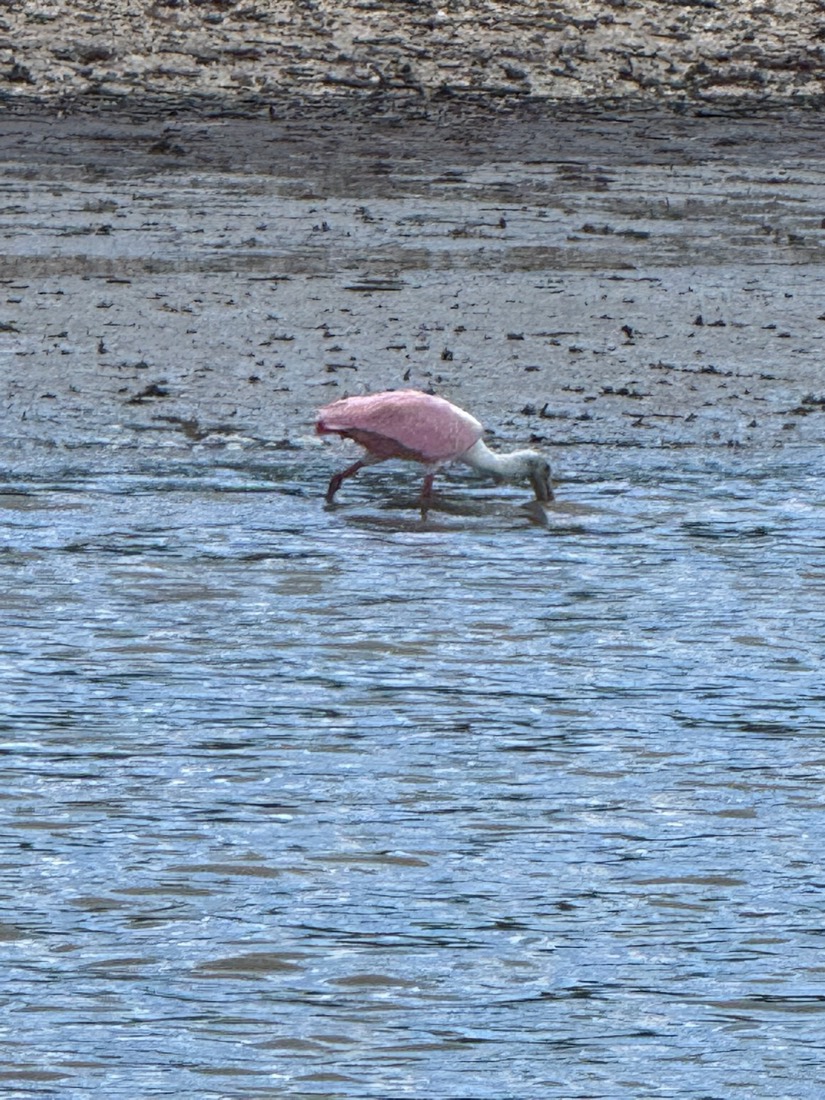
🐬 At a glance
- Scientific name
- Haematopus palliatus
- Size
- About 17 to 21 in. long, crow-sized with a broad wingspan
- Tell-tale
- Long, blade-like carrot-orange bill, black head & back, white belly, dusty-pink legs, yellow eye ringed in orange
- Where & when
- Oyster bars & sandbars in Rookery Bay, Big Marco Pass and the Ten Thousand Islands, worked hardest at low tide, year-round
- Status
- Florida state-threatened species; nests on open sand, so give roped-off areas room
- Diet
- Oysters, mussels & limpets, pried or hammered open with that bill
What exactly is an American oystercatcher?
The American oystercatcher (Haematopus palliatus) is one of the most unmistakable shorebirds in the Ten Thousand Islands — and one of the harder ones to actually catch working a sandbar up close. Picture a bird roughly the size of a crow, dressed in a sharp black hood and back over a clean white belly, standing on thick, dusty-pink legs. Then add the feature that gives the bird its name and its living: a long, laterally flattened bill in a color somewhere between carrot and traffic cone, built more like a chisel than a beak. A startling lemon-yellow eye ringed in orange finishes the look. The genus name Haematopus translates roughly to "blood foot," a nod to those pink-red legs, though on this bird the eye and bill do most of the showing off. Juveniles carry a duller, darker-tipped bill until they mature into the full solid orange of an adult, so a slightly muddy bill color usually just means you're looking at a younger bird, not a different species.
How to spot one from the boat
Most first sightings go the same way: someone on deck says "what is that orange thing," and by the time binoculars come up, the bird has already flushed low over the water with a sharp, piping call that carries a long way across open flats. American oystercatchers rarely mix into big flocks the way willets or sandpipers do. You're more likely to find a single bird or a mated pair standing still at the edge of an exposed oyster bar, head down and working the shell, or flying a low, direct line between bars on stiff wingbeats. Established pairs tend to return to the same general stretch of shoreline year after year, which is part of why our captains can usually point out roughly the right neighborhood before ever slowing the boat down. That combination — solitary or paired, bill down at the tideline, and that unmistakable color — is usually all you need to call it. If you're hunting shorebirds specifically rather than hoping to stumble onto one, our captains build birdwatching stops into select routes, since the same backwater channels that hold dolphins also hold the oyster bars this bird depends on.
A handful of other orange-or-red-billed birds around Marco Island can cause a second guess from a distance, especially the black skimmer and the royal tern. Here's the fast version:
| Species | Bill | Size | Typical behavior |
|---|---|---|---|
| American oystercatcher | Long, thick, solid carrot-orange blade | Crow-sized | Solo or paired, working an oyster bar bill-down at low tide |
| Black skimmer | Red-orange base, black tip, longer lower mandible | Similar length, slimmer | Skims the water's surface at dusk; rests in loafing flocks on sandbars |
| Royal tern | Thin, tapered, all orange | Smaller, gull-like | Plunge-dives for baitfish; shaggy black crest |
For the deeper dive on the tern side of that mix-up, our royal tern guide covers that bird's shaggy, punk-rock crest and plunge-diving style in detail.
Where they feed in the Ten Thousand Islands
American oystercatchers need two things close together: oyster bars to feed on and open sand or shell to nest on, and this stretch of Southwest Florida has both in spades. Rookery Bay National Estuarine Research Reserve is the anchor — its maze of mangrove creeks and exposed oyster bars at low tide holds some of the most reliable feeding habitat in the region, which happens to be water our shelling and wildlife runs already pass through. The Big Marco Pass Critical Wildlife Area, plus the sandbars off Sand Dollar Island and Tigertail Beach, sees regular use too, especially on the lowest tides of the month when acres of oyster-crusted bottom come up out of the water at once. Keewaydin's backside flats and the quieter Goodland backwaters round out the picture. None of these spots are guaranteed sightings — oystercatchers move with the tide and the season — but they're the real, named places where our captains actually watch for this bird, not a vague "somewhere in the Everglades" answer.
How that bill actually opens an oyster
That bill isn't decoration — it's a specialized tool, and it's the reason the species is called an oystercatcher in the first place. Individual birds tend to specialize in one of two techniques. "Stabbers" watch for an oyster that's gapped open even slightly, slip the flattened bill tip into the crack, and snap the adductor muscle before the shell can clamp shut. "Hammerers" go after mussels and other closed bivalves by pounding a weak point in the shell until it cracks, then prying it open. Either way, it's a learned skill, not something that arrives fully formed — young birds spend weeks trailing a parent and fumbling with shells before they get efficient at it, and a slow learner can go hungry on a falling tide. A healthy adult can keep honing this routine for well over a decade, which is part of why the technique looks so effortless once a bird has a few seasons of practice behind it. Limpets, marine worms and other soft-bottom invertebrates round out the diet when oysters aren't cooperating. It's genuinely fun to watch through binoculars once you know what you're looking at: a bird methodically working a single oyster like it's got a lock to pick, which, biologically, it does.
Why it's a state-threatened species
Florida lists the American oystercatcher as a state-threatened species, and the reason comes down to where it nests, not just where it feeds. These birds lay eggs directly on open sand or shell above the tideline — no built-up nest, no tree, nothing hidden — which worked fine for thousands of years before beaches filled up with foot traffic, dogs and boat wakes. A nest that simple is exposed to summer storm tides, ghost crabs, raccoons, and anyone who walks too close and never even notices the pair of birds dive-bombing overhead in protest. Local and state wildlife agencies monitor known nesting areas each spring and summer, which is part of why you'll sometimes see researchers or volunteers posted near an active site. That's also why you'll see posted, roped-off sections on certain sandbars and beach points during nesting season, including inside the Big Marco Pass Critical Wildlife Area, and why our captains keep a respectful distance from active bars rather than idling right up on them. Giving these birds room isn't just good etiquette — on a threatened species, it's the difference between a nest that fledges chicks and one that doesn't. None of this means you won't see the bird; it just means the sighting is worth appreciating for what it actually is.
You don't have to go looking for oystercatchers specifically to run into one. They turn up as a bonus on the same water we already run for shelling and dolphins — working the oyster bars along the edges of Rookery Bay, the same backwater channels covered on our dolphin & wildlife tours out of Marco Island and Goodland. Back at the wildlife guide, you'll find the rest of the birds, mammals and reptiles that share this same stretch of the Ten Thousand Islands.