
🐬 At a glance
- Scientific name
- Pelecanus erythrorhynchos
- Size
- Wingspan up to about 9 ft — among the largest of any North American bird
- Season here
- Winter visitor only, roughly November through early April
- Tell-tale
- All-white body with black flight feathers; soars in lines, never plunge-dives
- Where
- Remote sandbars & shallow bays of the Ten Thousand Islands
- Feeding style
- Cooperative surface herding, scooping fish while swimming as a group
What Is an American White Pelican?
The first time you see an American white pelican, your brain tries to file it as something else — a swan, an egret blown wildly out of proportion, maybe a leftover pterodactyl. At up to 9 feet across the wings, it’s one of the heaviest flying birds in North America, and the pale, ivory-white body reads even bigger against a blue Gulf sky. Look closer and you’ll see black flight feathers along the trailing edge and wingtips, a sharp two-tone pattern that flashes every time the flock banks together on a thermal.
One quirky field mark you won’t see on our winter birds: up north during breeding season, adults grow a strange flattened plate on top of the bill, then shed it once nesting is done. The pelicans that raft up in our backwaters all winter are bare-billed and off duty, dressed down for the season.
Unlike the brown pelicans you’ll see working nearly every dock and channel marker around Naples and Marco Island year-round, the American white pelican is a visitor, not a local. It doesn’t nest here, doesn’t raise young in the mangroves, and doesn’t stick around for summer. It shows up dressed for winter, spends a few months getting fat on Gulf baitfish, and heads back north well before hurricane season warms the water again. You’ll find the full cast of feathered regulars, including this one, in our Wildlife Guide.
White Pelican vs. Brown Pelican
Ask any of our captains and they’ll tell you the easiest way to sort a white pelican from a brown pelican is to watch what it does, not just what color it is. Brown pelicans are the ones you already know from every Naples pier photo: dark gray-brown, noticeably smaller, and famous for the spectacular headfirst dive — folding their wings and dropping out of the sky onto a school of baitfish. American white pelicans never do that. Their bodies are built more like a big soaring goose than a diving bomber, and a plunge dive at that size and weight simply isn’t how the bird is designed to feed.
Instead, American white pelicans feed the way you’d expect a wading bird to feed, just at a much larger scale and usually with company. They swim on the surface, dip their long orange bills, and often work as a loose team, pushing fish into water shallow enough to scoop up without ever leaving the surface. Size is another giveaway once you’ve seen both side by side: white pelicans are noticeably larger, with a wingspan a couple of feet wider than a brown pelican’s, and a body that rides higher and heavier on the water.
The table below breaks down the differences our guests ask about most on winter trips through the islands.
| American White Pelican | Brown Pelican | |
|---|---|---|
| Presence in Florida | Winter visitor only (roughly Nov.-Apr.) | Year-round resident |
| Color | All-white body, black flight feathers | Grayish-brown, silvery back |
| Feeding style | Swims & herds fish cooperatively; never dives | Plunge-dives from the air |
| Wingspan | Up to roughly 9 ft | About 6-7 ft |
| Where you’ll see it | Remote sandbars & open bays | Docks, channel markers, nearshore water |
When to See Them in the Ten Thousand Islands
White pelicans start showing up in our waters around November, as cold fronts push south and the northern lakes where they nest freeze over. From there, the Ten Thousand Islands stay theirs through the winter season, all the way into early April, when the flocks lift out and head back toward nesting colonies on lakes and reservoirs in the northern Great Plains and Canada — they don’t breed in Florida at all.
That window lines up almost exactly with our busiest months on the water, which is good news if you’re hoping to see one. A December, January or February trip through the backwaters gives you good odds of spotting a raft of white pelicans loafing together, since that’s deep winter for the flock and they’re settled in rather than staging to leave. By late March you might still catch stragglers, but the big rafts thin out fast as the season turns. For the fuller month-by-month picture of who’s around and when, our wildlife-by-season guide lays out the whole calendar.
Where They Loaf and Feed
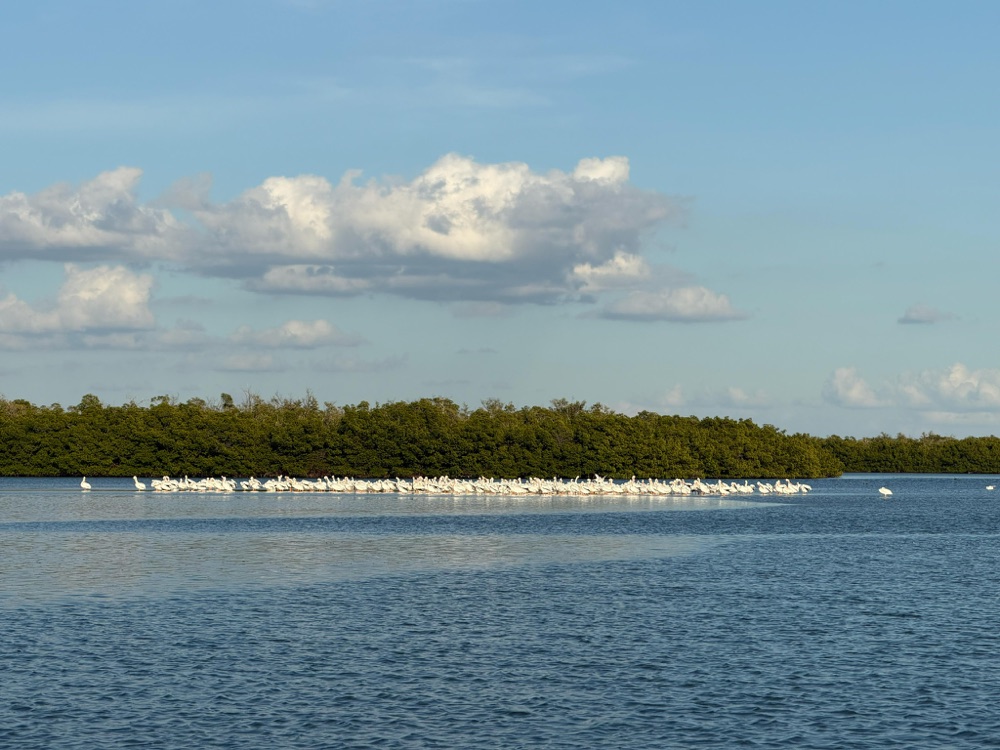
American white pelicans aren’t dock birds. You won’t find them lined up on a piling next to the brown pelicans waiting for a fillet scrap — they keep to open water and quiet, undisturbed ground. Our captains most often find them loafing in tight rafts on exposed sandbars and spoil islands well off the beaten path, the same kind of remote, boat-only stretches of the Ten Thousand Islands where shorebirds and wading birds gather undisturbed.
Shallow bays and backwater flats near Cape Romano, Gullivan Bay and the mangrove maze around Goodland are typical winter ground, along with open water inside the Ten Thousand Islands National Wildlife Refuge and the fringes of Rookery Bay. These are areas a boat reaches a lot more easily than a beach walker or kayaker ever could, which is exactly why a winter trip with a captain who already knows this water tends to turn up more wildlife than trying to find it from shore.
How They Fish Without Diving
The feeding behavior is really what sets this bird apart, even more than the size. A brown pelican fishes alone, spotting a baitfish from the air and folding into a dive. An American white pelican fishes like it’s working a shift with coworkers. Groups swim in loose lines or shallow semicircles, beating their wings against the surface and dipping their bills in near-unison to spook fish into shallower water, then scooping them up in that enormous pouch before the school can scatter.
It’s a genuinely different survival strategy from anything else hunting these waters, and it only works because the bird is heavy enough to push a lot of water and social enough to coordinate with a group instead of freelancing. Watch a raft of them work a shallow flat on a calm winter morning and you’ll see the pattern: swim, dip, herd, scoop, repeat — unhurried and cooperative, a world away from a brown pelican’s aerial ambush. It’s exactly the kind of behavior our winter dolphin & wildlife tours are built to put you in front of.