
🐬 At a glance
- Best light
- First hour after sunrise & last hour before sunset (low, gold, side-lit)
- Shutter speed
- 1/2000s+ for diving pelicans & skimmers; 1/1000s for wading birds
- Star species
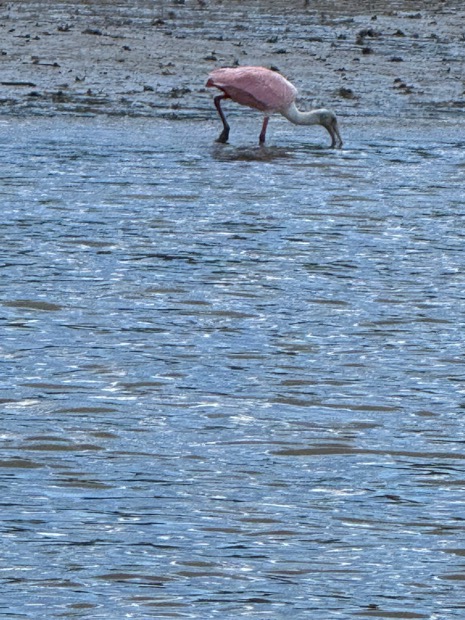
- Roseate spoonbill, brown pelican, black skimmer, reddish egret, wood stork
- Where
- Rookery Bay estuary, mangrove rookery islands, oyster bars & tidal flats
- Golden rule
- Stay back from nesting flats & rookeries — never flush a roost for a shot
Why a boat beats the beach for bird shots
The problem with shooting birds from shore is your angle. You’re standing up, looking down, and the bird sees a tall predator-shaped silhouette long before you’re in range. From a boat you’re low to the water, your outline is broken up by the hull, and you arrive on the bird’s level — that flat, eye-to-eye perspective that makes a portrait feel like the bird is looking right at you. A slow, quiet boat is the best photo hide on this coast.
It also reaches the addresses birds actually use. The mangrove wading birds and roosting flocks pile onto islands and oyster bars you can’t walk to, deep in the Rookery Bay estuary. We idle in from the water side, kill the motor, and let the boat drift the last stretch so you’re shooting from a stable, near-silent platform. On a dolphin & wildlife tour we’re already weaving through that same backwater, so the birds come with the territory.
Camera settings that nail wings and water
The two killers of bird shots are motion blur and a missed exposure on a bright white bird against dark mangroves. Shoot shutter-priority or full manual and start with a fast shutter: 1/2000s or faster for a brown pelican folding into a dive or a black skimmer cutting the surface, and around 1/1000s for slower waders like a great blue heron or a stalking reddish egret. Open your aperture, push ISO until the shutter holds, and let the modern sensor sort out the grain — a sharp noisy frame beats a clean blurry one every time.
Use continuous autofocus and back-button focus if you have it, and burst-shoot the action; a pelican’s dive is over in a heartbeat. White birds blow out fast, so dial in a touch of negative exposure compensation (around −0.7) to hold detail in a spoonbill’s pink or an egret’s feathers. And forget the tripod — a boat is always moving. Brace your elbows on the rail or your knee, breathe out, and let the hull do the steadying.
| Subject | Shutter | Why |
|---|---|---|
| Diving brown pelican | 1/2500–1/3200s | Freezes the plunge & the splash |
| Black skimmer skimming | 1/2000s+ | Wingtips & the water trail stay crisp |
| Roseate spoonbill in flight | 1/1600s | Holds the pink, freezes slow wingbeats |
| Wading heron or egret | 1/1000s | Sharp on a near-still bird, lower ISO |
| Perched osprey or eagle | 1/640s | Plenty for a still subject from a drifting boat |
Chasing the golden hour on the water
Time of day matters more than gear. The first hour after sunrise and the last hour before sunset give you low, warm, side-lit light that wraps a bird in dimension and turns the water to molten gold behind it. Midday sun is flat and harsh, and white birds glare. We can run a wildlife trip at the edges of the day specifically for this — ask about a family wildlife tour at first light, or pair the birds with a glowing finish on a sunset cruise when the spoonbills and ibis flap back to roost in pink sky.
Position is everything: you want the sun behind you, throwing light onto the bird, not behind the bird turning it into a silhouette. Tell your captain what you’re after — on a private charter we’ll set the boat’s angle to the sun for you, hold a position off a feeding flat, and wait. That patience is where the keepers come from. For the full month-by-month rundown of what’s flying and feeding, our wildlife-by-season guide tells you when the spoonbills are reddest and the rookeries are busiest.
Shooting without spooking: nesting flats & rookeries
Here’s the part that separates a real wildlife photographer from a tourist with a long lens: the birds come first, the photo second. Nesting flats and rookery islands are off-limits to approach. If a bird stops feeding, stands tall, opens its bill, or lifts off, you’re too close — back off, because a flushed roost can mean abandoned eggs or chicks exposed to the sun and gulls. Our captains read that body language for a living and we simply won’t push a roost for a shot.
The good news is you don’t need to. A long lens and a quiet drift get you frame-filling images from a respectful distance, and the birds behave naturally instead of fleeing — which makes for better photos anyway. We keep our wake down, our voices low, and our angle off the flat, in line with sensible wildlife-viewing etiquette. If you want to know exactly who you might frame, our Naples wildlife checklist runs through the regulars, from the brown pelican to the reddish egret to the wood stork.
From the Helm: Positioning the boat for bird shots at Big Marco Pass
Before we ever throttle down for a photographer aboard, we're thinking about the sun, not the bird. Running the outside edge of Big Marco Pass in the first hour of light, our captains swing the boat so the sun sits over your shoulder rather than behind the birds, because a pelican silhouetted against a bright sky makes a lousy photo no matter how close you get. That single positioning call does more for your shots than any camera setting ever will, and it's the first thing we check before we even ask what lens you brought.
Once we're lined up, we cut the engine to neutral and let the boat drift rather than idle in gear — idle vibration is subtle, but it's enough to soften a shot at a fast shutter speed, and a drifting boat is quieter besides, which buys a few extra seconds before a skittish bird lifts off. We use the current and a light breeze to hold our angle rather than fight it with the throttle, nudging back into position only once the shot's done.
The tell we're watching for isn't the bird, it's the water around it — a nervous scatter of baitfish or a sudden dimple on the surface usually means a pelican's about to fold its wings and drop, and that's the half-second worth having your finger already on the shutter for. We'll call it out low, “here it comes,” so you're not still framing the shot when the bird hits the water and comes up with a fish.
We'll also angle the boat so your rail side stays clear of the console and outriggers — nothing kills a shot faster than a shadow or a rod holder creeping into the corner of the frame, and it's an easy fix from the helm that most guests never think to ask for.
If the light's flat or the wind's wrong at Big Marco Pass, we'll run out toward Gordon Pass instead, since a change in the water usually changes what's working there too. Either way, we keep the boat broadside to the birds rather than bow-on, because that gives everyone aboard — not just whoever's closest to the rail — a clean angle without craning around the console.
None of this replaces slow water and patience, which is really what separates a boat full of photographers from a beach full of them. For the colonies worth the long lens, see our rookery guide, and if you want the boat held on one spot as long as the light's good rather than moving on a schedule, a private charter is the way to run it.