
🐬 At a glance
- Scientific name
- Luidia senegalensis
- Arm count
- Usually nine — some individuals show seven to eleven
- Size
- Arm span can stretch close to a foot across
- Texture
- Sandpapery, spine-fringed arms; pointed tube feet with no suckers
- Where & when
- Sand and seagrass flats at low tide, Ten Thousand Islands backwaters
- Rule
- Live animal — look, photograph, leave it on the bottom (taking live sea stars is prohibited in Collier & Lee)
What Is a Nine-Armed Sea Star?
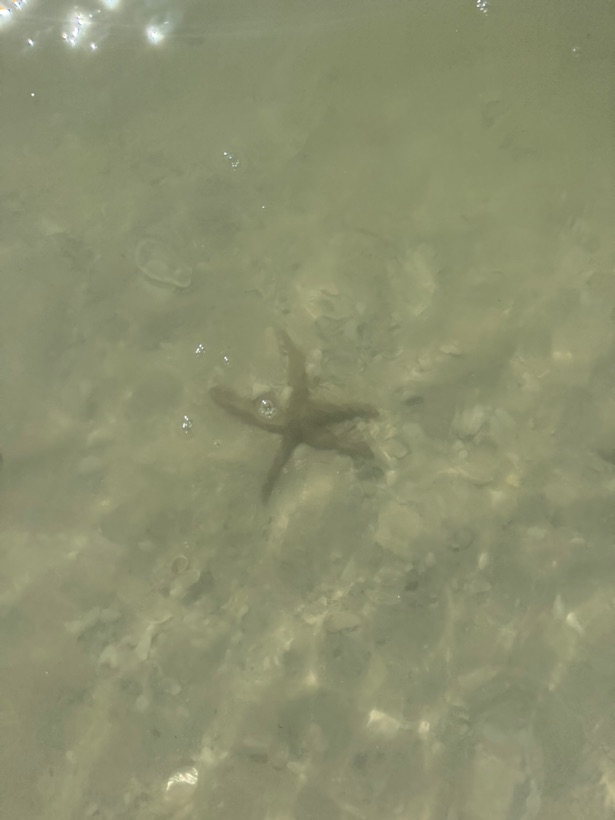
Say “sea star” and most people picture the classic five-pointed shape from a beach-house throw pillow. Luidia senegalensis never got that memo. It’s a real, living sea star native to the Western Atlantic and Gulf of Mexico, ranging from North Carolina down through the Caribbean to Brazil, and it typically carries nine long, tapering arms radiating off a small central disc instead of five. Around Marco Island, Goodland and Naples, it’s one of the more surprising things our captains point out when a shelling trip idles over a skinny sand flat at low water — guests assume it’s a starfish gone wrong until they count the arms twice.
The name is a little looser than it sounds. Nine is the average, not a guarantee — you’ll occasionally find individuals with seven, eight, ten or even eleven arms, since sea stars regrow damaged limbs and don’t always regenerate the exact original count. Top color runs gray to olive-tan, sometimes with faint darker bands running down each arm, fading to a pale cream on the underside where the tube feet do all the work. The skin has a rough, sandpapery feel rather than the smooth look it has in photos, and the whole animal sits flatter and broader than the chunky five-armed stars people usually imagine.
How to Identify One on a Sand Flat
The giveaway is almost always the arm count before anything else. If you spot a flat, star-shaped animal with what looks like too many points — and a quick count lands on nine, or close to it — you’re looking at Luidia senegalensis, not a damaged or unusual version of a common five-armed sea star. The arms themselves are noticeably slender and taper to fine points, fringed along the edges with short spines that give them a slightly bristly outline rather than a smooth curve. Most of what you’ll actually see poking up is the arm tips; the disc and much of the arm length are usually tucked just under a skim of sand.
Don’t confuse it with the local keyhole urchin, the region’s true sand dollar, which is round, flat and covered in short fuzzy spines rather than star-shaped with distinct arms — and it’s a different animal entirely from the empty shells you’ll ID on our starfish and sea star beach-finds page. That page covers what to do with the dried, bleached sea star skeletons that sometimes wash up; this one is about the live animal you’ll actually see moving on a falling tide.
| Animal | Arm / Body Shape | Texture | Take It Home? |
|---|---|---|---|
| Nine-armed sea star | Nine slender, tapering arms (7–11 range) | Sandpapery, spine-fringed | No — live animal, leave on bottom |
| Common five-armed sea star | Five thick, stubby arms | Firm, knobby | No — live animal, leave on bottom |
| Keyhole urchin (local sand dollar) | Round, flat disc, no arms | Fuzzy short spines when live | Empty test only, never a live urchin |
| Dried sea star shell/skeleton | Bleached, rigid, arms intact | Hard, brittle | Yes — already dead and dried |
How It Plows and Feeds
Most sea stars amble along at a pace you can barely see happening in real time. Nine-armed sea stars are the exception — their tube feet are pointed rather than suction-cupped, built for digging and shoving through loose sediment instead of gripping rock, and that lets the animal genuinely plow just beneath the sand’s surface rather than crawl across the top of it. Watch one for a minute on a clear, shallow flat and you can actually see the sand ridge up slightly as it pushes forward, arm tips occasionally breaking the surface like a tiny, slow-motion submarine.
Feeding is opportunistic and a little indiscriminate. A nine-armed sea star will engulf small mollusks, worms, crustaceans and other invertebrates it bumps into, and it’s also known to take in mouthfuls of sediment itself, straining out organic material and tiny prey before moving on — more of a vacuum than the picky, single-clam specialists some other sea stars are. It’s an important, unglamorous part of keeping a sand flat’s ecosystem cycling, which is exactly the kind of thing you start noticing once you slow down and actually watch the bottom instead of just the horizon.
Where and When to Find One in the Ten Thousand Islands
These aren’t animals you plan around a calendar for — they turn up whenever a sand or seagrass flat gets exposed or thinned by a falling tide, which around here means the boat-only backwaters and flats our Wildlife Guide covers throughout the year. The best encounters usually happen on our shelling tours, when the captain deliberately idles over the same skinny, negative-low-tide flats that produce the best shells — the same shallow water where a nine-armed sea star is most likely to be visible, arm tips just breaking the sand instead of buried out of sight in deeper water.
Look for them anywhere the bottom goes from a foot of water to a few inches: the edges of exposed sand bars, the sandy aprons around seagrass beds, and the quieter Ten Thousand Islands backwaters away from boat traffic. They’re not the flashiest thing on a low-tide flat — that’s usually the wading birds or a passing dolphin — but once a guest spots the first one, everyone on board starts scanning the sand for the next star-shaped bump. It’s the same sandy habitat that hosts seahorses tucked into the seagrass, so keep an eye on more than just the sea stars.
Look, Don’t Take: Why It Goes Back
Sea stars breathe and move through a system of tube feet and thin skin that depends on staying wet, and they dry out and stress fast once they’re out of the water for more than a minute or two. That’s one reason on top of the legal one: taking a live sea star, live shell or live sand dollar off a Collier or Lee County beach is prohibited, full stop, whether it’s a nine-armed sea star, a keyhole urchin or anything else still breathing when you pick it up. The rule that governs the empty-shells-only ethic on the rest of this site applies just as firmly here — a living animal is never a souvenir.
The good move, and honestly the more memorable one, is to crouch down, watch it work for a few minutes, get a photo if you want one, and set it back exactly where the tide left it. A captain who’s been running these flats for years will tell you the animal itself is more interesting alive and moving than it would ever be dried out on a shelf — and you get a story about watching a nine-armed sea star actually plow through sand in real time, which beats a static shell every time.