
⭐ At a glance
- What they are
- Sea stars — echinoderms, kin to sand dollars & urchins
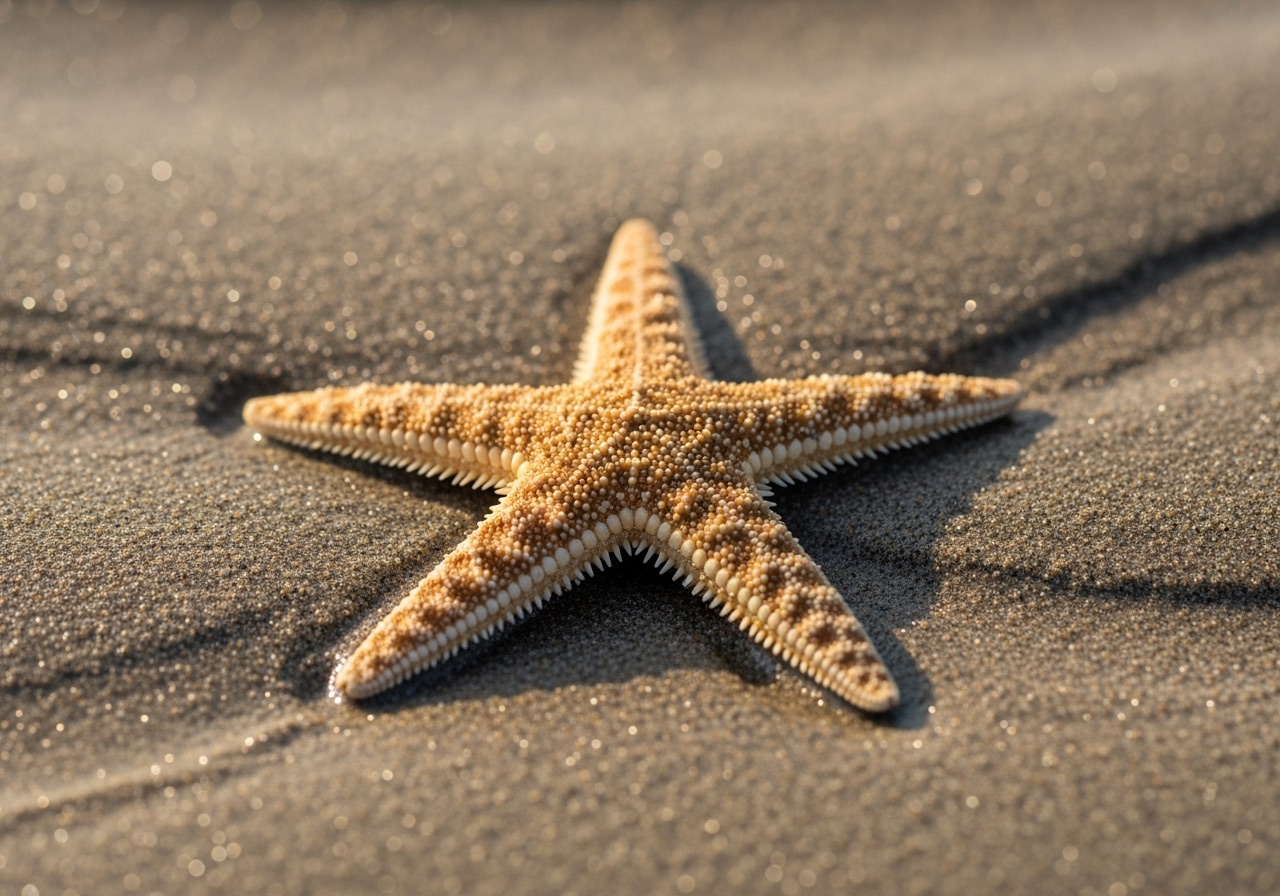
- Common look
- Five arms, tan to orange-brown, often firm and a bit stiff
- Alive?
- Almost always — even limp, stranded ones
- Where & when
- Shallow grass flats & sandbars; wash up after storms
- Rule
- Never take a live sea star — protected in Collier & Lee
How to identify a sea star
You already know the shape — five (sometimes more) tapering arms radiating from a central disc. Our Gulf species tend to run tan, sandy-brown or a warm orange, with a slightly bumpy, leathery top. Flip one underwater and you’ll see hundreds of tiny tube feet lining the grooves of each arm; that’s how it walks and grips. They’re in the same echinoderm family as the keyhole sand dollar and the sea biscuit, just with arms instead of a disc.
Why they’re almost always alive
This trips people up: a sea star can look completely lifeless — stiff, dry on top, not moving — and still be very much alive. Unlike a shell, the sea star is the animal; there’s no empty “shell” version to keep. A star drying in the sun is a star in trouble, not a souvenir. So the rule is simple and absolute: live sea stars are protected in Collier & Lee, and you never take one. The only ethical move is to help it back to the water.
How to save a stranded sea star
If you spot one stranded at the tide line, you can genuinely save its life with a few seconds of care. Slide your hand flat underneath, lift gently without yanking any arms, and walk it out to water deep enough to cover it. Set it down softly on the bottom and give it a moment. Don’t toss it — a hard throw can injure it. Keep it out of the air as briefly as possible.
| Do | Don’t |
|---|---|
| Lift gently with a flat hand under it | Pull or twist its arms |
| Return it to water deep enough to cover it | Leave it drying for a photo |
| Set it softly on the bottom | Throw it |
| Take only photos home | Bag it — it’s alive and protected |
On our shelling tours around Keewaydin and the Ten Thousand Islands, helping a stranded star back home is one of the kids’ favorite moments — and it lines up exactly with the empty-shells-only rule we live by.
From the Helm: Spotting Sea Stars at Tigertail's Lagoon Mouth on a Dead-Low Morning
The lagoon mouth at Tigertail Beach is where we look first, a shallow cut where grass flat meets open sand and drains hard on a dead-low morning. As the water thins out over that mouth, sea stars that spend the tide tucked in the grass get stranded in ankle-deep pools you can see clearly from the boat. We ease in slow and cut the engine well short of the flat, because the wake from an idling boat is enough to stir silt and hide exactly what we came to show you.
From the rail, we watch for a dull orange or tan shape sitting still against the paler sand — a sea star rarely moves fast enough to give itself away by motion, so we're looking for shape and color, not action. Once a guest spots one, we guide the approach on foot rather than pointing from the boat, since a star half-buried in a pool is easy to miss on your own but obvious the moment someone experienced walks you right up to it. We work the pools in order along the mouth rather than scanning the whole flat at once, since that steady, pool-by-pool sweep turns up far more stars than wandering does, and it's the habit a first-timer never thinks to copy on their own.
We tell every guest before they crouch down: assume it's alive, because on this stretch it almost always is, even the ones sitting completely still in shallow water. We'll lift one gently from underneath with wet hands so you can see the underside and the tiny tube feet working, then set it back exactly where it was within a few seconds. We never let it sit in a dry hand or a bucket — out of the water even briefly stresses an animal built to breathe through its skin.
If the tide's still too high to expose the lagoon mouth when we arrive, we work the grass flat edge a little further up the beach instead, where a slower drain still strands a few stars in shallow water even before the mouth itself opens up. It's a smaller showing, but it lets us keep the stop honest instead of promising a sighting the tide simply isn't ready to give yet.
This stop folds naturally into time on the boat-only beaches we already visit for shelling, since the same falling tide that strands stars at the lagoon mouth is opening shell wrack close by. If watching wildlife matters more to your group than shells that day, say so before you book a shelling tour — we'll lean the stop toward the lagoon instead of the wrack line.