The honest answer
No. Dolphins are wild animals, and no ethical tour operator can guarantee you’ll see one. Anyone who flatly promises it is either bending the truth or doing something to the animals you wouldn’t want them to. We’d rather be straight with you.
Why the odds are still excellent
Here’s the reassuring part: Naples’ waters hold a healthy, year-round presence of wild bottlenose dolphins, and we see them on the great majority of our trips. Around Gordon Pass especially, where the tide stacks up bait, sightings are the norm rather than the exception.
Why we won’t promise (and won’t chase)
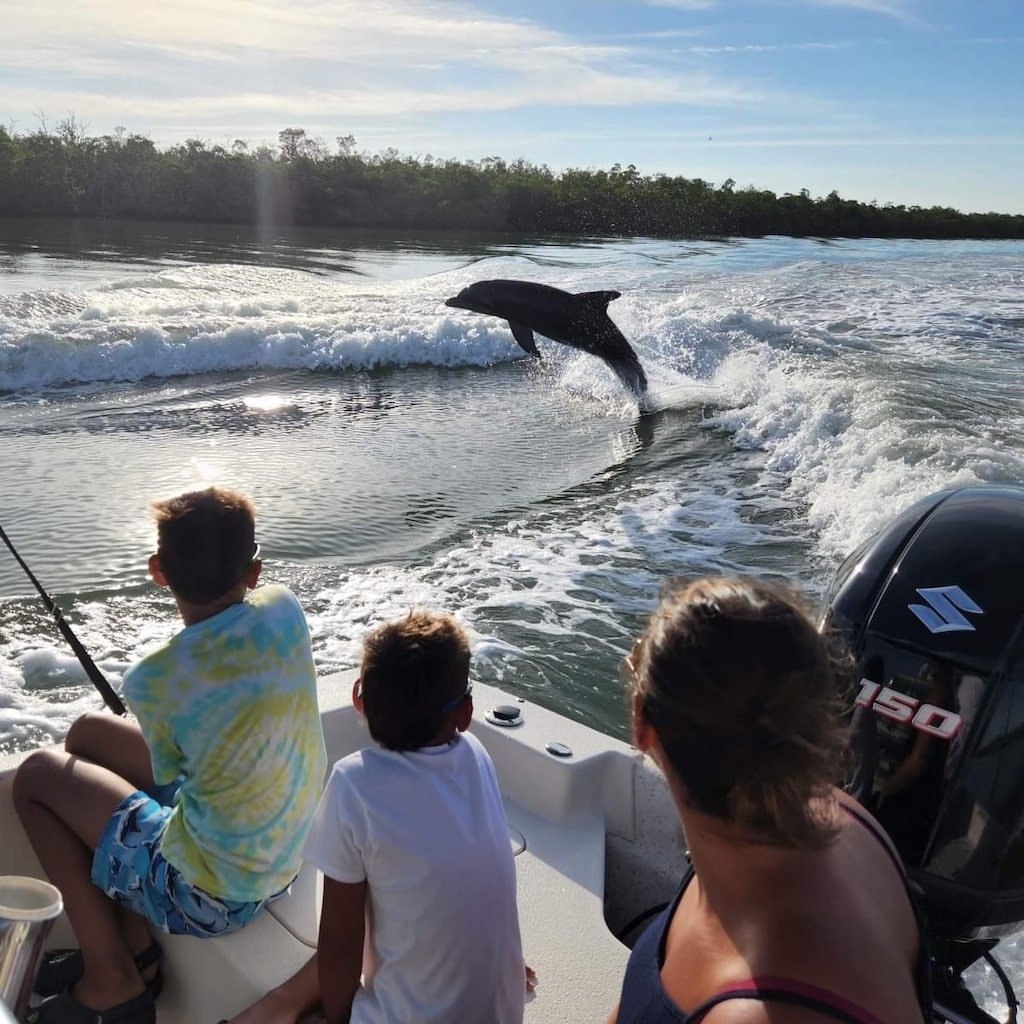
Part of viewing wildlife responsibly is letting the animals stay wild. We don’t harass pods, cut them off, or feed them to force an encounter. We position the boat, idle, and let the dolphins do their thing — which, happily, they usually do, often surfing right up to the wake on their own terms.
How we stack the deck in your favor
Experience does the heavy lifting: our captains time trips to the moving tide, know exactly where the pods have been feeding, and read the water as they go. That’s why our Naples dolphin tours have such a high success rate — not a gimmick, just local knowledge. (For more, see the best time of day to see dolphins.)
From the Helm: Dolphin odds: reading bird stacks and bait pushes off Capri Pass
At the dock, the question almost always comes before the lines are even untied: are we actually going to see dolphins? Your captain’s honest answer is the same one you’ll read anywhere on this site — we can’t promise a wild animal will show up on command. What the tidy written answer leaves out is what we’re actually doing with our eyes the whole first ten minutes underway: scanning for frigatebirds and terns stacking up over one patch of water, because a bird stack almost always means bait is getting pushed, and pushed bait means something is hunting it.
Off Capri Pass on an incoming tide we watch for a slick patch on otherwise textured water, a spot where the surface goes glassy for no obvious reason — that’s often a mud boil or a bait ball getting worked from below. We’ll idle toward it, not gun the engine, because dolphins spook off an approaching wake faster than most guests expect. Half the skill in this job is closing the last hundred yards slow enough that the animal decides we’re not worth avoiding.
When we do find them, we cut to neutral and let the boat drift rather than circling, which is the move guests notice least and dolphins tolerate best. Bottlenose dolphins around here will sometimes ride the bow wake on their own terms, peeling off after thirty seconds or staying for several minutes — entirely their call, never something we can cue up. We’ve had mornings where a few different pods show themselves within the hour, and quieter days where the water stays empty of anything but mullet.
Some mornings there’s nothing working at all — flat water, no birds, no signs — and that’s when we’ll shift toward the deeper edge of the channel instead of running farther and farther on a hunch. Dolphins push into that deeper cut on a falling tide even when the surface gives nothing away, so we’ll ease along it slow rather than sprint from spot to spot burning fuel and daylight chasing a feeling instead of a sign.
That range is exactly why we won’t sell you a guarantee, and why we’d rather talk you through what actually improves your odds — tide stage, time of day, which stretch of water we run. A dolphin tour booked around an incoming tide gives us the best version of that read, and pairing it with a look at the wildlife you might spot along the way sets expectations closer to what a real morning on this water looks like.
None of this means the odds are bad — most mornings deliver a sighting, sometimes several — it just means we’d rather under-promise at the dock than oversell you on the drive over. Ask your captain what the birds are doing before you ask what the dolphins are doing; more often than not, the birds already told us the answer.