
📖 At a glance
- Year-round?
- Present all year, much easier to spot Nov–Mar
- The trigger
- They gather when water drops below ~68°F
- Where
- Rookery Bay mangrove estuary & warm backwaters
- How they group
- Dispersed — not Crystal-River-style herds
- Best odds
- Calm, cool mornings in winter
Yes, but with an asterisk
The honest answer is that West Indian manatees never really leave Southwest Florida. A few hang around the warmer pockets all summer, grazing seagrass and surfacing for slow, lazy breaths. So technically, yes — they're a year-round resident. But in the warm months they're spread thin across miles of open bay and Gulf, which makes them genuinely hard to find. We'd rather tell you that up front than promise a summer sighting we can't deliver.
Why winter is manatee season
Here's the biology that drives everything: manatees can't handle cold water for long. Once the Gulf dips below about 68°F — usually starting in November and lasting through March — they pull out of the open water and crowd into warmer, calmer spots. Around here that means the mangrove-lined creeks and basins of Rookery Bay Reserve, where the shallow water holds heat and the wind can't reach. A cold front actually improves your odds: the chill pushes the herd into predictable warm pockets. Our cold-season manatee guide digs deeper into the timing.
What it's NOT: the Crystal River myth
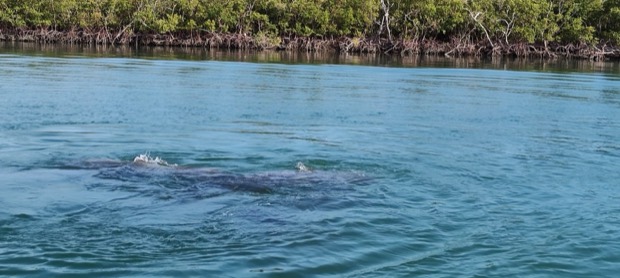
People picture the famous spring-fed photos — hundreds of manatees stacked nose-to-tail in crystal water. That's a different place. Crystal River, two-plus hours north, has constant 72°F springs that concentrate manatees in tight, snorkel-with-them gatherings. Our manatees stay dispersed across the Rookery Bay backwater, moving with the tides and the temperature. That means you won't see a wall of them — you'll see a back surface here, a snout there, a pair drifting under the mangroves. It's quieter, wilder, and frankly more special when it happens.
| Months | Water temp | Your odds |
|---|---|---|
| Nov–Mar | Cool, often below 68°F | Best — they gather in warm backwaters |
| Apr & Oct | Shoulder, variable | Decent on cooler snaps |
| May–Sep | Bath-warm | Possible but dispersed and hard to find |
How to give yourself the best shot
Come in winter, go early, and keep it slow and quiet. Manatees are easy to miss — they surface gently, leaving little more than a swirl and a soft puff of breath. Our captains know the warm backwater corners they favor and how to ease in without spooking them; we always keep a respectful distance and let them set the pace. If a manatee encounter is the dream, our manatee tours focus the route on their winter haunts, and the broader dolphin tours often turn one up along the way. Either way, when that whiskered nose breaks the surface, you'll understand why we never stop chasing it.
From the Helm: Chasing the Warm-Water Boils Near Rookery Bay’s Creek Mouths in January
Before we commit to a manatee run, our captains check the Gulf surface temperature much the way you’d check a forecast before a beach day, because the whole search hinges on one number: once it drops under roughly 68°F, manatees stop lingering in open water and stack up in the warmer, current-sheltered creek mouths feeding Rookery Bay. On a cold January morning with a north wind still holding, we’ll bypass open bay entirely and idle straight for those tucked mangrove creeks instead of running our usual loop.
What we’re actually scanning for from the helm almost never looks like a manatee — it’s a smooth, oily-looking boil on the surface, or a pattern like someone dragged a paddle underwater a few feet down. Guests expect a gray back breaking the surface the way a dolphin does; manatees mostly hang below breathing quietly, so the tell is stillness inside moving water, not a splash you can point a camera at in time.
If a creek mouth sits dead quiet on a given morning, we don’t park and wait it out — we work two or three known warm pockets in sequence rather than betting everything on one spot, because manatees shift between them with the tide and the sun’s angle on the water. That’s the wrinkle a quick yes-or-no answer skips: it’s rarely one guaranteed spot, it’s a short list we check in order, patiently, before we call a run empty.
We always kill the engine well outside the creek mouth and drift or pole the last stretch, because manatees are slow and largely unbothered by a boat they can hear coming from a distance, but a sudden throttle-up close in will send them under for good in an instant. It’s the same quiet-approach habit we lean on across our dolphin tours and every other stop in our wildlife encounters, just slower and closer to the mangrove edge here.
We also keep guests at the bow rather than clustered at one rail when we do find a pocket of manatees, since even shifting weight can send a small ripple across water that’s otherwise dead calm, and calm is exactly what lets a manatee surface unbothered a few feet from the hull. A snout breaking the surface for one slow breath is often all you get, so we tell guests to watch, not reach.
Outside that cold window, a sighting turns back into a genuine surprise rather than a routine, which is honestly the better version of the moment — you’re not chasing a known cluster, you’re catching a resident that simply happened to be passing through that morning.