
🦛 At a glance
- Size
- Around 10 ft, often 800–1,200 lb
- Tell-tale
- Rounded snout, paddle tail, no dorsal fin, gray skin
- Best season
- Cool months — gather below roughly 68°F (Nov–Mar)
- Where
- Rookery Bay, Gordon River, Caxambas Pass — dispersed
- Honest note
- Not Crystal-River-style herds; sightings never guaranteed
How to identify a West Indian manatee
You'll know a manatee by how little it does. They're big gray-brown animals, roughly ten feet long, drifting through the shallows with no hurry at all. Look for the rounded, whiskered snout that pushes up first for a breath, the broad flat back with no dorsal fin, and a single rounded paddle of a tail. Up close you'll often see scars or a fuzz of algae — both normal. If you're still unsure, our manatee vs dolphin guide nails the difference: a fin on the back means dolphin, a flat back means manatee.
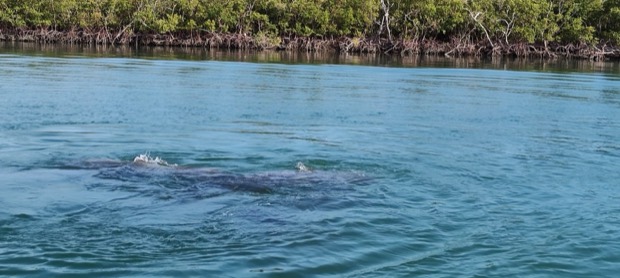
The other tell is the water. Before the animal appears you'll often see a swirl of stirred sediment and a smooth oval “footprint” on the surface where its tail pushed up a slug of water. Spot those and slow down — a manatee is right there.
When to see them
Manatees can't handle cold water, so the calendar matters. Through the warm months they spread out and are harder to pin down. But when a cool front drops the Gulf temperature below about 68°F — roughly November through March — they pull into warmer, sheltered water and become far easier to find. Calm, low-wind mornings after a front are prime. For the full timing picture, our manatee season guide and the wildlife-by-season calendar walk through it. Even in peak season, though, a manatee is a gift, not a guarantee.
| Season | Behavior | Your odds |
|---|---|---|
| Cool (Nov–Mar) | Concentrate in warm, sheltered water | Best |
| Spring/Fall | Spreading out as water warms or cools | Variable |
| Summer | Widely dispersed across the estuary | Hit or miss |
Where we find them near Marco & Naples
This isn't Crystal River — our manatees don't pack into one famous spring by the hundreds. Instead they're spread, in ones and small groups, through the warmer corners of the estuary. We look in the Rookery Bay reserve, up the Gordon River, and around Caxambas Pass and the mangrove creeks near Marco, where slack tide and sun-warmed shallows hold them. On a dolphin and wildlife tour we idle into those quiet creeks and let any manatee we find graze on its own terms — no chasing, no feeding, just watching a gentle giant do its thing.
From the Helm: reading manatee footprints in the Marco River canals after a cold snap
A cold snap rolls through and the first thing we check isn’t the manatee itself — it’s the surface. On a still, chilly morning in the Marco River canals, a resting or feeding manatee leaves a footprint: a smooth, oily-looking swirl the size of a trash can lid that rises and fades every time it flexes its tail below. No splash, no fin, just a flat patch of calm water sitting among the ripple. We’ll idle down and scan for two or three of those swirls in a line before we ever expect a snout to break the surface.
Once we spot a footprint, we shut down to idle speed well outside the posted zone rather than right at its edge, because a manatee already logging near the surface will often keep doing exactly that if nothing spooks it. We hold position rather than creep closer, letting the current bring the canal past us instead of pushing the hull toward the animal. In the tightest turns of the narrower canals we’ll cut the outboard entirely and ease along on a small trolling motor instead, since even a slow-idling prop draws more attention in six feet of canal water than a soft electric hum. Most mornings that patience pays off with a slow snout rise a boat length or two away, sometimes two or three animals loosely rafted together rather than one lone traveler working the canal alone.
At the rail, we ask guests to go quiet rather than point and call out, because the real giveaway is a sound, not a shape — a soft, single exhale, almost a sigh, the instant a snout breaks to breathe. Engine noise buries that sound completely, which is one more reason we’d rather idle and drift than motor closer for a better angle. Guests who stay patient and quiet usually hear two or three of those breaths before anyone actually spots the animal, and by then we already have a rough idea where to look next.
When the canals run empty, it usually just means the morning hasn’t dipped cold enough yet — manatees drift toward these warm-water pockets as the ambient temperature falls, not on a fixed schedule, so a mild stretch in December can be quieter than a sharp cold snap in February. We’ll shift the search toward the mouths of side canals and boat basins, where warmer discharge tends to hold, rather than the open river. It’s always a look, never a promise — some mornings the swirls just aren’t there, and we say so before you climb aboard.
If the cool season lines up with your visit, our dolphin tours work this same stretch of backwater and give the best shot at a footprint sighting, and the wildlife by season guide lays out roughly when that window tends to open and close each year.