
❄️ At a glance
- Trigger
- Cold fronts dropping water below roughly 68°F
- Where they go
- Warmer mangrove creeks & canals (Faka Union, Caxambas)
- Best conditions
- Calm, low-wind mornings after a front
- Season
- Roughly November–March
- Honest note
- Sightings improve in cold season but are never guaranteed
Why cold weather helps
Manatees are big, but they carry little insulating fat for their size, so they can't tolerate cold water for long. When a front drives the open Gulf and bays below about 68°F, they seek out anywhere the water stays a few degrees warmer — sun-soaked shallows, deeper canals, and the dark mangrove creeks that hold the day's heat. That instinct works in your favor: instead of being scattered across miles of estuary like they are in summer, they concentrate in a handful of warm pockets our captains know by heart. The West Indian manatee basically tells you where it'll be, if you understand the thermometer.
The best conditions to go
Timing is everything. The sweet spot is the calm morning a day or two after a cold front passes — the water's cool enough to have pushed manatees into the warm creeks, but the wind has laid down so the surface is glassy and you can actually see them. Wind is the enemy here: a chop hides the tell-tale swirl and surface “footprint” a manatee leaves. Early light also means warmer creeks after a cold night and fewer boats stirring the water. Our manatee season guide and wildlife-by-season calendar help you line up the trip.
| Condition | Best | Why |
|---|---|---|
| Water temp | Below ~68°F | Pushes manatees into warm creeks |
| Wind | Calm/low | Glassy water shows surface swirls |
| Time of day | Morning | Warm creeks, quiet water |
| Timing | Day or two after a front | Manatees settled in, wind eased |
Where they tuck in
We look in the warm refuges, not the open bays. The mangrove creeks and canals around Caxambas and Marco, the back reaches of the Rookery Bay reserve, and the Faka Union canal system all hold warmer water that draws manatees during a cold snap. We idle in slow, kill the noise, and let them graze — no feeding, no chasing, just a respectful watch on a dolphin and wildlife tour. And we'll always tell you straight: cold season gives you the best odds of the year, but a wild manatee is never a sure thing.
From the Helm: Idling into the Goodland canals on the first calm morning after a front
After a hard cold front pushes through, our captains make one decision before anything else: which canal to idle into first. We don’t run the open bay looking for manatee the way you might watch for dolphin fins — we ease down into the narrow, mangrove-lined canals off the back side of Goodland, cut the engine to idle speed, and let the boat drift while everyone goes quiet. That quiet matters more here than it does on any other kind of sighting we run.
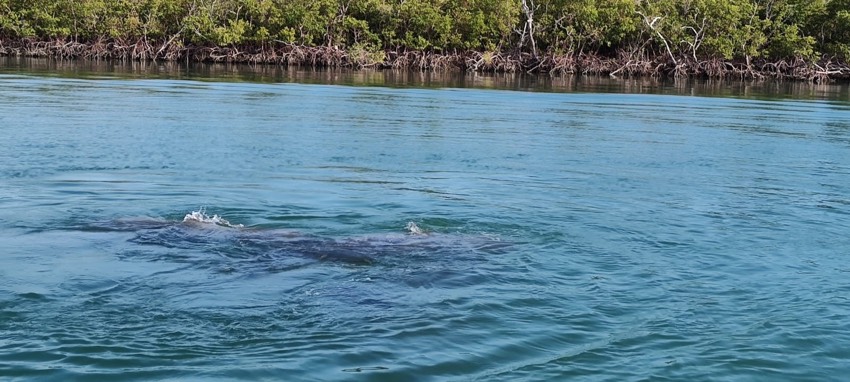
What gives a manatee away isn’t a nose breaking the surface, most mornings — it’s a flat, oily-looking circle on otherwise rippled water, what we call a footprint, left behind by the sweep of a tail a few feet down. We teach guests to scan for that smooth patch rather than watch for a splash, since a resting manatee can go a long stretch between breaths, and the footprint often shows up seconds before the animal does. Calm, glassy water on a still morning makes that footprint far easier to spot than it is on a breezy one.
We run at true idle the whole way into these canals, well under the posted no-wake speed, because a manatee resting just under the surface won’t move out of the way of a hull the way a fish will. Our captains keep one hand near the throttle and one eye on the water directly ahead rather than out at the horizon, since the animal you’re most likely to come across is the one you never saw coming at a comfortable cruising speed. We’ll also post a guest at the bow as a second set of eyes on a narrow canal, since a spotter looking straight down into the water often catches a shape a driver focused on the channel ahead can miss entirely.
We’ll idle through two or three canals in a row some mornings before we find one holding manatee, since the animals shift creek to creek as the water temperature nudges up or down through the day. A canal that was full on one visit can sit empty on the next if the sun’s warmed the open bay back up overnight. That unpredictability is exactly why we build in the time to check more than one spot rather than committing to a single canal and hoping.
We can’t promise a manatee will be tucked into that particular canal on your morning — they move as the water temperature shifts, and a warm afternoon can send them back out before we ever get there. What we can promise is that a calm, cold morning right after a front gives you better odds than any other window we run, and it’s part of why we build our cool-season itineraries around an early start rather than a lazy one.