
🐬 At a glance
- Recommended distance
- At least 50 yards (about 150 feet) from wild dolphins
- Feeding
- Illegal under the Marine Mammal Protection Act — never feed or touch
- Approach rule
- Let them come to you; never chase, encircle or cut off a pod
- Mother & calf pairs
- Give extra room and never come between a calf and its mother
- Where we see them
- Marco River, Gordon Pass & the Ten Thousand Islands, most days of the year
The 50-Yard Rule: What Federal Guidance Actually Says
If you’ve typed “how close can you get to dolphins on a boat” into Google before your Marco Island trip, here’s the number: 50 yards, or about 150 feet — roughly half a football field. That’s the minimum viewing distance NOAA Fisheries recommends for wild dolphins, backed by the Marine Mammal Protection Act, the federal law that makes it illegal to harass, chase, hunt, capture or kill any marine mammal in U.S. waters. Harassment isn’t just aggressive behavior — it legally covers anything with the potential to disrupt a dolphin’s normal feeding, resting or nursing, which is why running a boat straight at a pod, cutting one off, or splitting a mother from her calf all cross the line even if nobody ever touches the water.
Fifty yards is the standard distance recreational boaters and tour operators alike are asked to hold in open water. It’s a guideline, not a fence — and it evaporates the moment the dolphins decide to close the gap on their own, which, in our experience running the Marco River and Gordon Pass, happens more often than you’d think. Some channels and passes tighten that number further with posted manatee and idle-speed zones, and captains who run these waters every day know exactly where those boundaries sit before a pod ever shows up.
Why You Can’t Chase, Encircle or Feed a Wild Dolphin
It’s easy to understand why people want to close the gap — dolphins are magnetic, and a bow full of them can feel like the whole reason you got on the boat. But feeding a wild dolphin is illegal in Florida waters, no matter how well-meaning the tossed baitfish. Once a dolphin learns a boat means a handout, it starts approaching every hull it sees, begging instead of hunting, and eventually gets too close to props and hooks it never should have been near. Repeat violations can carry real federal penalties, and more importantly, a fed dolphin often trades a full life in open water for a shorter, riskier one hanging around boat traffic. We break down the specifics — and why the law exists for the dolphins’ own good — in our guide on whether it’s illegal to feed dolphins in Florida.
Chasing and encircling cause the same kind of damage from a different angle. A pod that’s resting, nursing or working a bait ball needs to be left alone to finish; boats that close in, split the group, or box dolphins against a seawall force the animals to burn energy avoiding people instead of living their lives. Mother-and-calf pairs are especially sensitive to this kind of pressure, which is exactly why they get the widest berth of all.
How Our Captains Keep Their Distance (and Still Get Close)
Our USCG-licensed captains treat the 50-yard guideline as a floor, not a target. On a dolphin tour, that means idling the engine well outside the zone, holding a steady, predictable course parallel to a pod instead of driving straight at it, and never speeding up to keep pace with a dolphin that’s clearly moving away. When other boats are working the same stretch of water, our captains will often flag a pod’s location by radio so nobody else has to guess where the animals are headed. It’s a slower, quieter style of wildlife watching — and it works, because dolphins are curious, fast and completely capable of deciding for themselves whether a boat is worth investigating.
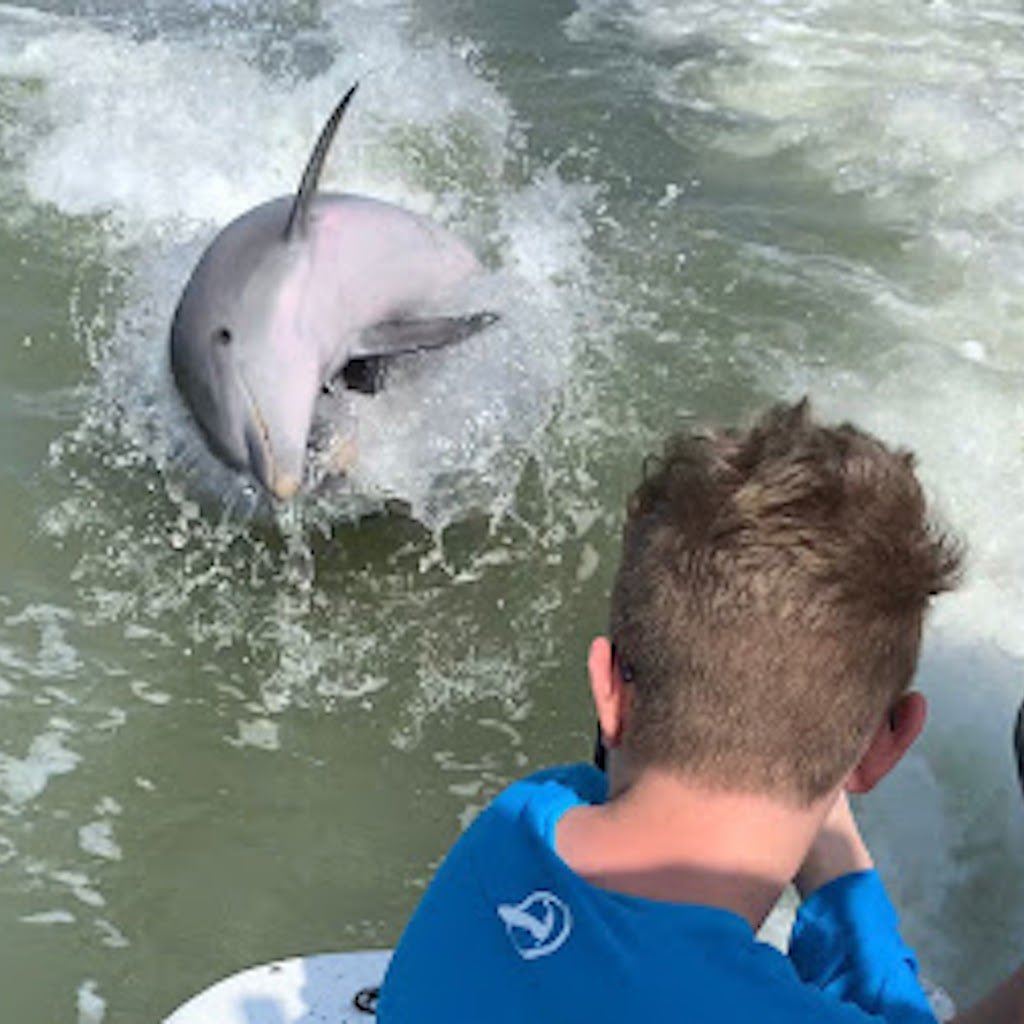
That’s exactly what tends to happen on trips through the Marco River: a pod that feels familiar — though no dolphin group here is ever a fixed, countable “resident stock” — peels off from whatever it’s doing and swims straight for our wake, riding the pressure wave for the sheer fun of it. When that happens, the distance rule effectively takes care of itself, because the dolphins closed the gap, not us. Read more about how we watch dolphins responsibly around boats — it’s a far better story than a boat that chased one down.
Dolphins vs. Manatees vs. Sea Turtles: Different Animals, Different Rules
None of these distance guidelines exist to keep you from seeing wildlife — they’re designed so the animals stick around long enough for the next boat, and the one after that, to see them too. Dolphins aren’t the only protected species you’ll cross paths with in the Ten Thousand Islands, and the rules aren’t identical for each one. Manatees show up in slow, shallow water — especially in cooler months when they gather in spots like Rookery Bay as temperatures drop — and the bigger danger for them is a boat strike, not chasing, so idle-speed and no-wake zones matter more than a specific yardage. Sea turtles, mostly nesting loggerheads on Gulf beaches from May through October, need their distance on land rather than water: no lights, no approaching a nest, no handling hatchlings. The table below is a quick reference for what each animal actually needs from you.
| Animal | Distance / rule | Why it matters |
|---|---|---|
| Bottlenose dolphin | 50 yards (about 150 ft); never chase, encircle or feed | Protects natural feeding, resting and nursing behavior |
| Manatee | Idle- and no-wake zones; never touch or feed | Slow-moving and vulnerable to boat strikes |
| Loggerhead sea turtle | Stay well back from nests; no white light at night | Nesting occurs on Gulf beaches May–Oct |
| Wading bird rookeries | Don’t beach or idle near rookery islands | Nesting birds flush easily and abandon nests |
What to Do If Dolphins Approach Your Boat
If dolphins choose to ride your bow or wake, the etiquette flips: hold your speed and course steady, and resist the urge to speed up, slow down suddenly, or turn hard just to keep them in view. Never reach out, splash, or toss anything overboard — even food you think of as harmless is still an illegal handout to a wild animal. Watch for calves in the group and give the pod room to peel off whenever it wants to; a dolphin that sticks around is usually a sign you got the distance right, not wrong.
Riders on our water shuttle between Marco Island, Goodland and Naples get this exact kind of encounter on a regular basis — the dolphins show up on their own schedule, not ours, which is really the whole point. If you want the best odds of an encounter like this from the start, a dedicated dolphin tour puts you with a captain who already knows where the pods have been working that week, then lets the animals take it from there. For more rules-of-the-water answers like this one, browse the rest of our Travel Guide.