
🐚 Shelling at a glance
- Most prized
- Junonia (Scaphella junonia) — rare, deep-water, washes up after storms
- Florida state shell
- Horse conch (Triplofusus giganteus) — the largest sea snail in American waters
- Most common
- Florida fighting conch, calico scallop, coquina
- Best beaches
- Boat-only barrier islands: Keewaydin, Kice, Shell Island
- The one rule
- Collect empty shells only — never a living animal
A field chart: shells you can find around Naples & Marco Island
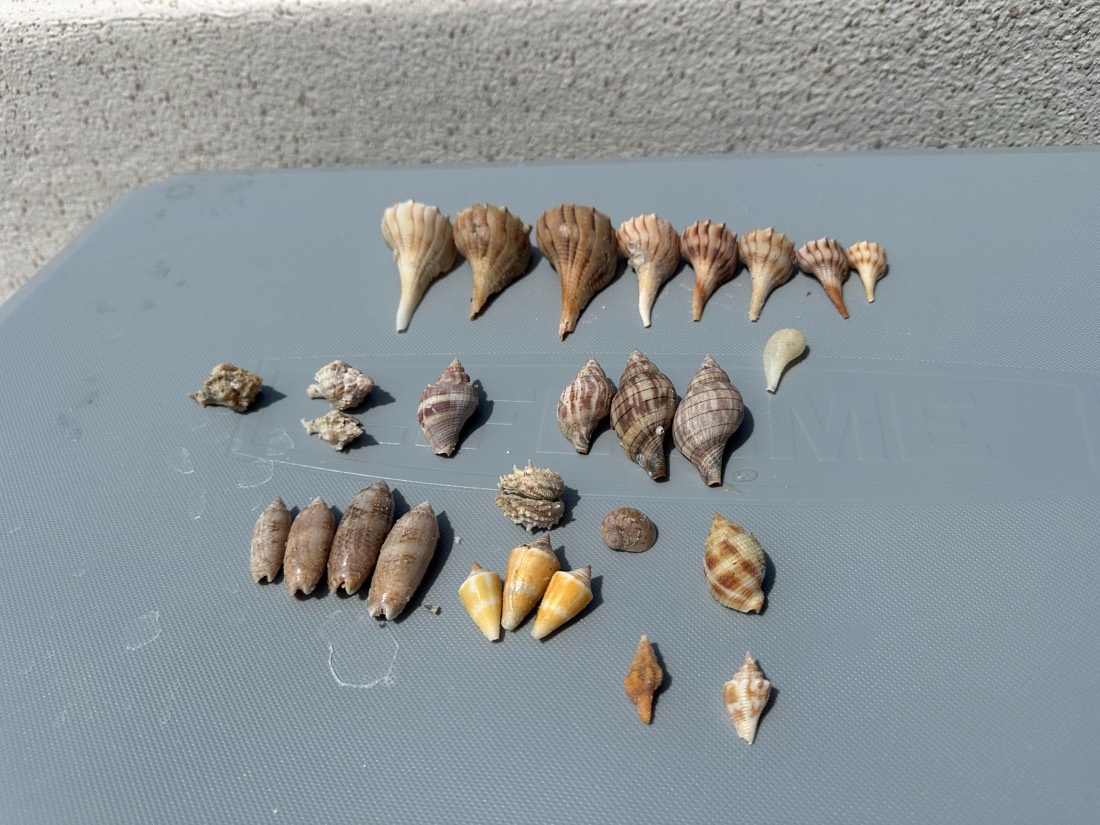
On a single trip you might fill a bag with a dozen species. Here are the shells our captains see most often on the islands, what each looks like, and how common it is on local beaches.
| Shell | Typical size | What it looks like | How common |
|---|---|---|---|
| Florida fighting conch | 2–4 in | Thick, glossy orange-brown shell with a flared, notched lip | Very common |
| Lightning whelk | 3–6 in (up to ~16 in) | Pear-shaped spiral with brown “lightning” streaks; opens on the left | Common |
| Lettered olive | ~2 in | Glossy, polished cylinder with brown letter-like squiggles | Common |
| Banded tulip | 2–4 in | Smooth spindle, gray with fine spiral lines and bluish blotches | Common |
| True tulip | 4–6 in | Larger spindle, green-brown-red blotches, finer spiral lines | Common |
| Alphabet cone | 2–3 in | Cone shape, cream with rows of orange-brown spots like letters | Common |
| Apple murex | 2–5 in | Knobby, frilled rounded shell in tan and brown | Common |
| Calico scallop | up to 3 in | Fan shape with ~20 ribs, mottled purple on cream | Very common |
| Atlantic giant cockle | up to 5–6 in | Big, plump, heart-shaped with 30–40 ribs; pink inside | Common |
| Kitten’s paw | up to 1.5 in | Small triangular bivalve with toe-pad ridges | Common |
| Coquina | 0.5–1 in | Tiny wedge clams in rainbow colors, found in the surf zone | Very common |
| Keyhole sand dollar | ~3 in | Flat disc with five long slots; white when bleached | Common |
| Junonia | 2–4 in | Cream cylinder with neat rows of square brown spots | Rare |
| Horse conch | up to ~24 in | Huge orange spindle; Florida’s state shell | Uncommon |
The rare prizes every sheller wants
The junonia (Scaphella junonia)
The holy grail of Gulf shelling — a cream shell wrapped in neat rows of chocolate-brown spots. It’s rare because the animal lives in deep water (roughly 100 to 425 feet down), so empty shells usually wash ashore only after a strong storm or winter front stirs the Gulf. Find one and you’re the legend of the boat. The remote, boat-only beaches on our Marco Island shelling tours give you the best odds.
The horse conch (Triplofusus giganteus)
Florida’s official state shell and the largest sea snail in American waters — big adults can reach about two feet, with a vivid orange body when alive. You’re most likely to find smaller specimens here; a large empty horse conch is a true trophy.
Alphabet cone & true tulip
Less famous than the junonia but every bit as satisfying to find — boldly patterned and prized by serious collectors.
Sand dollars
Our namesake, and a guest favorite. The local species is the keyhole sand dollar (Mellita quinquiesperforata), named for the five long slots in its disc. Whole ones turn up on the low-tide flats, and your captain will show you how to spot the freshest. (Full guide: finding sand dollars in Naples.)
How to clean and keep your shells
Your captain helps identify everything you find on the spot — half the fun is learning what you’ve got. To keep your finds bright for years:
- Rinse off loose sand and salt under fresh water.
- Soak in a 50/50 water-and-bleach solution for two to four hours to lift grime and odor (shorten or skip for delicate shells and sand dollars).
- Rinse again and air-dry completely in the sun.
- Wipe with a little mineral oil to restore the shine and deepen the colors.
Can you take shells home? The Florida rules
Yes — with one firm rule: collect empty shells only, never a shell with a living animal inside. A few specifics worth knowing:
- In Collier County (Naples and Marco Island), you may take empty shells but not live ones — and that includes live sand dollars and starfish.
- Taking any live shell in Florida requires a saltwater fishing license, and live queen conch may not be taken anywhere in the state.
- Protected areas like the Ten Thousand Islands refuges and state parks can have stricter rules — when in doubt, leave it.
Our captains help everyone collect responsibly, so you go home with treasures and the beach stays alive for the next hunter.
From the Helm: What We Point Out at the Panther Key Wrack Line
The question comes up almost every trip, usually right as we’re idling toward a stretch of beach: what are we going to find today? At a spot like Panther Key, our captains will ease the boat in near dead low tide and point first at the wrack line — that ragged band of debris the last high tide left behind — because that’s where the fresher material collects, not out in the open sand everyone walks past without looking twice.
We hand guests a mesh bag instead of a bucket, and there’s a reason: a bucket fills with water and sand and gets heavy fast, while a mesh bag drains as you walk and lets you feel what you’ve actually picked up. A fresh-dead shell still carries a faint shine and some weight in your hand; a long-tumbled one feels chalky and light by comparison. That’s the difference our captains are teaching guests to feel for, more than any single species name.
What a species list leaves out is how much a single front changes things. A stretch of beach that looked picked over on one visit can turn up a scatter of fresh shells after a cold front pushes through and stirs the bottom, which is part of why our captains keep an eye on the weather as much as the tide chart. We’ll say plainly that a great haul is never guaranteed — some days the wrack line is thin, and that’s just the Gulf being the Gulf.
When the wrack line comes up thin, our captains will often walk guests toward the tide pools at the flat’s edge instead, since a falling tide strands plenty in the shallow pockets between sandbars. It’s not quite the same as bending down at a fresh wrack line, but a good egg case or an olive shell tucked in wet sand still gets guests just as excited, and it keeps the stop from feeling like a letdown on a slower day.
Whatever ends up in the bag, our captains remind guests it has to be an empty shell — nothing living, no sand dollars or starfish still moving, which matters most in these Collier County waters. If you want the fuller rules before you go, our shell collecting rules guide covers it in full. For the trip itself, a shelling tour is really the only practical way to reach beaches like this one, since they’re not connected by road.
The find that gets the loudest reaction at the rail usually isn’t the rarest one — it’s whatever a guest is holding up for the first time, turning it over, asking our captains what it is. That moment, more than any species checklist, is the actual point of the stop.