
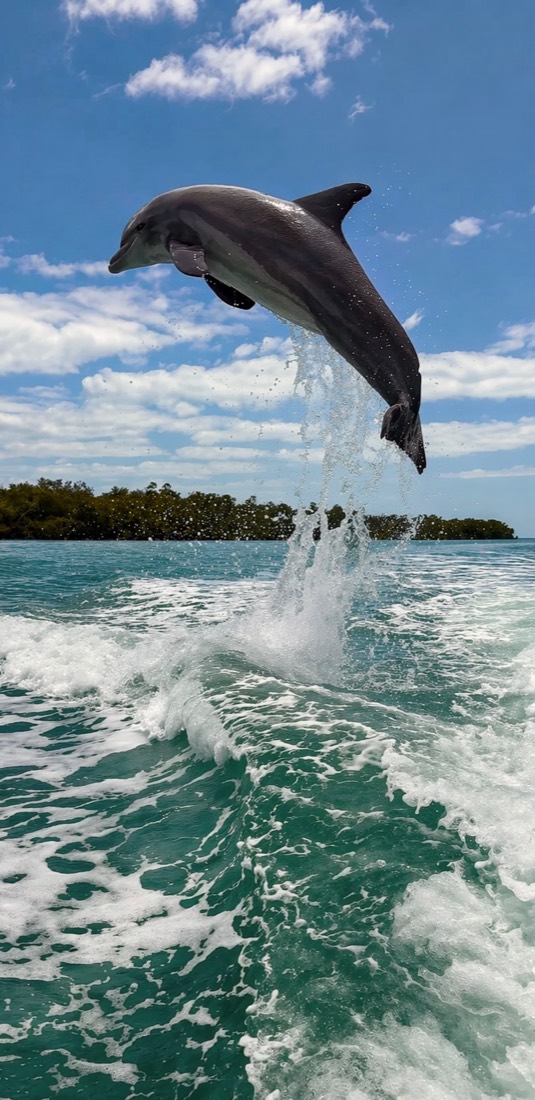
🐬 At a glance
- Species you’ll see here
- Atlantic bottlenose dolphin (Tursiops truncatus)
- Most common jump
- Porpoising — low, fast arcs while swimming
- Why they leap
- Energy-saving travel, bait-herding, play, communication & shaking off parasites
- Best local spots
- Marco River, Gordon Pass & the Ten Thousand Islands backwaters
- When to look
- Year-round — bottlenose dolphins live here all year, no migration required
- Rule of thumb
- Never chase or feed wild dolphins — let them choose to approach
Why do dolphins jump out of the water?
Watch a pod of bottlenose dolphins work the Marco River for more than a few minutes and you’ll see it happen: a low, arcing leap, a full clear-of-the-water breach, a splash right next to the bow. From the deck it looks like one behavior, but it’s really several different ones bundled under the same word. Marine biologists split “jumping” into porpoising (quick, low leaps used while swimming fast), breaching (a full launch clear of the surface, often ending in a twist and a splash), and bow-wake riding (using the pressure wave off a moving boat for an extra lift). Each one has a different job, and on any given afternoon in the Ten Thousand Islands you’re likely to see more than one kind.
None of it is a distress signal, and a jumping dolphin is not a struggling one. A healthy bottlenose dolphin can hold its breath for several minutes and swim in bursts well over 15 miles per hour, so a leap is closer to a deliberate, controlled move than an accident. The real reasons line up with what you’d expect from a fast, social, intelligent predator: efficiency, feeding, communication, and, sometimes, nothing more complicated than fun.
Traveling faster: porpoising to save energy
The jump you’ll see most often isn’t really a jump at all — it’s porpoising, the same low, repeated arc that gave the pig-nosed fish its name. Once a dolphin’s cruising speed gets fast enough, moving briefly through the air actually costs less energy than pushing through water the entire time. Water is roughly 800 times denser than air, so at speed a dolphin that stays fully submerged is fighting drag on every inch of its body with every stroke. By breaking the surface in a shallow arc, it trades a fraction of a second of airtime for a real reduction in resistance, then slices back in nose-first with almost no splash.
You’ll usually catch porpoising when a pod is covering real distance — crossing open water toward Gordon Pass, running down a moving tide line, or catching up with a boat that’s already underway. It’s efficient, not showy: low, quick, and repeated in a straight line, more like a skipping stone than a dramatic leap. If you want the full breakdown of what each surface behavior actually means, our dolphin behavior glossary is worth a look before your trip.
Herding bait fish: leaps over a bait ball
This is the one that gets everybody on deck reaching for their phone. When a school of mullet, pilchards or glass minnows gets pushed into a tight, panicked ball — usually against a shoreline, a sandbar, or right up against the surface — dolphins work it from below, driving the baitfish upward while diving birds hit it from above. In the middle of that chaos, a dolphin will sometimes launch clean out of the water, occasionally with a fish still in its mouth. It isn’t showing off. It’s the fastest way to close on a fish that’s trying to jump clear of the water itself to escape.
The Marco River is one of the more reliable places to run into this. Moving tide pushes bait through the pass, mullet stack up along the mangrove edges, and it doesn’t take much — a diving pelican, a nervous ripple on otherwise flat water — to tip you off that a bait ball is forming nearby. Our captains read those same signs to put you in position, which is a big part of why a dolphin tour through these backwaters tends to produce more sightings, and better ones, than shore-watching ever will.
Play, Communication & Parasites
Not every leap has a practical payoff. Bottlenose dolphins are social, playful animals, and young calves in particular spend real time breaching just to practice the motor skills they’ll need later — timing a launch, controlling a landing, reading the surface as they come down. Adults do it too, especially around other dolphins, and a hard slap-down landing sends a low-frequency thump through the water that can be heard and felt by pod members well out of sight. Some researchers think a breach right next to a boat, or off the bow, is a version of the same signal — a way of saying “we’re here,” whether that’s meant for another dolphin or for you.
There’s also a physical reason. Dolphins pick up hitchhikers — remoras, barnacles, small parasites clinging to the skin — and a hard breach followed by a slapping landing can help knock some of it loose. It’s routine maintenance more than a spectacle, even though it looks spectacular from the rail. Between the play, the signaling and the upkeep, a good share of the jumps you’ll see on any given trip aren’t about food or travel at all. They’re just what a smart, social animal does with a burst of extra energy.
| What you’ll see | What it looks like | Most likely reason |
|---|---|---|
| Porpoising | Low, quick arcs, repeated in a line, barely airborne | Saves energy while swimming fast |
| Full breach | Clears the water entirely, often twists, lands with a splash | Play, communication, or shaking off parasites |
| Bait-ball leap | Sudden jump out of a churning patch of baitfish and diving birds | Herding & feeding on corralled fish |
| Bow-wake ride | Riding the pressure wave off the bow, sometimes launching clear | Play and an easy, low-effort ride |
Where & When to See It Near Marco Island
Because Atlantic bottlenose dolphins live in these waters year-round, you don’t need a particular season to see one jump — you need to be on the water when a pod is actively hunting, traveling, or riding a wake. The Marco River, Gordon Pass, and the mangrove backwaters of the Ten Thousand Islands see dolphin activity in every month of the year, though a moving tide tends to trigger more bait-herding leaps than dead-slack water does. Dolphins also love to ride the pressure wave off a moving hull, which is its own kind of jump worth knowing about — we cover the mechanics of it in why dolphins bow-ride.
A boat gives you a real edge over shore-watching, both because you can follow a pod that’s on the move and because our captains already know which passes and mangrove edges tend to hold bait on a given tide. A dolphin tour is built around exactly this kind of sighting, and it’s common to watch several different kinds of jumps — porpoising on the run out, a breach or two mid-trip, bow-riding on the way back in — in a single afternoon. If you’re curious about dolphin behavior beyond the jumping itself, our Travel Guide covers related questions too, including whether dolphins ever really stop moving to sleep.