
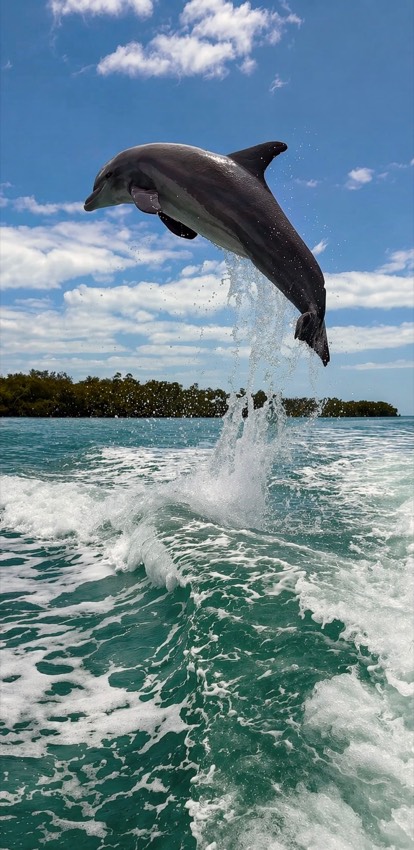
🐬 At a glance
- Most common on a tour
- Relaxed surfacing, logging, porpoising
- Lucky to catch
- Full breaches and high leaps
- What they mean
- Travel, rest, looking around, signaling or play
- Where
- Calm bays & passes near Naples & Marco Island
- Wild?
- Yes — every behavior is self-directed, never cued
The moves, decoded
Here's your field glossary. None of these are tricks — they're natural behaviors of wild bottlenose dolphins, and the meaning we list is the most likely read, since a dolphin won't tell you for sure.
- Breach — the showstopper: the dolphin launches its whole body clear of the water and crashes back down. May signal, dislodge parasites, or just be play.
- Porpoising — fast, low, repeated arcing leaps while traveling at speed, which is actually more efficient than plowing through the surface.
- Spy-hop — the dolphin rises straight up, holding its head above water to look around. Curiosity and scanning.
- Logging — floating motionless at the surface like a log, resting. Look for a still gray back that isn't going anywhere.
- Tail-slap (lobtailing) — smacking the tail flat on the water, often a signal or a sign of irritation or excitement.
- Bow-riding — surfing the wave off the boat's bow for a free push, which gets its own deep dive in why dolphins bow-ride.
What you'll actually see on a calm bay
Honesty time: most of a dolphin encounter is calmer than the highlight reels. On the sheltered water of Naples Bay and the passes, the bread-and-butter sights are relaxed surfacing in sets, logging dolphins resting, gentle porpoising as a pod travels, and the occasional bow-ride. Big aerial breaches do happen — and they're unforgettable — but they're the bonus, not the baseline. Set your expectations there and every trip over-delivers.
| Behavior | Likely meaning | How often on a tour |
|---|---|---|
| Relaxed surfacing | Breathing while traveling | Very common |
| Logging | Resting | Common |
| Porpoising | Traveling fast | Common |
| Spy-hop | Looking around | Occasional |
| Tail-slap | Signaling / excitement | Occasional |
| Full breach | Signal or play | Lucky bonus |
Why knowing the moves makes the trip
When you can name what you're watching, a pod stops being “some dolphins” and becomes a story you can follow — that one's resting, those two are traveling, here comes a curious one for a spy-hop. It's also how you spot the subtle stuff, like a mother steering a calf in echelon, or read a feeding pod working bait the way our feeding guide describes. Our captains will call the moves with you the whole way on a dolphin & wildlife tour.
From the Helm: Calling porpoising, logging and spy-hopping from the rail off Capri Pass
Once guests learn the difference between a dolphin that’s traveling and one that’s resting, they start calling out behaviors before we can — and that’s really the goal. On a calm morning drifting off the mouth of Capri Pass, we’ll often idle down next to a pod doing nothing more dramatic than logging: floating motionless at the surface, barely a ripple, catching a break between feeding runs. It’s the least flashy behavior on the list and also the one guests are most likely to actually see, so we point it out first.
Porpoising looks completely different and it’s easy to spot from a distance: a string of low, fast arcing leaps as a pod covers ground in a hurry, usually headed somewhere with purpose rather than lingering to play. We’ll cut our own speed to match rather than chase alongside, since running parallel at their pace tends to hold a pod’s attention longer than trying to close the gap. Most of what you’ll see on a calm-water morning off the pass falls into logging or easy, unhurried porpoising rather than anything more acrobatic.
Spy-hopping — a dolphin rising vertically, head up, to look around above the surface — and a full tail-slap are rarer, and we’re honest with guests that we can’t schedule either one. When it does happen, it’s almost always a single animal doing it once, not a show, and it’s over in a second or two, so we tell people to keep their eyes up and their phone ready rather than looking down to check a screen between behaviors. A tail-slap in particular carries — the crack of it hitting flat water reaches the boat before the splash does, which is usually what turns every head at once.
We’re careful never to promise a specific behavior before we’ve left the dock, since a pod that’s logging one morning might be porpoising hard the next, depending on what they’re doing when we find them. What we can promise is that knowing the vocabulary beforehand turns a vague “look, dolphins” into something guests can actually describe afterward — and that shift, more than any single behavior, is usually what people tell us they didn’t expect going in.
Knowing the moves ahead of time changes what a trip feels like at the rail — instead of just seeing a dolphin, you’re watching a specific decision the animal is making, whether that’s resting, traveling or checking out the boat. We walk through all of this again once you’re aboard one of our dolphin tours, but guests who’ve read up beforehand tend to be the first ones calling out logging or porpoising before we’ve even said a word.