
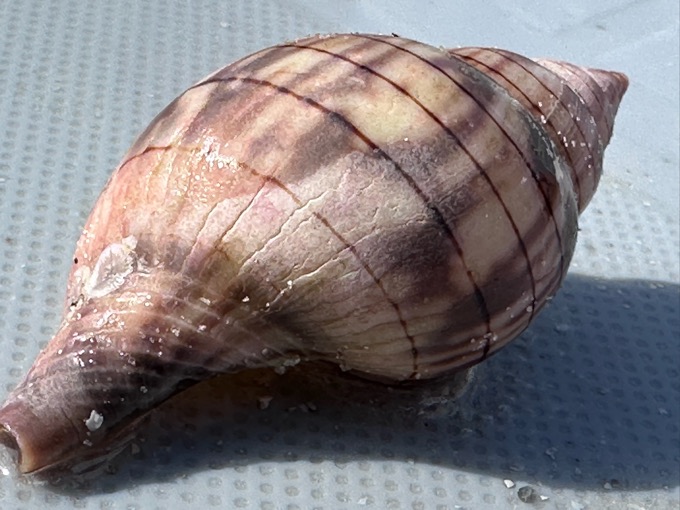
🐚 At a glance
- Scientific name
- Cinctura hunteria
- Size
- Usually under 3 in — smaller than the true tulip
- Tell-tale
- Clean thin dark spiral lines, not broken streaks
- Where & when
- Seagrass-flat wrack lines of the boat-only islands; low tide
- Rule
- Empty shells only in Collier & Lee
How to identify a banded tulip
Start with size and surface: the banded tulip is smaller and noticeably smoother than its big cousin, with a high natural polish. The base color is soft — pale pinkish-gray, cream or tan — and across it run thin, dark, evenly spaced spiral lines, like fine pinstripes circling the shell from spire to tip. There's none of the smudgy, broken coloring you see on a true tulip; the bands stay crisp and orderly. That tidiness is the whole signature.
Like the true tulip, it has the classic tulip spindle shape that tapers to a point at both ends, so the shape alone won't tell the two apart — the markings do.
Banded tulip vs. true tulip (the decisive split)
This is the call every sheller wants nailed down, and the banded tulip makes it easy: clean lines plus small size equals banded. Here's the side-by-side.
| Feature | Banded tulip | True tulip |
|---|---|---|
| Markings | Clean thin dark spiral lines | Broken, smudged streaks |
| Size | Usually under 3 in | Larger (3–6+ in) |
| Surface | Smooth, high polish | Glossy with spiral threads |
For the full breakdown with the borderline cases, see our true vs. banded tulip guide.
Where we find them
Banded tulips are a regular along the seagrass-flat wrack lines of the boat-only barrier islands, and they tend to come ashore whole and bright. On our shelling tours we walk the fresh wrack at low tide on islands like Keewaydin and out through the Ten Thousand Islands, where the pickings haven't been beaten flat by foot traffic. They clean up gorgeous — see our shell-cleaning guide — and remember Collier County is empty-shells-only, so confirm the shell's vacant before it goes in the bag.
From the Helm: The tide line inside Gullivan Bay where banded tulips collect after a front
A guest at the rail asked us once why we head into the calm water behind the islands instead of the open Gulf beach for tulips, and the honest answer is that these shells live right on the grass flats tucked inside Gullivan Bay, not out where the surf pounds. So instead of a beach walk, this stop is a slow drift along the tide line where a falling tide has just pulled back off the grass, leaving a thin ribbon of shell debris stranded right at the edge.
We time it for a couple hours after a front has pushed through and the wind has swung around to the north, since that’s when the bay pushes extra material up onto the grass edges rather than leaving it settled on the bottom out of reach. A dead-calm week without any wind behind it tends to leave this particular tide line thin and disappointing by comparison, so we watch the forecast a few days out before committing a trip to this stop.
Working the line itself is more of a crouch-and-scan than a wide walk — we’re moving a few feet at a time along the debris ribbon, letting eyes adjust to the mix of grass blades, small shell hash, and the occasional whole spindle shell sitting right on top. It rewards a narrow, careful search over covering distance, which surprises guests used to the open-beach pace of other stops. We’ll often kneel right down at the line rather than stay bent over it, since that low angle catches the glossy curve of a shell against duller grass far better than looking down from standing height.
A shell picked straight off the tide line that morning still has a bit of sheen and sometimes a faint trace of the grass smell clinging to it, while one that’s been tumbling around the bay longer turns duller and picks up a light chalky feel along the spire. We hand guests both kinds side by side when we can, since feeling the difference in two shells at once teaches it faster than any description does. A rinse in a little seawater in your palm brings that sheen right back out if the sun’s washing it out on the spot.
When the wind hasn’t swung the way we want and the tide line looks bare, we shift the group toward a different grass-flat pocket a short run away rather than force a thin stretch — the bay has more than one edge worth checking. It’s a quiet, close-in stop we build into our shelling tours for guests who want the hunt without the open-water walk, and a nice one to compare against the rest of our seashell guide afterward.