
🐚 At a glance
- Family
- Echinoderms — cousins of sand dollars & sea stars
- Sea biscuit
- Rounded, domed test with a five-petal pattern
- Sea urchin
- Round spiny shell; usually found as a bare test + loose spines
- Where & when
- Outer island flats & wrack lines, best after a blow stirs the bottom
- Rule
- Empty bleached tests only — live ones are protected
How to identify a sea biscuit and an urchin
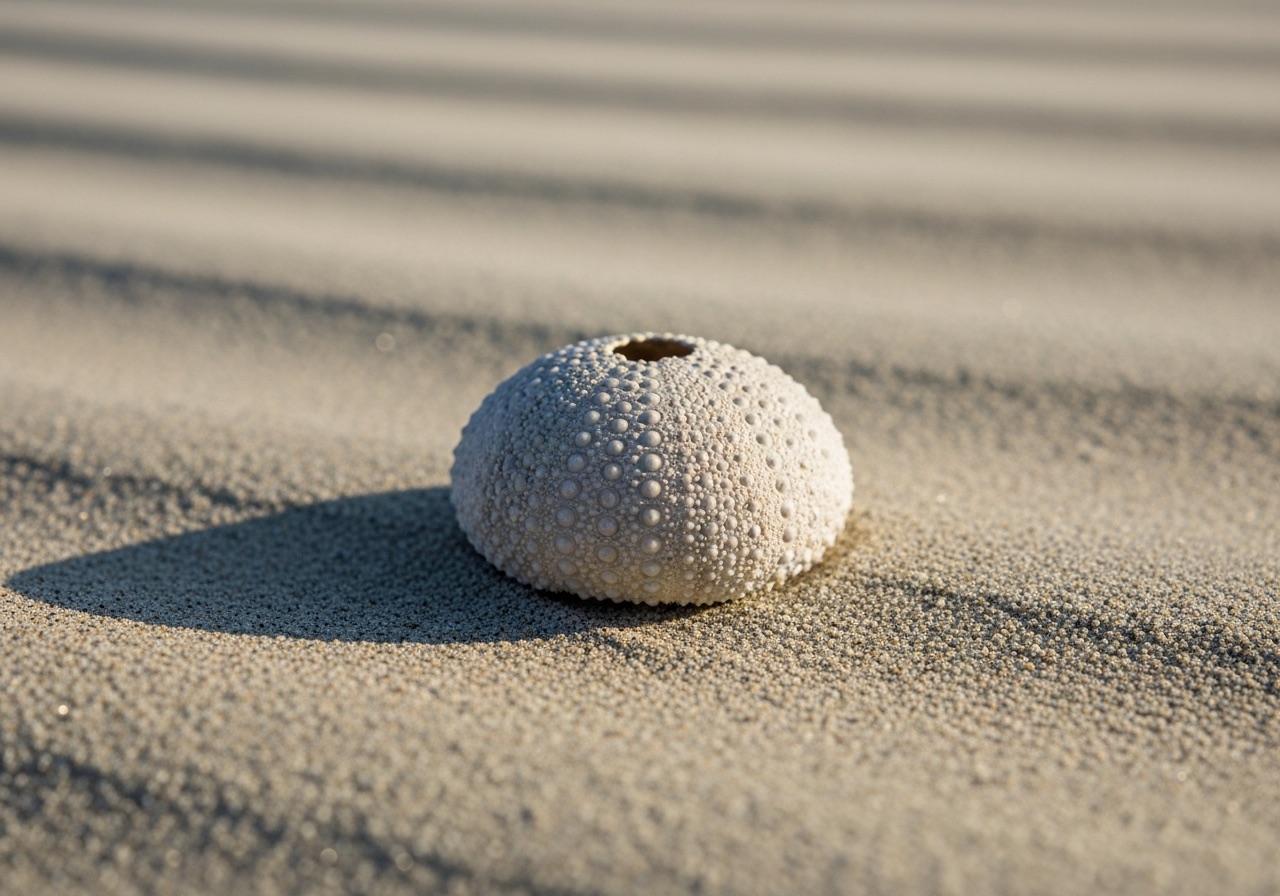
A sea biscuit looks like a sand dollar that decided to puff up. Where a keyhole sand dollar is flat with slots through it, a sea biscuit is a solid little dome — usually an inch or two across, pale tan to white, with that same faint five-petal flower etched on top from its breathing pores. They feel light and chalky, and a whole one is a genuinely lucky find because the dome cracks easily.
A sea urchin is the spiky one. Alive, it’s a pincushion of moving spines. By the time it reaches the beach you’re usually looking at the bare round test — greenish, purplish or white, covered in neat rows of little bumps where the spines attached — plus a scatter of the loose spines themselves nearby.
Telling the cousins apart
It’s an easy family once you see them side by side. They’re all echinoderms, the same group as the sea stars you’ll also find out here.
| Find | Shape | Quick tell |
|---|---|---|
| Sand dollar | Flat disc | Five slots through it; five-petal top |
| Sea biscuit | Rounded dome | Puffy “loaf,” five-petal top, no slots |
| Sea urchin | Round ball | Bumpy test + loose spines nearby |
Where we find them
Sea biscuits and urchins live on the sandy and grassy bottoms just offshore, so their tests come ashore on the wilder outer beaches after weather stirs the bottom — the kind of post-front shelling that brings up the good stuff. We find them on the boat-only flats around Cape Romano and the Ten Thousand Islands, where the beaches don’t get picked over. Our shelling tours run to exactly those spots. Bag only the empty bleached tests — a live urchin or biscuit stays in the Gulf, since Collier & Lee are empty-only.
From the Helm: Sea Biscuits & Urchins: the shoal edge off Caxambas Pass on a falling tide
Guests usually notice the domed shape before they know what it is — someone at the rail turning over what looks like a fat, rounded sand dollar and asking why it’s puffy instead of flat. That’s almost always a sea biscuit, and the shoal edge off Caxambas Pass, where the bottom shelves up sharply as the tide falls, is where our captains find the best mix of these and the spinier sea urchin tests. We ease in close on the last stretch of a falling tide, when the shoal’s shallow enough to wade but hasn’t fully dried out yet.
The domed sea biscuit test holds together better than the flatter sand dollar version, so guests can pick up a whole one more often than not, faint five-petal pattern still visible across the top even when the color’s bleached to bone white. Urchin tests are a different story — thinner, rounder, and usually cracked, with loose spines scattered separately in the same patch rather than still attached. We tell guests not to expect a perfect spiny ball; a bare green or white test with a scatter of loose spines nearby is the realistic, honest version of an urchin find here.
We work this shoal edge specifically rather than the open beach past it, since current sorts the heavier, rounder tests into that narrow band the same way it sorts gravel elsewhere. If the shoal’s still too deep on approach, which happens on a slower-than-usual tide, we’ll idle a few extra minutes rather than land guests in knee-deep water for a rushed look. That patience usually turns a marginal stop into a good one once the sand actually clears the surface.
Every test that comes up gets the same check before it goes in a bag: is it empty, is it dead, does it still have anything living inside. Collier County protects the live version of every echinoderm on this list, sea biscuits and urchins included, so we only ever keep the bleached, hollow ones. Guests wanting to compare these against the site’s other echinoderm finds can check the keyhole sand dollar page, and we typically work this shoal into the same shelling tour stop as the biscuit hunt above rather than a separate trip.
The shoal edge rewards a slow, careful walk more than a fast one, since both the biscuits and the urchin tests sit low and pale against sand that’s still wet and reflective right after the tide drops. Guests who crouch and scan close to the surface, rather than scanning from standing height, tend to spot twice as many. We’d rather spend the extra ten minutes here than rush toward the next stop, since this particular shoal doesn’t give up its finds to anyone moving quickly across it.