
🐚 At a glance
- Scientific name
- Mellita quinquiesperforata
- Size
- Usually 1–3 in across, occasionally larger
- Tell-tale
- Five long “keyhole” slots and a five-petal flower on top
- Alive vs. dead
- Purple & fuzzy = alive; clean white = empty test
- Rule
- White tests only — never take a live sand dollar in Collier & Lee
How to identify a keyhole sand dollar
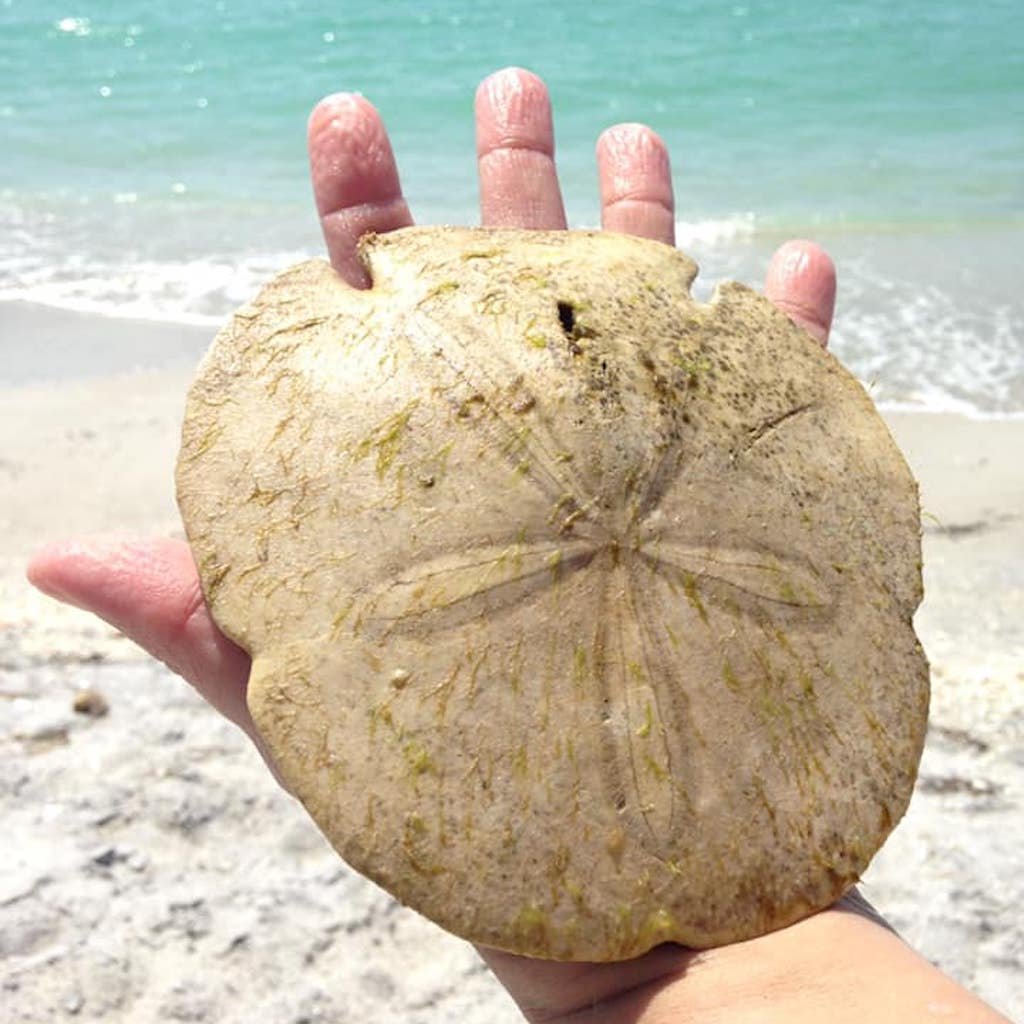
Flip one over in your palm and the ID is easy. A keyhole sand dollar is a flat, thin disc with five elongated slots (the “keyholes”) cut right through the body — that’s what separates our local species from the closed-disc sand dollars you see in gift shops. On the top side you’ll see a delicate five-petal flower pattern, the breathing pores of the animal that lived inside. The whole thing is surprisingly fragile, so the perfect unbroken ones are the trophies.
It’s a relative of the puffy sea biscuit and sea urchin — all of them are echinoderms, the same family as sea stars. The sand dollar just flattened itself out to burrow under the sand.
Alive, or just an empty test?
This is the part that matters most, because it decides whether you can legally take it. A living sand dollar is dark purple, gray or brown, and covered in thousands of tiny fuzzy spines that actually move — set one on your hand and you can sometimes feel it. A dead one has lost all that, sun-bleaching to a chalky white skeleton we call a test. The simple rule we give every guest: if it has any color or any fuzz, it’s alive, so it goes right back in the water.
| Sign | Alive (leave it) | Empty test (keeper) |
|---|---|---|
| Color | Purple, gray or brown | Bleached white |
| Surface | Velvety, fuzzy spines | Smooth, bare skeleton |
| Movement | Tiny spines wiggle | None |
| Smell | Briny, organic | None |
Where we find them
Keyhole sand dollars live just under the sand on calm, shallow Gulf flats, so the best white tests wash up on the low-energy beaches of the boat-only barrier islands — Keewaydin, Kice and the bars of the Ten Thousand Islands. Low tide after a calm spell is prime, when the wide flats are exposed and the fragile tests haven’t been crushed by surf or foot traffic. Our shelling tours run straight to those sandbars. And remember — Collier & Lee are empty-shells-only, so a live purple sand dollar always goes home to the Gulf.
From the Helm: Keyhole Sand Dollars: the falling-tide sandbar at Tigertail’s Sand Dollar Island
The first keyhole sand dollar of a stop is almost always spotted from a few feet up, someone at the rail catching a flash of pale white or purple-brown against the darker sand before the boat’s even stopped. We aim for the shallow sandbar off Tigertail Beach, on Marco Island’s bay side, that locals call Sand Dollar Island for exactly this reason — it only fully bares itself on a good falling tide, and a foot less water can be the difference between a wide, walkable flat and a bar still under a few inches of Gulf.
We time the stop to the last hour or two of that falling tide rather than dead low itself, since the sand is still damp and easy to sort through then, before the sun bakes the surface into a crust that hides everything just under it. Our captains walk guests out slowly, eyes down, scanning for the round outline and the five-petal pattern rather than color alone, since a buried live one shows barely more than its outline through a skim of wet sand. That’s the moment we ask everyone to pause and look before stepping — a live one deserves a wide berth.
In the hand, the difference between a live keyhole urchin and an empty test is immediate: living ones are heavier, faintly fuzzy with short moving spines, and colored a deep purple-brown, while a true test is bone-white, bone-light, and rigid enough to hold up in a pocket without cracking. Freshly bleached ones still show a faint tan tint at the edges; ones that have tumbled through a season or two go chalky and paper-thin. We only ever bag the second kind, and we say so plainly before anyone’s hands are in the sand.
If the bar’s still submerged when we arrive — wind or a stronger-than-average tide can do that — we hold offshore a few minutes rather than push people onto wet sand for a rushed look. That patience usually pays off within the hour. For the fuller shell picture around this same sandbar, browse the Seashell Guide for everything else sharing this flat, and this stop works best folded into a shelling tour built around Marco Island’s bay-side flats rather than the open Gulf beaches.
We keep the group moving in a loose line across the bar instead of clustering in one spot, since keyhole urchins spread themselves thin across sand rather than pile up the way some shells do. A patient walker who covers more open ground usually does better than someone standing still in one promising-looking patch. It’s a small habit, but it’s the one that turns a quiet first ten minutes into a bar full of pale discs held up for a look before going right back to the honest, empty ones.