
🐚 At a glance
- Scientific name
- Melongena corona
- Size
- Commonly 2–4 in; some reach 5 in
- Tell-tale
- Ring of blunt spines on the shoulder; dark spiral banding
- Where & when
- Mangrove & oyster estuaries of the Ten Thousand Islands & Goodland
- Rule
- Empty shells only — live collection banned in Collier & Lee
How to identify a crown conch
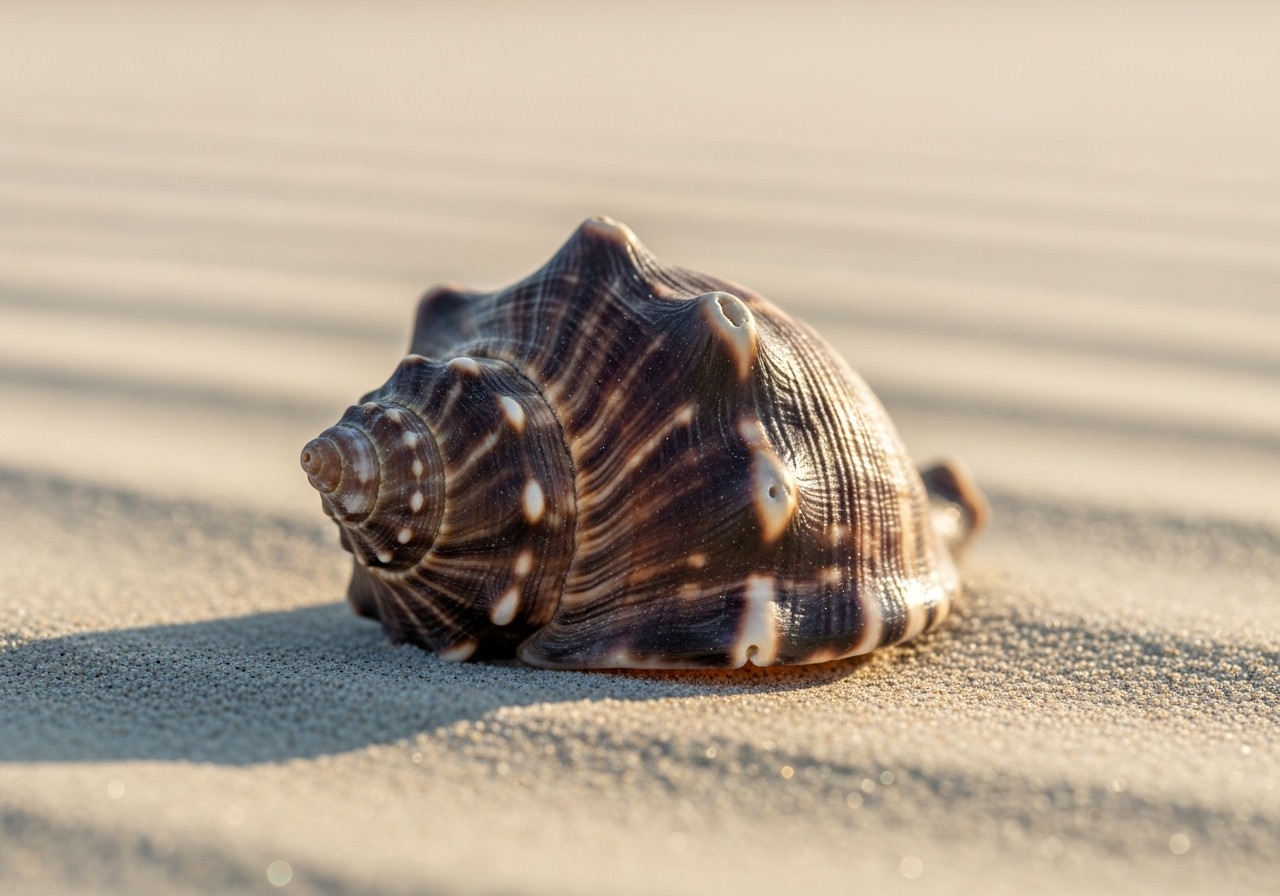
Look at the shoulder first. A crown conch carries one or two rows of short, blunt spines circling the widest part of the shell — not the long, sharp spikes of a murex, but stubby little points, like a kid's drawing of a crown. The body is a chunky, heavy shell wrapped in dark brown and cream spiral bands, with a fairly tall spire and a smooth, glossy aperture inside. Young shells often show the boldest banding; older ones can wear gray and chalky.
Despite the name, it's no relation to the queen conch and only a distant cousin of our Florida fighting conch. It's actually a predatory snail that hunts oysters and clams on the bars where it lives — which is exactly why you find it where you do.
Where we find them
This is an estuary shell, through and through. You won't comb the open Gulf sand and turn up a crown conch the way you would a whelk — they live in the brackish maze of mangrove creeks, oyster bars and mud flats behind the islands. On the backwater stretches of the Ten Thousand Islands and around the Goodland waterways, empty crown conchs collect along the wrack and tucked against oyster rakes. Our shelling tours run into that backcountry where the Gulf-beach crowds never reach. Live ones are common back there, so check before you pocket anything — Collier County is empty-shells-only.
Crown conch vs. look-alikes
The crown throws people off because a few other Gulf shells carry shoulder knobs too. Here's how the crown sorts out from the usual mix-ups.
| Shell | Shoulder | Quick tell |
|---|---|---|
| Crown conch | Ring of blunt spines | Dark spiral banding, estuary habitat |
| Florida fighting conch | Low knobs, flared lip | Heavy orange-brown, open Gulf flats |
| Lightning whelk | Small knobs, no spines | Left-handed opening, much larger |
Once the crown of spines and the banded body click together, this one's unmistakable — and a real signature of our backwater shelling.
From the Helm: Timing the Oyster Bars Near Dismal Key for Crown Conchs at Dead Low
We deliberately time crown conch stops for dead low tide, because that’s the only window the oyster bars near Dismal Key actually stand clear of water. Wind barely factors into this decision the way it does out on the open Gulf beaches — these backwaters stay protected either way — so tide is really the only variable we’re watching before we call this stop into the day’s run. Show up even an hour off dead low and half the bar you wanted to walk is still under a foot of water.
Getting the boat close enough matters as much as the tide does. We’ll pole or use the trolling motor for the last stretch rather than run the outboard, since prop wash over water this shallow can stir bottom mud fast enough to cloud the whole bar before anyone’s stepped off. A quiet approach also means we’re less likely to spook whatever’s already working the bar when we arrive, so the first live conch sighting often happens before the anchor’s even down.
Footing matters more here than at any shelling stop we run. Oyster clusters are sharp enough to open a bare foot in a hurry, so we hand out water shoes before anyone steps off the boat and we walk the bar ourselves first to find the firmer mud paths between clusters. It slows the stop down by a few minutes, but it’s the difference between guests exploring freely and guests white-knuckling every step across broken shell.
As we idle along the bar’s edge, we’ll often spot a live crown conch wedged into an oyster clump, working on its next meal — these are predatory snails, and watching one at work is part of the stop even before anyone finds an empty shell of their own. A fresh-dead crown still carries mud-dark color and a sharp, intact ring of spines around the shoulder; the ones sitting higher and drier on the bank have gone chalky and smooth-shouldered from months of sun instead.
If the bar we planned on is still too wet at our arrival time, we’ll shift the stop to a similar mud flat a short run further into the backwater, since crown conchs work the same oyster-and-mud habitat all through this stretch of the Ten Thousand Islands rather than favoring one exact bar over another.
Crown conch stops usually attach to a broader shelling tour or a quieter private charter route through the backwaters, since the pace here runs slower and more exploratory than a beach walk. It’s a favorite add-on for guests who’d rather wade a mud flat than lie out on open sand.
| What you see | What it means |
|---|---|
| Mud-dark shell wedged in a live oyster clump | Likely still occupied — leave it in place |
| Bleached, smooth-shouldered shell high on the bank | Long-empty and safe to take, Collier County empty-only rule |
| Fresh mud color with sharp spines | A recently vacated shell, our best fresh-dead find |