
🐚 At a glance
- Scientific name
- Busycon sinistrum
- Size
- Commonly 4–12 in; big ones reach 16 in
- Tell-tale
- Sinistral — spire up, the opening is on the LEFT
- Where & when
- Keewaydin, Kice & Cape Romano; best at low tide after a winter front
- Rule
- Empty shells only — live collection is banned in Collier & Lee
How to identify a lightning whelk
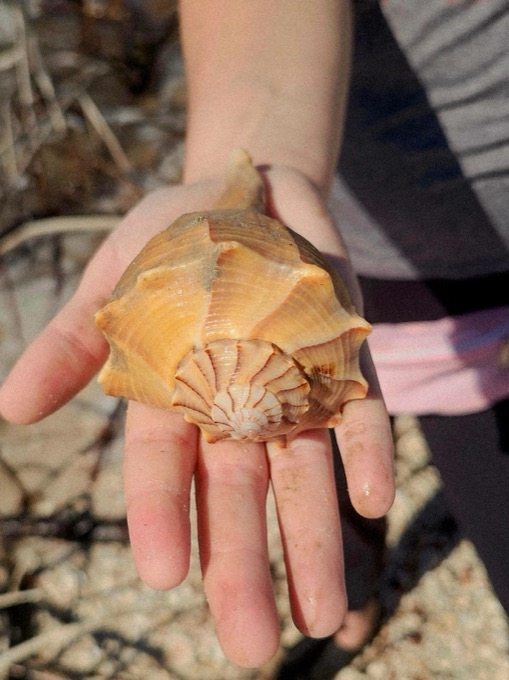
Start with the shape: a lightning whelk is a stout, pear-shaped shell with a low spire on top, a row of small knobs at the shoulder, and a long straight canal at the bottom. Young shells wear thin brown-purple streaks that fan down the body like little lightning bolts — that's where the name comes from. As they age the streaks fade and the shell turns a clean grayish-white, often with an orange-tinted opening inside.
It's easy to confuse with its cousin the knobbed whelk, so most shellers go straight to the one test that never fails.
The left-handed trick that settles it
Here's the move every local makes without thinking: hold the shell with the pointed spire up and the opening facing you. If the opening (the aperture) is on the left, it's a lightning whelk. If it's on the right, it's a knobbed whelk or another right-handed snail. Almost all sea snails are right-handed, so a left-handed shell is a genuine little oddity — and once you've felt it, you'll never forget it.
| Shell | Opens on the… | Quick tell |
|---|---|---|
| Lightning whelk | Left (sinistral) | Knobbed shoulder, lightning streaks when young |
| Knobbed whelk | Right (dextral) | Taller knobs, no streaks |
| Florida fighting conch | Right | Heavier, flared lip, orange-brown |
Where we find them
Lightning whelks like the wide, sandy Gulf-facing flats of the barrier islands, and the best ones turn up on beaches you can't drive to. On our shelling tours we run to Keewaydin Island, Kice Island and the Ten Thousand Islands, where the tide restocks the sand faster than anyone can pick it clean. The hauls jump after a winter cold front pushes fresh shells ashore, and we always time trips to low tide, when the most beach — and the most whelks — are exposed. Found a whole, empty one? That's a keeper. Just make sure nothing's living inside, because Collier County is empty-shells-only.
From the Helm: Working the bay-side flats behind Cape Romano Shoals for lightning whelks
A guest who’s read up on lightning whelks usually pictures a wild Gulf beach after a storm, so it surprises people when we cut the engine on the quiet bay side instead. Behind Cape Romano Shoals, the ocean swell drops away and the water goes glassy over a wide sand-and-mud flat — and that flat, not the pounding surf side, is where our captains actually expect to find a whelk still on the move. Wind and wave matter less here than the flat simply being calm enough to see a track in the mud.
Lightning whelks hunt bivalves buried in soft bottom, and the sheltered bay side holds far more of that undisturbed sand than the wave-scoured Gulf beach ever does. So while everyone else walks the ocean side hoping a shell appears in the surf, we’re working skinny water on the bay side, eyes down for a low ridge in the mud with a shell sitting at the head of it. It’s a quieter, slower kind of hunting, closer to sight-fishing than beachcombing.
A whelk that’s just died still shows some sheen inside the aperture and a body whorl that hasn’t chalked over, the brown streaking crisp instead of bleached out. One that’s tumbled around the flat for a season goes matte gray all over, and the spire tends to wear down first, so the shell feels lighter and rougher in the hand than a fresher one of the same size. We let guests weigh both against each other when we’ve got them, since the difference is easier felt than described.
If the bay flat isn’t showing anything — wrong stage of tide, or the water’s stirred up from chop — we’d rather pole quietly along the grass edge than gun the motor to another spot and spook whatever’s left. A push pole keeps the boat silent enough that a whelk working the shallows doesn’t bury itself before we get close, which a running outboard will do to it every single time.
It’s the shell most people book with us hoping to find, and the left-or-right comparison we run alongside it on a shelling tour is worth doing even if you only turn up one. Either way it comes home the same way it left the water — empty, and exactly as we found it.
Winter cold fronts push extra water off that bay flat as they pass, which drops the level a few extra inches and exposes more sand than an ordinary tide alone would manage. In summer we lean on the same falling stage but time it around the afternoon sea breeze instead, working the flat before the wind kicks the surface into chop. Either season, we’re chasing calm, shallow water over that flat — not a particular month on the calendar.