
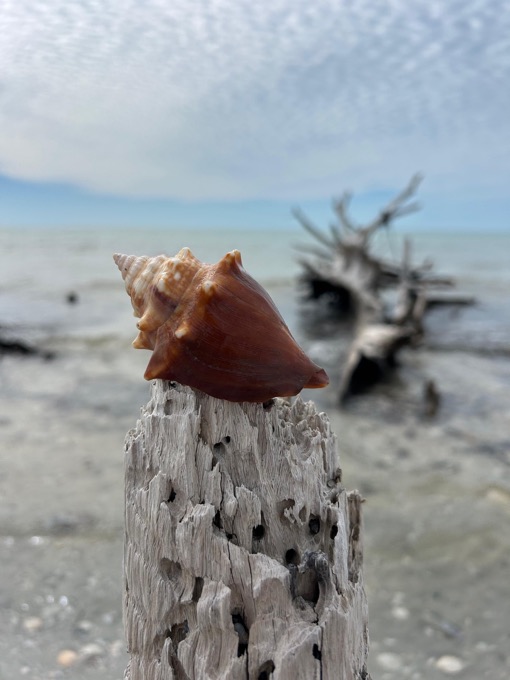
🐚 At a glance
- Scientific name
- Strombus alatus
- Size
- Commonly 2–4 in — heavy for its size
- Tell-tale
- Orange-brown, flared lip, pointed spire
- Where & when
- Keewaydin, Kice & the Ten Thousand Islands; low tide after a front
- Rule
- Empty shells only — live collection is banned in Collier & Lee
How to identify a Florida fighting conch
Pick one up and the first thing you notice is the weight — it’s a dense, solid little shell. The color is the giveaway: warm orange-brown, sometimes with darker streaks or a near-black interior, and the wide outer lip flares out and gently lobes near the front. The spire is short and pointed with low knobs at the shoulder. Live ones have a sharp, claw-like operculum (a trap door) they use to flip themselves along. It’s a true conch, unlike the so-called horse conch, which is actually a giant predatory snail.
Why it's called the 'fighting' conch
Don’t worry, they’re not aggressive. The name comes from the way the animal moves: it has a strong, muscular foot tipped with that sickle-shaped operculum, and it uses it to vault and leap across the sand rather than glide like most snails. Watch a live one in the shallows and it looks like it’s pole-vaulting. Early naturalists thought the jerky, lunging motion looked like fighting, and the name stuck. It’s one of the fun facts our captains love sharing on the water.
| Shell | Size | Quick tell |
|---|---|---|
| Florida fighting conch | 2–4 in | Heavy, orange-brown, flared lip |
| Horse conch | Up to 24 in | Giant spindle; orange aperture |
| Lightning whelk | 4–16 in | Opens LEFT; knobbed shoulder |
Where we find them
Fighting conchs are everywhere on the sandy Gulf flats — they’re one of the most abundant shells down here — and the cleanest, freshest ones wash onto the boat-only barrier islands. On our shelling tours we run to Keewaydin Island, Kice Island and the Ten Thousand Islands, working the wrack at low tide after a winter front. Because they’re so common, beginners and kids usually fill their first bag with these. One catch worth watching: live fighting conchs are abundant in the shallows, so check carefully — if the animal or its trap-door foot is inside, it’s alive, and Collier County is empty-shells-only.
From the Helm: Bagging fighting conchs off Keewaydin’s outside bar on a falling tide
The first fighting conch of a trip almost always gets the same reaction: someone picks up what feels like a genuinely heavy shell, turns it over, and asks if something’s still living inside. We tell them straight — check the flared lip and the operculum, that little trapdoor, and if it’s empty and dry to the touch, it’s fair game to keep. That moment at the rail, weighing a shell in your palm for the first time, is usually what convinces a first-timer that shelling isn’t just picking up broken bits — some of what washes up out here is basically intact.
We run most fighting-conch mornings off Keewaydin’s outside bar, in the last couple of hours of a falling tide, because that’s when the sandbar itself starts to show and the shells sitting in six inches of water become walkable. It’s a different stretch than the swash line most people picture — we’re working the exposed bar itself, not just the wet sand at the waterline, and that’s where the bagfuls tend to be. If a stiff onshore wind keeps that bar submerged longer than the tide chart says it should, we’ll idle a little further down the island to a stretch that clears earlier rather than stand around waiting on water that isn’t dropping.
A fresh fighting conch still carries a faint orange-brown blush on the outer lip and a bit of grit or algae film that hasn’t weathered off yet. Leave one in the sun a season and that lip fades toward bone-white while the surface goes matte and chalky — still a good keeper, just an older one. We’ll hold up a fresh one next to a sun-bleached one so guests can see the color drop-off themselves, because once you know the tell, you start spotting the freshest ones in a pile from three feet away.
Because this is the most common conch on our beaches, it’s also the one we use to teach the empty-shell check before anyone’s eyes glaze over from a longer safety talk. Collier and Lee County require empty shells only, and a fighting conch is the easiest species to practice that check on since they’re everywhere and the tell is simple. Get comfortable with it here and you’ll do the same check automatically on rarer finds later in the day. We’ll also flag any shell that pulls back sharply when tapped — still alive despite looking abandoned on the sand — so guests see firsthand why the empty-shell rule matters beyond just the letter of the law.
If you want a beach where bagfuls are close to a sure thing rather than a long shot, this is usually the one we point families toward first — it builds confidence before we go chase something harder. Curious what else shows up on the same stretch of sand? The shelling beaches guide breaks down which islands run heavy with which shells, and our shelling tours can build a Keewaydin run around whichever tide window suits your morning.