
🐚 At a glance
- What it is
- A mirror-image mosaic of tiny shells glued inside a hinged, octagonal wooden box
- True origin
- Barbados curio shops, mid-1800s — not made by sailors at sea
- Shell count
- Often several hundred to 1,000+ tiny shells per finished piece
- Best local material
- Rice olives, marginella, coquina & kitten’s paw
- Where to gather it
- Wrack lines on boat-only islands like Keewaydin & Kice
- Collecting rule
- Empty shells only in Collier & Lee County
What Is a Sailor’s Valentine?
Hold one in your hands and a sailor’s valentine looks almost too precise to be handmade: hundreds of shells no bigger than a grain of rice, arranged in a perfectly mirrored pattern — a rosette, a heart, a compass star — radiating out from a center point inside a shallow wooden box. The box itself is the giveaway detail: octagonal, usually two matching halves hinged like a book, each side framed under glass so the mosaic stays put no matter how many times it’s packed and shipped. Many carry a message worked right into the shell pattern itself — “REMEMBER ME” or “TOKEN OF LOVE” spelled out letter by letter in tiny individually placed shells, the folk-art equivalent of a message in a bottle.
What makes a valentine work isn’t rare or exotic shells. It’s volume, patience and an eye for symmetry — the same eye you’ll train on a morning of micro-shelling, sorting through a double handful of sand for the tiny bivalves and gastropods most beachcombers walk right past without a second look.
Where Sailor’s Valentines Really Came From
The honest version of this story is better than the legend, and it starts nowhere near a ship’s deck. Through most of the 1800s, sailor’s valentines were assembled in curio shops in Bridgetown, Barbados — a major stop for British and American vessels working the West Indies trade and whaling routes home. Local craftswomen and shopkeepers built the mosaics by hand from trays of tiny shells, many imported from the Pacific and Indian Oceans specifically because their colors held up better under glass than most anything found on a Caribbean beach. A finished valentine was then sold, ready-made, to a sailor about to head home — a durable, exotic-looking souvenir that packed flat in a sea chest and survived the crossing far better than flowers ever could.
That’s the twist most people never hear: the craftsmanship belonged to Barbadian artisans, not to the sailors who carried the finished pieces home. It’s not a lesser story — it’s a genuine 19th-century souvenir industry, complete with a real workshop history, and it’s exactly why the pieces that survive today are prized by folk-art collectors and maritime museums up and down the Atlantic coast.
Why They’re Called Sailor’s Valentines
So why does the name stick if sailors rarely built them? Picture the actual working conditions: a wooden sailing ship rolling through weeks of open ocean, dim lamplight, salt air working on every surface, and a mosaic that depends on hundreds of shells staying exactly where you glued them. Add months at sea and no steady table, and a project like that falls apart before the glue even sets. What a sailor actually did was buy the finished piece in port and carry it home in his sea chest, then present it to a wife or sweetheart as proof he’d thought of her the whole voyage.
The valentine part of the name is honest — it really was a love token, given and received in earnest. The sailor part just describes who delivered it, not who built it, which makes the true story a better one, not a worse one.
The Tiny Shells That Build One
Every sailor’s valentine lives or dies on the material, and that’s where the Ten Thousand Islands genuinely compete with anything Barbados ever imported. The shells that build a strong mosaic run small — a quarter inch to about three-quarters of an inch — uniform enough to repeat in a pattern, and glossy or textured enough to catch light under glass. Rice olives are the workhorse: small, smooth and naturally cream-to-purple, they fill background space and build fine radial lines. Marginella shells bring polish and pastel color for rosette centers. Coquina supply an entire rainbow out of one bucket — pink, purple, yellow, sometimes striped — perfect for color-blocked borders. Kitten’s paw shells add texture with their ribbed, fan-shaped halves, usually worked in as radiating “petals.”
None of this requires a rare find. It requires volume — a serious valentine can use several hundred individual shells — and the boat-only barrier islands our captains run to refill their wrack lines with exactly this scale of micro-shell after nearly every tide change.
| Shell | Typical size | Look | Role in the mosaic |
|---|---|---|---|
| Rice olive | About ¼ in | Glossy, cream to purple-streaked | Background fill, fine radial lines |
| Marginella | ¼–½ in | Smooth, polished, pastel tones | Rosette centers, small accents |
| Coquina | ½–¾ in | Rainbow of pinks, purples & yellows | Color-blocked borders |
| Kitten’s paw | ½–¾ in | Ribbed, fan-shaped, orange to white | Radiating “petal” shapes |
| Cerith & auger | ½–1 in | Spiraled, banded brown | Linear borders, lettering |
| Nerite | About ½ in | Boldly patterned, glossy | Focal medallions |
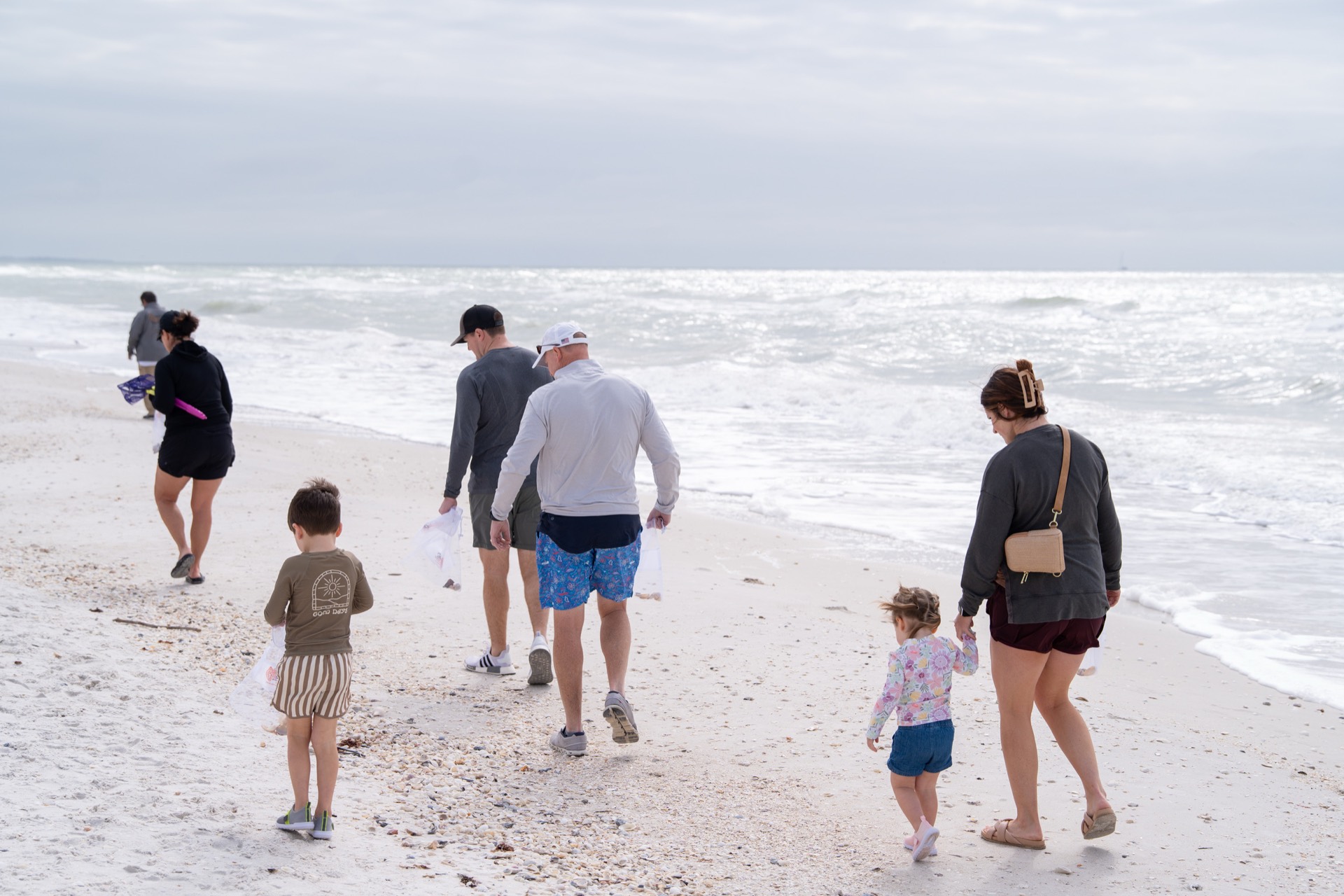
You’ll find the richest micro-shell wrack lines on boat-only islands like Keewaydin, Kice and the Caxambas Pass spits — places a shelling tour can reach that a mainland beach walk simply can’t. As with every shell in the Seashell Guide, the rule holds here too: empty shells only. Collier and Lee County protect live shells, sand dollars and starfish, so a valentine box only ever holds material the tide already gave up on its own.
How to Start Your Own Sailor’s Valentine
Building your first sailor’s valentine doesn’t require a workshop, just patience and a plan. Start by sorting the shells you bring home — our guide to cleaning collected shells covers rinsing sand and residue out of tiny olives and coquina before you glue anything, since trapped grit will telegraph right through the finished pattern. From there, the process is mostly patient repetition.
- Clean and sort. Rinse every shell, then sort by color, size and shape into small trays or an old egg carton.
- Choose a box. Find or build a shallow, octagonal frame with a glass or clear lid, roughly 6 to 10 inches across.
- Sketch the pattern. Mark a center point on the backing board and draw light guide lines so every quadrant will mirror its neighbor.
- Glue from the center out. Place shells with a small dab of tacky glue, finishing one full ring of the pattern before starting the next so the symmetry doesn’t drift.
- Seal and frame. Once the glue fully cures, set the glass or clear lid in place and close the hinge.
First attempts rarely look like a museum piece, and that’s fine — even the original Barbadian pieces ranged from simple geometric rings to elaborate, multi-ring compositions. Start small: a single rosette glued inside a jar lid teaches you the mirror-symmetry trick before you commit to a full octagonal box.