
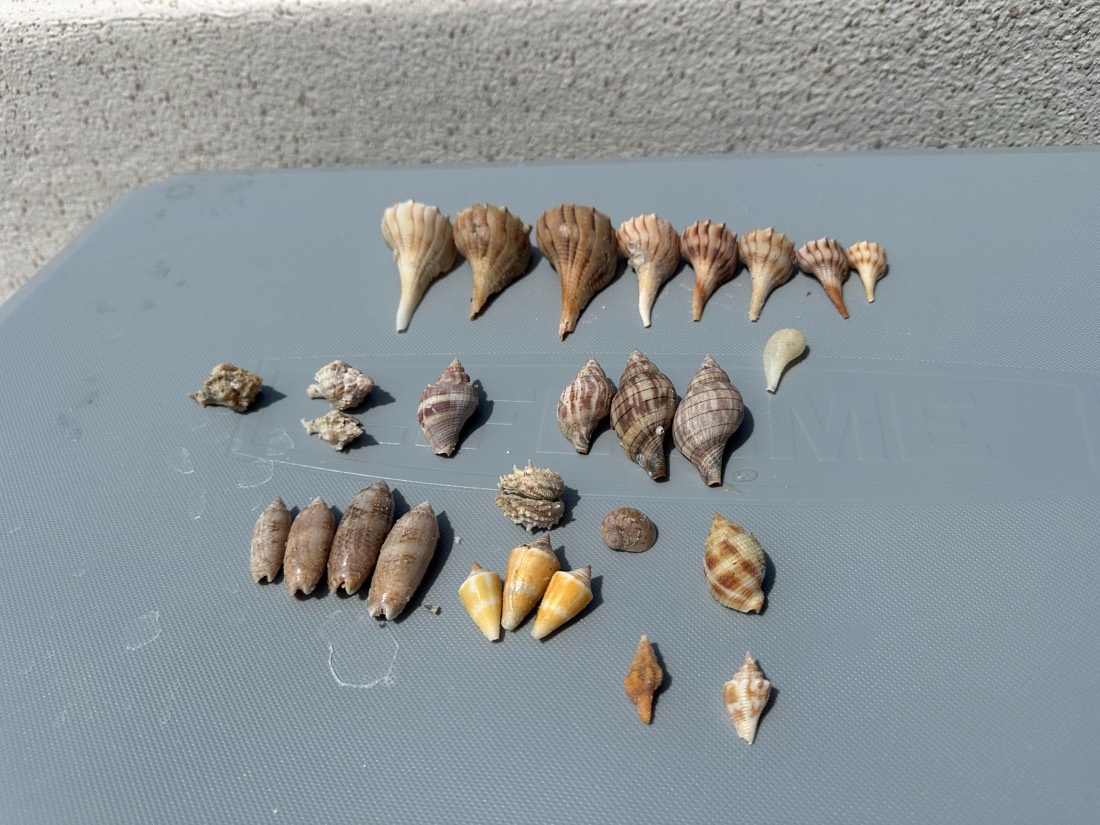
🐚 At a glance
- Scientific name
- Olivella spp., commonly Olivella mutica
- Family
- Olividae — same family as the lettered olive
- Size
- ¼–½ in (6–12 mm), true to the “rice” name
- Tell-tale
- Glossy bullet/torpedo shape, cream to violet-gray, no ribs or ridges
- Where & when
- Swash line & drift windrows on Keewaydin, Kice & the Caxambas spits, any outgoing tide
- Rule
- Empty shells only in Collier & Lee — check before you bag a handful
What are dwarf olives (rice shells)?
A dwarf olive is a real, whole sea snail shell in the genus Olivella — not a chip, not a fragment, not a broken piece of something bigger. Along the Gulf beaches near Marco Island, the common species is the variable dwarf olive, Olivella mutica, a pint-sized cousin of the much larger lettered olive in the same family, Olividae. Both share the family trademark: a glassy, almost lacquered shine that comes straight from the living animal, whose mantle wraps up and over the outside of the shell while it’s alive, polishing it the whole time. That’s why even a shell that’s been tumbling in the surf for who knows how long still looks freshly waxed.
Shellers and crafters started calling them “rice shells” for the obvious reason — scatter a handful on a white towel and they genuinely look like grains of rice, right down to the length and the slight taper at each end. Don’t let the size fool you into writing them off as junk shells, though. A dwarf olive is a fully formed predator and scavenger with its own spire, aperture and a tiny horn-colored operculum sealing the opening, just built at about a tenth the scale of its famous relative. On a good drift line near a shelling tour stop, you can find hundreds of them without ever picking up anything else.
How to identify a dwarf olive
Pick one up and roll it between two fingers — that’s really the whole test. A dwarf olive is a smooth, glossy, bullet- or torpedo-shaped little cylinder, rounded at the base and drawn up into a short, neat point at the spire. The aperture, the long narrow opening where the animal’s foot extends, runs almost the entire length of the shell along one side, with a small notch at the base where the siphon once poked out. There’s no ridge, no rib, no bump anywhere on the surface — just an unbroken, polished curve from tip to tip, which is exactly what separates a true dwarf olive from a similarly sized fragment of something else.
Color is where they get interesting, because no two handfuls look quite alike. Most run cream to pale tan, but you’ll also turn up shells in dove gray, soft violet-gray, and the occasional one with faint darker banding or a mottled, cloud-like pattern near the shoulder. Size stays fairly consistent: most mature dwarf olives run about a quarter inch long, with a genuinely large one pushing closer to half an inch. If it’s longer than that and it’s wearing bold, dark zigzag markings, you’ve actually found a young lettered olive, not a dwarf — more on telling those two apart below.
Where to find rice shells near Marco Island
Dwarf olives live and die right in the swash — the thin sheet of water that runs up the sand with every wave and slides back down again. While they’re alive, they actually ride that motion, letting a wave carry them a few inches up the beach before digging back down into the wet sand as the water pulls away, over and over, all day. Watch the wash line closely on a Gulf-facing beach and you’ll sometimes catch a little flick of movement that’s a live one re-burrowing rather than a trick of the light. Empty shells, meanwhile, get shuffled up and out of the wave zone entirely and settle into the drift line — the ragged little windrow of shell grit, sea grass, and debris that marks the last high tide.
Boat-only barrier islands like Keewaydin, Kice, and the Caxambas Pass spits are the best ground we know for them, mostly because so few feet ever cross that sand between tides. You don’t need to time a dramatic negative low the way you would for some of the bigger, deeper-water finds — any outgoing tide near the wash will turn up dwarf olives, though a lower tide does expose more swash zone to work. The fastest method is also the simplest: crouch at the edge of the water, scoop a double handful of wet sand, and let it sift slowly through your fingers back into the Gulf. If you want a broader rundown of technique for shells this size, our guide to micro-shelling and mini shells covers the whole tiny-shell game, and the shelling beaches hub has the rest of the islands worth walking.
Dwarf olive vs. lettered olive: what’s the difference?
The two shells share a shape, a shine, and a family tree, which is exactly why first-time shellers mix them up. The easiest split is size: a dwarf olive tops out around half an inch, while an adult lettered olive commonly reaches two to three inches — a genuinely different handful. Pattern settles it the rest of the way. A lettered olive earns its name from bold, dark zigzag markings that really do look like scrawled cursive writing across a tan or gray background. A dwarf olive’s color is much quieter — solid cream, tan, or violet-gray, with at most a faint band or soft mottling, never that sharp hand-written pattern.
Behavior tracks the size difference too. Lettered olives are active nighttime hunters that plow visibly just under the surface, leaving a little furrow you can follow with your eyes at dawn, and shellers usually find them one at a time. Dwarf olives are the ones that show up by the hundred in a single drift-line windrow, because there are simply far more of them and they get shuffled together by the surf. Both, notably, are still shells worth respecting — not empty husks to grab without a glance — so treat a moving one exactly like you would any other live find on a Collier or Lee County beach and let it go.
| Shell | Size | Pattern | How you find it |
|---|---|---|---|
| Dwarf olive (rice shell) | ¼–½ in | Plain cream, tan or violet-gray; faint banding at most | By the hundred in drift-line windrows |
| Lettered olive | 2–3 in | Bold dark zigzag “lettered” markings | One at a time, often near a fresh plow furrow |
Why crafters love rice shells
Rice shells have a genuine following outside the shelling world, mostly thanks to sailor’s valentines — the octagonal, shell-mosaic keepsakes that got their start as souvenirs sold to 19th-century sailors passing through the Caribbean. Modern hobbyists making their own version, or restoring old ones, specifically hunt for shells like dwarf olives because of what they already have going for them: a uniform bullet shape that packs edge to edge without gaps, a small enough size to form tight rows and rosettes, and that natural glassy polish the living animal built in, so there’s no tumbling or buffing required before they go into a design. Our sailor’s valentine guide walks through the craft itself if you want to try building one.
One habit worth keeping even when you’re collecting by the handful for a craft project: dump your scoop out and check it before you bag anything. Because dwarf olives are so small and so often gathered in bulk straight out of the swash, it’s easy to sweep up a few that are still occupied along with the empty ones. A quick look for the little operculum sealing the opening, or for one that’s clearly trying to dig back into your palm, tells you which ones to slide back into the water. Bring the rest home with you, or better yet, sort them right there in the wash where you found them — either way, it’s the easiest rule on the beach to follow.