
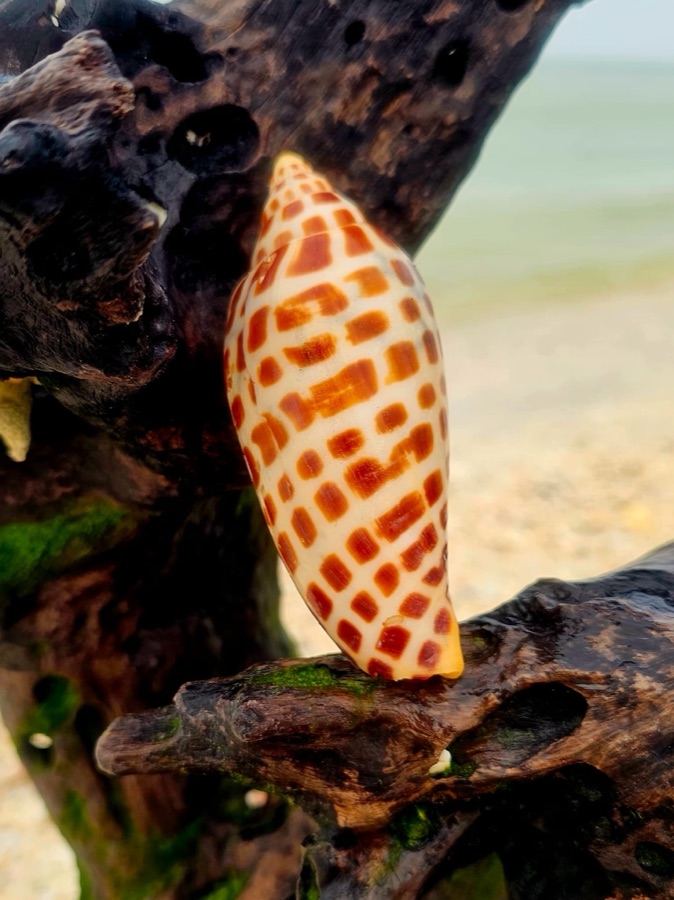
🐚 At a glance
- Scientific name
- Scaphella junonia
- Look
- Glossy cream shell with spiral rows of brown spots
- Why rare
- Lives ~100–425 ft deep; washes up only after storms
- Best odds
- Remote outer islands & sandbars after a winter front or storm
- Rule
- Empty shells only in Collier & Lee
How to identify a junonia
You'll know it instantly. A junonia is a smooth, glossy, somewhat cylindrical shell, three to five inches long, in a creamy white-to-tan base color decorated with tidy spiral rows of square brown spots — collectors describe them like a leopard print laid out in lines. Nothing else on a Gulf beach looks quite like it, which is part of the thrill: the moment you spot the spots, your heart skips.
Why it's the holy grail
The junonia isn't rare because there are few of them — it's rare because they live where you can't walk. The animal spends its life in deep Gulf water, well offshore and far below the surf, so an empty shell only reaches the beach when a powerful storm or a strong winter cold front churns the bottom and carries it in. That's why a junonia find makes the local news and earns a photo at the shell shop. It's luck stacked on top of good timing.
How to give yourself the best odds
You can't guarantee a junonia — anyone who promises one isn't being honest — but you can stack the deck. Get to the wildest, least-walked beaches right after rough weather, when fresh material is still arriving and few footprints have beaten you to it. That means the boat-only outer islands and sandbars of the Ten Thousand Islands and around Cape Romano, not the crowded mainland. Our shelling tours run to exactly those spots and time trips to low tide after fronts. Bring patience, keep your eyes on the wrack line, and remember it's empty shells only — see our Florida shelling rules.
From the Helm: Running Kice Island’s outside bar after a winter cold front for junonia
The morning after a real winter cold front blows through, we’re watching Kice Island’s outside bar more than anywhere else in the Ten Thousand Islands. That gulf-facing stretch takes the brunt of a north wind, and a hard front is exactly what stirs bottom sediment loose enough to carry a junonia up from the deep water it normally lives in. We don’t promise one — nobody honest does — but the days right after a front are the only days the odds are even worth talking about. Even then the honest math is still long — a scattered find across a whole season, not a guarantee for any single trip — and we say so plainly before anyone’s hopes outrun the tide chart.
On those mornings we walk slower than usual and lower to the sand, because a junonia doesn’t sit shell-hash-colored on top the way a bright fighting conch does — its spotted pattern actually breaks up its outline in a scatter of shell rubble, so most people walk past one the first time and only catch it on a second pass. We’ll tell a group to stop scanning wide and start checking anything cream-colored half-buried at the edge of the last wave’s reach. We’ll often crouch and run a hand lightly across the sand rather than just look, since a junonia’s smooth curve can hide under a skim of loose grit that the eye alone skips right over.
We also watch the overnight wind forecast the night before, since a front that’s already three or four days old has usually let the water settle back down, and any junonia that washed up has likely already been picked up by someone walking the beach at first light. If the front’s fresh — inside a day, maybe two — that’s when we’ll actually build a trip around the chance instead of treating it as a long-shot bonus.
When a junonia does turn up, the shell in hand is usually still damp and a little gritty with the sand it was buried in, the chocolate spots sharp against that cream background rather than faded — a genuinely different feel from the bleached, sun-dried shells that fill most of a bag by the end of a trip. That contrast is part of why it gets treated as the big find even among people who’ve shelled here for years.
We can’t schedule a junonia, but we can schedule the conditions that make one possible, which is why guests chasing this specific shell usually ask us to build a trip around the forecast rather than the calendar. If a front just came through, ask your captain when you book — and browse the rest of the seashell guide or our shelling tours page for what else that same morning tends to produce.