
🪶 At a glance
- What it is
- A colony where wading birds nest together
- Who shares it
- Herons, egrets, spoonbills, ibis, pelicans
- Why an island
- Surrounding water keeps land predators off the nests
- Peak season
- Spring nesting spectacle
- Rule
- Keep your distance — never flush nesting birds
What a rookery is
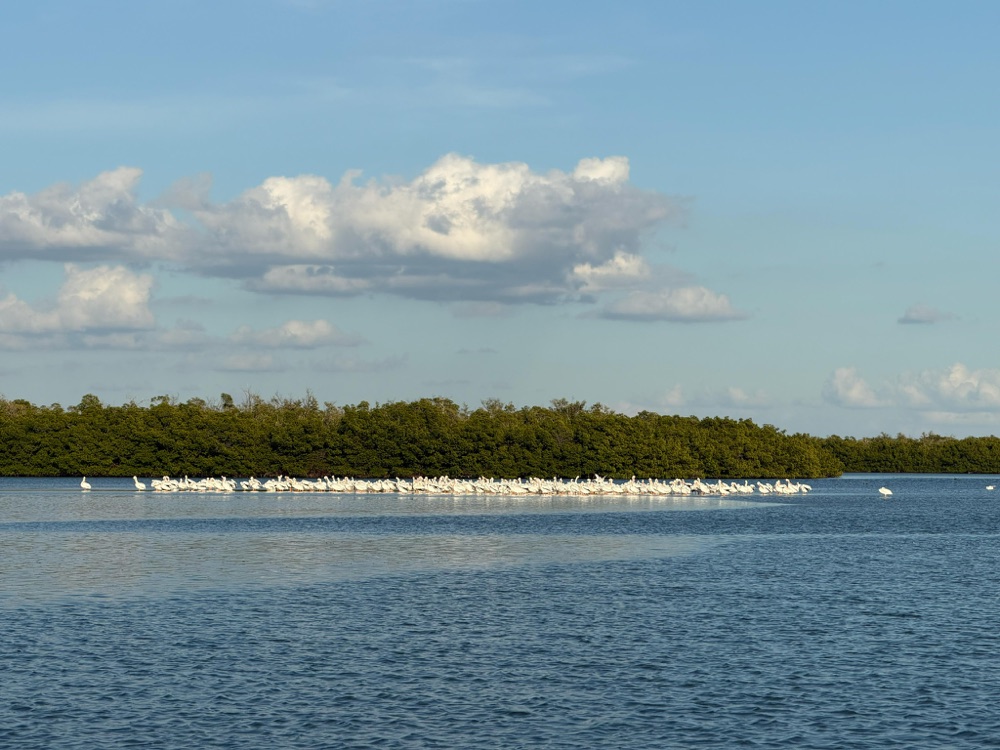
A rookery is simply a place where birds nest in a colony instead of alone — and for the wading birds of the Gulf coast, that usually means one small mangrove island absolutely loaded with nests. Why crowd together? Safety in numbers. A single nest is an easy target, but hundreds of sharp-eyed parents on one island spot a predator instantly and mob it. Out here the colonies favor little mangrove islets surrounded by water deep enough to keep raccoons, the big nest-raiders, from wading across. Pick the right island in spring and you'll find herons, egrets, spoonbills and ibis all stacked into the same green tangle, each in its preferred layer of the canopy.
Who nests together
The cast is the best part. Great blue herons take the high, sturdy branches; great and snowy egrets pack the middle; white ibis nest in dense clusters lower down; and the prize, the roseate spoonbill, glows shrimp-pink against the green when it comes in to land. Brown pelicans and cormorants often claim their own corners. In breeding season the birds put on their finest — egrets grow lacy plumes, herons flush brighter, spoonbills deepen to a startling rose — so a spring rookery isn't just loud, it's gorgeous. The name “Rookery Bay” south of Naples comes straight from these colonies.
The spring spectacle
Timing makes the rookery. Activity ramps up through late winter and peaks in spring, when courtship, nest-building, and then a chorus of begging chicks turn a quiet island into pure pandemonium. This is also the most sensitive time, which is exactly why how you watch matters so much.
| Season | What's happening |
|---|---|
| Late winter | Birds arrive, pair up, courtship displays |
| Spring | Peak nesting — eggs, then loud, hungry chicks |
| Early summer | Fledglings testing wings; colony winding down |
| Fall–winter | Birds disperse to feed across the flats |
Watching one the right way
Here's the rule we never bend: keep your distance. If a boat gets close enough to flush nesting adults off the island, even briefly, eggs and chicks are left exposed to sun and predators — a few minutes can wreck a whole nest. So we idle past, cut the engine well off, and let binoculars and long lenses do the close-up work. The good news is you don't need to crowd a rookery to enjoy it; the spectacle is loud and visible from a respectful distance. Our bird-watching tours and dolphin and wildlife trips through the Ten Thousand Islands are built around exactly that kind of low-impact viewing, the same way we treat every wild animal we share the water with. For more, see our mangrove wading birds guide.
From the Helm: Approaching the Rabbit Key rookery without spooking the colony
Cut the engine too close to a mangrove islet like Rabbit Key in nesting season and you'll watch the whole colony lift off at once, which is the opposite of what anyone aboard actually wants. Our captains kill the motor well back and coast the rest of the way in on whatever current is running, because a rookery used to boats idling past at a respectful distance tolerates far more than one that gets buzzed on approach.
From that distance the racket reaches you before the detail does — a constant low chatter of herons and egrets working nests stacked practically on top of each other, spoonbills and ibis mixed in wherever there's room. We hold position rather than circle, since repositioning the boat reads to the colony as another approach, and let the wind or current do the slow work of swinging you around for a different angle on the same tangle of nests.
Spring is when we watch hardest, because that's when nests fill fastest and the noise and wingbeats turn into something closer to a spectacle than a scattered sighting. Early runs tend to catch more activity than a midday pass, since the heat of the day settles this colony down the same way it settles most of this water's wildlife, birds included.
We keep the engine noise as the guide, too — if a low murmur turns into sharp alarm calls the moment we ease closer, that's our signal we've already pushed too far, and we back off before anyone even asks why. A rookery that stays at its steady chatter is one that's comfortable with the distance we've held, and that's really the whole read we're working off out here. A pair of binoculars passed rail to rail does the rest of the work a closer approach would otherwise have to do.
If Rabbit Key is quiet on a given morning, we'll ease toward another screened mangrove key instead rather than push in closer to the first one hoping for more — disturbing a rookery for a better look isn't a trade our captains will make. Binoculars do more work here than a zoom lens ever will, since the whole point is staying far enough back that the colony never clocks the boat as a threat.
Eagles and ospreys will sometimes work the edges of a rookery too, hunting the same water for an easier meal, so keep an eye on our bald eagle guide while you're watching the mangroves. Timing a trip around this spring activity is one of the questions we get most, and our seasonal itinerary guide covers when else on the calendar this water is working.