
🐬 At a glance
- What it is
- A living fossil — an arachnid relative, not a crab
- Tell-tale
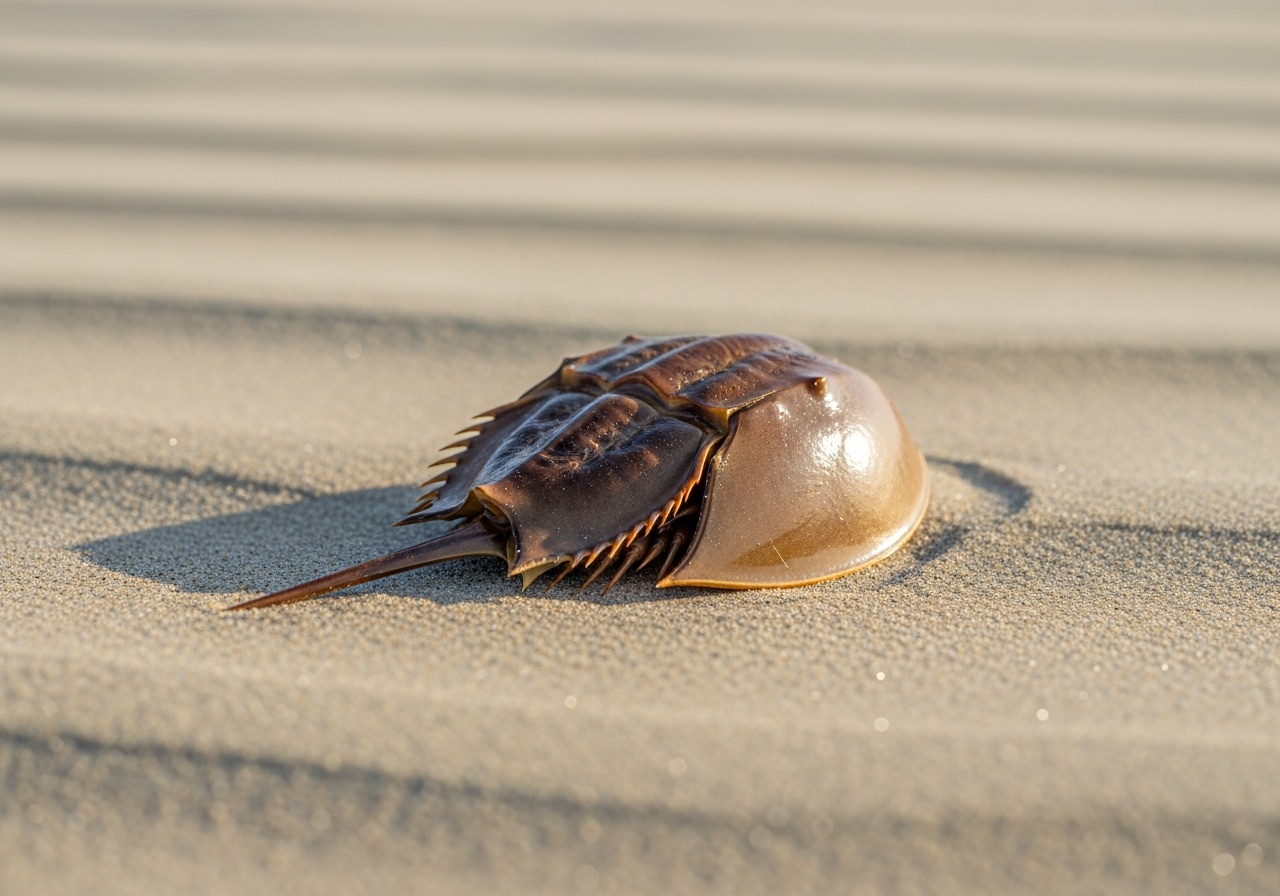
- Brown helmet shell, long spike tail (a rudder, not a stinger)
- Where & when
- Calm beaches; spawning on spring high tides; molts year-round
- If stranded
- Gently flip an overturned one back over — it's harmless
Why it isn't actually a crab
Despite the name, a horseshoe crab isn't a crab at all — it's an arthropod more closely related to spiders, scorpions and ticks, the last survivor of a lineage that's been around roughly 450 million years. That's older than the dinosaurs, older than trees, older than nearly everything. The hard brown shell is shaped like a horse's hoof, with a hinged tail spike trailing behind. That tail looks menacing and is completely harmless: it has no stinger and no venom, and the animal uses it as a rudder and a lever to flip itself upright. There are no claws to pinch you either — the mouth and legs are tucked safely underneath. It's one of the gentlest creatures you'll meet on a beach walk during our wildlife tours.
Spring spawning trains
The best time to see them is spring, when the highest tides — especially around the new and full moons — pull horseshoe crabs up onto calm, protected beaches to spawn. You'll often see a smaller male hitched to the back of a larger female, sometimes with extra males trailing, forming a little “train” as the female digs in near the waterline to lay eggs in the sand. Those eggs are a crucial food source for migrating shorebirds, which is part of why these ancient animals matter so much to the whole coast. We see them on the quiet, low-energy beaches of the back bays and barrier islands far more than on the open Gulf surf.
The molt shells you'll find shelling
Here's a fun one for shellers: a lot of the “dead horseshoe crabs” people find aren't dead at all. As they grow, horseshoe crabs shed their entire shell, leaving behind a perfect, hollow, light-as-paper replica — a molt. Flip one over and you'll see it's empty, with a split along the front edge where the live crab climbed out. They turn up year-round in the wrack line on our shelling tours, and they're a great keeper that doesn't harm a thing. Remember the rule on a live one, though: in Collier and Lee Counties you don't take living animals home — a molt is the one to keep.
| Live crab | Molt (shed shell) | |
|---|---|---|
| Weight | Heavy, solid | Light, hollow |
| Underside | Legs, mouth, moving | Empty, split at the front edge |
| What to do | Leave it; flip it if stranded | A fine keeper |
Blue blood and a helping flip
Horseshoe crabs really do have blue blood — copper-based instead of iron-based — and it's so valuable to medicine for detecting contamination in vaccines and IV drugs that these animals have quietly helped keep people safe for decades. You can help them right back with one easy gesture: if you find a live one stranded upside down on the beach, gently pick it up by the sides of the shell (never the tail, which can hurt the animal) and set it back upright facing the water. That's it. It's the same low-key respect we bring to all the creatures out here, and this one's been earning it for 450 million years.
From the Helm: Timing Panther Key’s spring tides for a horseshoe crab spawning run
Before we ever point the bow toward Panther Key, we’re already checking the tide tables against the moon — a horseshoe crab spawning train is a spring-tide event, and the highest tides of the new and full moon in April and May are the mornings we build the run around. A dead-average tide on a quarter moon almost never produces a train worth showing anyone, so we’ll shift the itinerary a day or two rather than chase a weak tide out of habit. That kind of small scheduling call is the difference between an empty sand spit and a beach genuinely crawling with crabs.
Once we’re close, we cut the outboard well off the spit and idle the last stretch on the trim tabs alone, because a hull grinding up onto a spawning beach can crush crabs working the swash we’d never even notice from the deck. We’ll anchor in a foot or two of water and wade the last bit in reef-safe water shoes, keeping our steps to the wet sand below the wrack line where the crabs are actually paired up and pushing eggs into the sand. It’s a slower approach than most guests expect, but it’s the only way to walk a spawning beach responsibly.
What you’ll usually notice first isn’t a single crab but the wake of dozens moving together, the smaller males trailing the larger females in loose chains that push into the swash and stall as each wave recedes. When we do lift one for a guest to see, we cup it from underneath at its widest point with two hands, and it’s always heavier than people expect — more like a wet dinner plate than a shell. The legs keep working slowly even in the air, a dozen small paddles still going through the motion, which is usually the moment that gets the best reaction at the rail. We keep the look brief and set it back down exactly where the wave line found it.
On stretches that get walked hard by other boats, spawning trains thin out fast, so we rotate which part of Panther Key we visit from trip to trip instead of working the same fifty yards every time out. When a strong onshore wind has chopped up the spit overnight, we’ll often skip the spawning beach entirely and swing toward calmer water, since crabs favor a low-energy shoreline and a wind-beaten beach just won’t produce the numbers. That kind of last-minute change happens more than most guests realize — the crabs set the plan more than any fixed schedule does.
We treat every horseshoe crab we see as a genuine highlight, never a guaranteed one — spring conditions have to line up, and even then a good spawning train is a matter of moon phase and luck as much as timing. If you want the best shot at catching one, ask about it when you book a shelling tour, since the same falling tides that expose fresh shell on the sand spits are what strand the molts we watch for on the way back in. It’s one of the small, ancient details that turns a regular beach stop into something worth slowing down for.