
🦀 At a glance
- Scientific name
- Limulus polyphemus
- What it is
- A living fossil — kin to spiders & scorpions, not crabs
- Molt tell-tale
- Empty shell split open along the front edge; light & hollow
- Dead crab
- Sealed shut, body still inside, heavier
- If alive & flipped
- Gently turn it right-side-up by the shell — never the tail
Molt or dead crab? How to tell
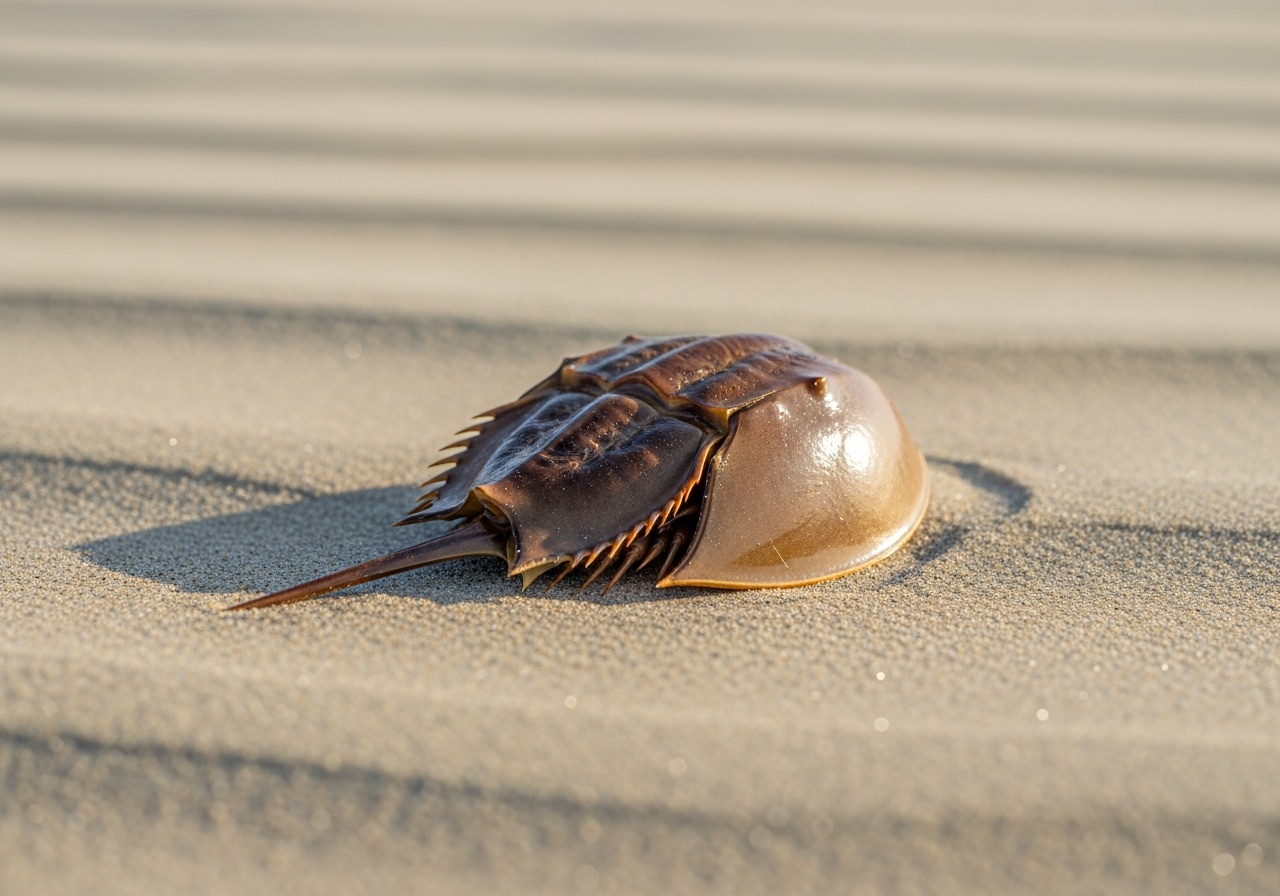
This is the whole game, and it’s easier than it looks. As a horseshoe crab grows, it crawls out of its hard shell and grows a new one — and it backs out through a split that opens along the front edge of the shell. So flip your find over: if there’s a clean seam cracked open across the front and the inside is empty, hollow and odorless, you’re holding a molt, a perfectly good keepsake. If the shell is sealed all the way around, feels heavier, and has the body and gills still tucked underneath, it’s a dead crab — leave it for the beach to recycle.
| Sign | Empty molt (keeper) | Dead crab (leave it) |
|---|---|---|
| Front edge | Split open — the escape seam | Sealed shut |
| Weight | Light, hollow | Heavier |
| Underneath | Empty | Body & gills still inside |
| Smell | None | Often briny/organic |
A living fossil, not a true crab
Here’s the fun part to know. Despite the name, a horseshoe crab isn’t a crab at all — it’s more closely related to spiders and scorpions, and its body plan has barely changed in hundreds of millions of years, which earns it the title “living fossil.” That long spiky tail (the telson) isn’t a weapon and isn’t a stinger; it’s a lever the animal uses to flip itself back over. They’re completely harmless to people. You’ll often see live ones in the shallows on our trips — learn more on our horseshoe crab wildlife page.
How to flip a stranded one
Spring tides sometimes leave live horseshoe crabs upside-down and stuck on the sand, especially around mating season. You can save one in two seconds: pick it up gently by the sides of the shell (the helmet), never by the tail — pulling the tail can hurt it — turn it right-side-up, and set it back toward the water. It’s one of the small good deeds our guests love on a shelling tour. And the usual rule still applies: an empty molt is a fine keepsake, but a living animal goes back, in keeping with Collier & Lee’s empty-only rule. We find them along the calm flats of Keewaydin and the Ten Thousand Islands.
From the Helm: Horseshoe Crab Molts: reading the flats behind Round Key on a big spring tide
Our captains watch the spring tide charts as closely as any weather report, because the biggest moon tides of the month are when the flat behind Round Key turns up the most horseshoe crab molts. A stronger-than-usual high tide floods the flat further than normal, then drains it slower, leaving whatever shed there stranded high and dry for guests to find. On a modest, average tide the same flat can look almost empty. We plan this stop around the tide tables first and the weather second, since the water’s reach matters more than sunshine.
A molt lies flat and light in the hand, split cleanly along the front edge where the crab backed itself out, and the inside is dry and hollow with almost no weight to it at all. We like handing one to a guest and letting them lift it themselves — the surprise is always how little it weighs, like a helmet made of paper instead of the armored fossil it looks like. That lightness, more than the color or size, is the fastest way to know you’re holding an empty shed and not a stranded animal.
Most mornings on that flat we find several molts scattered loose rather than one obvious pile, since the crabs shed a little at a time as they grow rather than all at once. If the flat’s dry and the molts are old and brittle, we’ll walk guests further along the mangrove edge where the ground stays damper and finds tend to be fresher. It’s a short walk, not a long search, and our captains can usually tell within a few steps whether that day’s flat is worth working or better swapped for the mangrove fringe nearby.
Every so often a guest finds one still occupied rather than empty, and we treat that moment carefully — a gentle turn back onto its legs, released right at the water’s edge, never picked up and carried around the boat. Horseshoe crabs are living fossils, older than the dinosaurs, and that fact tends to land harder once someone’s holding a real one rather than reading about it. Guests curious about what else shares these backwater flats can look into the wildlife hub, and this stop slots easily into a shelling tour that spends real time on the mangrove edge.
We keep this stop brief compared to a shelling beach, since the flat rewards a slow walk more than wide ground covered, and pushing guests to cover more sand rarely turns up more molts. What it does reward is patience at the mangrove edge, where the softer mud holds shape longer and a fresh shed stands out pale against the darker bottom. Our captains would rather spend fifteen unhurried minutes there than rush guests across the whole flat looking for volume.