
🐬 At a glance
- Golden rule
- Observe, don't interact — no feeding, no chasing, no touching
- Dolphin distance
- Federal guidance: stay ~50 yards from wild dolphins
- Speed
- Idle through posted slow and manatee zones
- Birds & turtles
- Give rookeries room; never approach marked nests
- How we run
- Engine in neutral near animals; let them come to us
Never feed or chase — it does real harm
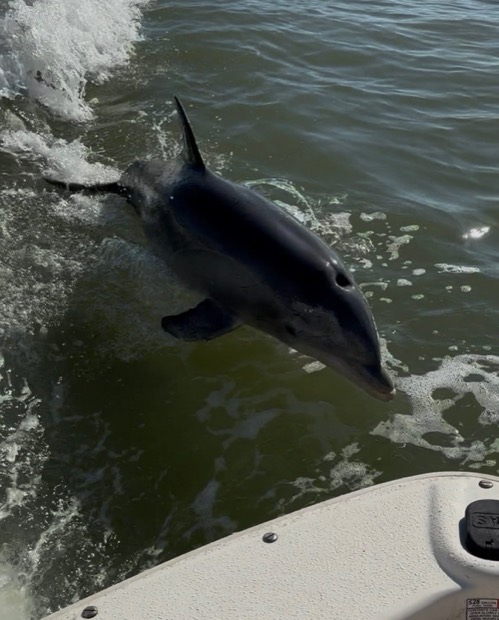
This is the big one. Feeding wild dolphins teaches them to beg around boats and docks, which gets them hurt by props and fishing gear and is illegal under federal law. Chasing animals to get closer stresses them, separates mothers from calves, and can push them off the very flats where they hunt. Our move is the opposite: we ease off the throttle, slip the engine into neutral, and let curious dolphins decide whether to come ride our bow. When they do it on their own terms, it's a far better moment anyway — and it's why we put so much care into how boats and dolphins share the water.
Give them room to be wild
Distance is respect. Federal guidance is to stay about 50 yards from wild dolphins, and we keep clear of manatees too — they need warm, quiet water to rest in, and our boat traffic is the last thing they should have to dodge. We idle through every posted slow-speed and manatee zone, which also happens to be the best way to actually spot a manatee, since you can't see one if you're roaring past. For the manatee-specific details, we keep a separate manatee manners page.
Mind the nests and rookeries
The same goes on land and along the mangroves. The island rookeries where herons, egrets and spoonbills nest are easily spooked — a boat that pushes too close can flush adults off the nest and leave eggs and chicks exposed to the sun and predators. We hold our distance and let you watch through binoculars and a zoom lens. On the beaches, marked sea-turtle nests are off-limits: stay well clear, never disturb the stakes, and keep lights and noise down at night during nesting season. Watch the whole approach in action on a dolphin & wildlife tour — responsible viewing is simply how we run.
From the Helm: why we idle down early through the Rookery Bay no-wake stretch, not just when we spot one
We drop to idle speed well before we reach the posted no-wake stretch through Rookery Bay, not the moment we happen to spot a manatee or a slow-moving shape. Waiting until you see the animal is often waiting too long — a manatee resting just under the surface gives almost no warning before a hull is on top of it, and the wake from a boat still on plane travels and rolls through skinny water long after you’ve backed off the throttle. Slowing early costs us a couple of minutes; it buys the whole stretch a calmer wake.
Once we’re idling, we scan for the same subtle signs whether or not we’re actively looking for manatees — a flat swirl where something just submerged, a v-shaped ripple moving against the current, a patch of water that’s just a little too still. Those signs matter as much for birds and rays as they do for manatees, since a low, slow approach keeps a heron on its perch or a ray on the flat instead of spooking it into flight. We’d rather cover less water carefully than more water fast. We’ll also flag other boats running too fast nearby and shift our own position to put our hull between their wake and a resting animal, since the water doesn’t stay calm just because we’ve slowed down ourselves.
At the rail, we ask guests to keep hands inside the boat and voices at a normal talking level rather than a shout, especially once we’re close enough that an animal could reasonably notice us. We don’t toss anything overboard to draw a closer look, and we don’t nose the bow straight at a resting animal the way you might drive toward a parking spot — we’ll ease alongside on a parallel line instead, so the animal can choose to stay or move off on its own terms.
The same low-and-slow habit carries over to the mangrove rookeries we pass along the way, where nesting herons and egrets sit close enough to see clearly from the channel without ever needing to close the distance further. If a bird flushes off a branch as we approach, we’ve come in too fast or too close, and we’ll back off and widen our line rather than push on for a better photo angle. It’s a habit that costs us very little and matters enormously to whatever’s trying to raise young in that same stretch of mangrove.
None of this is a rulebook we follow only when a ranger’s nearby — it’s how we run every trip through Rookery Bay and the creeks around it. Our dolphin tours and the West Indian manatee guide both cover this water, and running it slow is a big part of why the sightings hold up season after season.