
🐢 At a glance
- Tell-tale
- Large, blocky reddish-brown head; heart-shaped shell
- Nesting share
- About 98% of local Gulf-beach nests
- Season
- May–October
- Where
- Keewaydin, Kice & Cape Romano barrier beaches
- Rule
- Stay back from nests & crawls; lights-out at night
How to identify a loggerhead
The name says it: the loggerhead has a massive, blocky head, far bigger and broader than other sea turtles, in warm reddish-brown tones. The shell (carapace) is heart-shaped and roughly the same reddish-brown, often carrying barnacles and a passenger or two. Adults are big, heavy animals, and those powerful jaws are built to crush crabs, conchs and other hard-shelled prey. On a daytime tour you almost never see the turtle itself — they nest at night — but you'll read their story in the sand. To compare with the rarer locals, see our guide to green and Kemp's ridley turtles.
Nesting season on our beaches
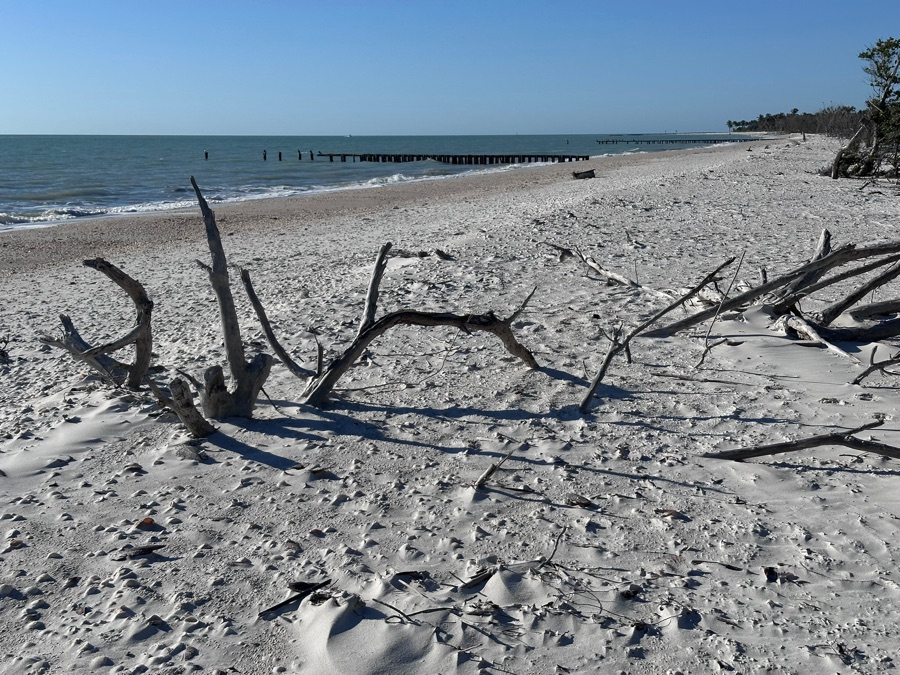
Loggerhead nesting runs May through October, peaking in the heart of summer. A female hauls out at night, digs a chamber above the high-tide line, lays a clutch of leathery eggs, covers it and returns to the Gulf, leaving that wide crawl behind. Surveyors find and stake the nests by morning. The boat-only barrier beaches — Keewaydin, Kice and Cape Romano — are prime because they're dark, quiet and undeveloped. Our sea turtle nesting season guide walks through the full timeline.
| Window | What's happening | What you'll see |
|---|---|---|
| May–Jun | Nesting begins | First crawls & staked nests |
| Jul–Aug | Peak nesting | Most nests & crawls on the beach |
| Aug–Oct | Hatching | Tiny tracks from nest to surf |
How to respect the nests
These turtles are protected, and the rules are simple. Never walk on or dig near a roped nest, keep your distance from any crawl, and fill in holes and knock down sandcastles before you leave so hatchlings have a clear path to the water. At night the big one is lights-out: artificial light disorients nesting females and hatchlings, steering them away from the Gulf. We share all this on our shelling tours and wildlife tours so you can enjoy a nesting beach without ever disturbing it. Read the wider etiquette on our wildlife viewing etiquette page.
From the Helm: The captain’s call when a loggerhead surfaces off Caxambas Pass
When someone spots a shell-shaped hump breaking the surface off Caxambas Pass, the first thing we do isn’t grab a camera — it’s pull the throttle back to idle and decide, in about two seconds, which way that turtle is likely headed so we can steer clear of it rather than toward it. A loggerhead spends most of its time well below the surface and only comes up to breathe for a few seconds at a time, so the decision to ease off has to happen before you’ve even confirmed what you saw, not after.
We run this stretch of coast more often on calm mornings with the wind out of the east, because a loggerhead’s small dome of a head is nearly impossible to pick out of any real chop, and a boat idling through rough water gives a diving turtle less warning of where the hull actually is. Polarized sunglasses do more work here than anything else on board — cutting glare off the surface is often the only way to catch the pale shape of a turtle drifting just under the surface before it’s gone again.
Most loggerheads we come across are simply moving through, unbothered, on their way to forage crabs and jellyfish off a nearshore ledge, and a good sighting is usually just a shell breaking the water twice — once for the breath, once more as it tips back under. We hold position and let the turtle set the pace rather than following it, because chasing a surfaced loggerhead does nothing but push it into a longer dive and a longer wait before it needs to breathe again.
If the water’s stirred up along that stretch, we’ll often work farther up the shoreline instead, since a cleaner patch of water even a half-mile off makes the difference between a real look and a guess at a shadow. As evening approaches on these beaches, we also give the shoreline a wider offshore berth than usual, since a boat running close to shore at dusk is the last thing we want near a stretch of sand a nesting female might be approaching.
A loggerhead sighting out on the open water is never something we can promise — they surface for seconds at a time, and the Gulf is a big place to hide in — but working this shoreline on the right kind of morning gives you a real shot at one. If turtles are what you’re hoping for, ask about routing near our beach & island tours, and the sibling page on green and Kemp’s ridley turtles covers the rarer cousins that occasionally turn up in the same water. Either way, a loggerhead breaking the surface is one of those moments that quiets the whole boat down for a second.