
🐬 At a glance
- What to look for
- White underside, dark eye-line, brown back
- In flight
- Long wings bent into a shallow M
- Nest
- Big stick pile on channel markers & platforms
- Hunting
- Hovers, then a feet-first plunge-dive
- When
- Year-round; loud chicks in spring
How to identify an osprey
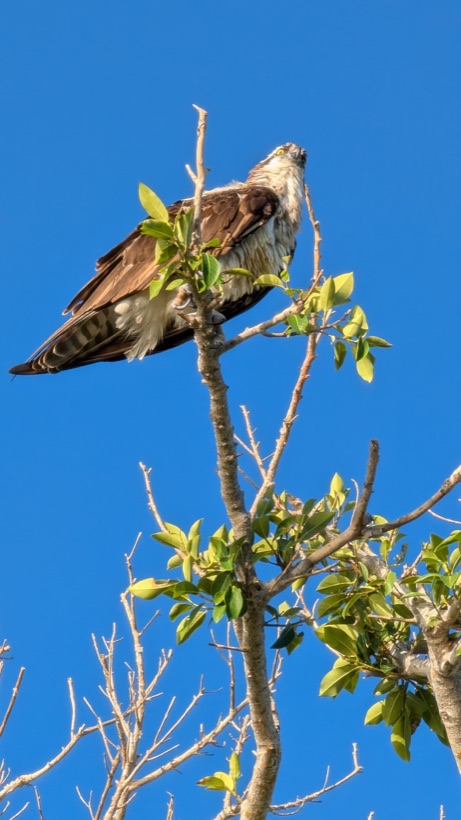
Get an osprey overhead and the field marks line up fast. The belly and the leading edge of the wings are bright white; the back and the wing-tips are dark brown; and there's a bold dark stripe running back through the eye like a bandit's mask. The real giveaway is the wing shape — an osprey holds its long wings in a shallow M or a crook, never flat like an eagle. From below it can read as black-and-white and a little gull-like until you clock the size and that masked face.
It's the most common big raptor over our water, and once you've got the M-wing locked in, you'll separate it from eagles instantly: eagles are bulkier, all-dark underneath, and fly on flat planks.
Channel-marker nests and spring chicks
Ospreys love a tall, sturdy platform with a clear view of fishy water, which is why they treat the channel markers of the Marco River and the back bays as prime real estate. Run any of the marked channels and you'll pass nest after nest — loose mounds of sticks and the occasional length of rope, packed onto the top of a marker. Pairs return to the same nest year after year.
Spring is the loud season. Chicks hatch and the adults shuttle fish back and forth while the young birds scream for more, so a springtime wildlife tour often turns into a front-row seat at an osprey nursery. By summer the youngsters are testing their wings off the platform edges.
The feet-first plunge-dive
This is the moment to keep your eyes up. An osprey hunts by hovering on beating wings thirty or forty feet over the shallows, locking onto a fish, then folding and dropping — talons swung forward, feet first — and hitting the water in a burst of spray. When it lifts off it carries the fish head-forward, lined up like a torpedo to cut wind drag. No other bird out here fishes quite like it; pelicans and terns dive head-first, but the osprey is the only one that goes in feet-first and comes up gripping dinner.
| Bird | How it dives | Quick tell |
|---|---|---|
| Osprey | Feet-first, after a hover | M-wings, masked eye, white belly |
| Brown pelican | Head-first, folded | Big bill & pouch, heavy body |
| Bald eagle | Snatches at the surface | Flat wings, white head, much bigger |
You'll find ospreys on the water all year, so any season works — though see our wildlife-by-season guide if you want the spring nesting drama. Either way, come watch a few dives with us.
From the Helm: Watching the Day-Marker Nests Work a Marco River Falling Tide
Running up the Marco River past a nest we know, we’ll often throttle back well before we’re alongside it, not because the birds spook easily — they’re some of the most boat-tolerant animals out here — but because a slow pass gives everyone time to actually find the nest before we’ve gone by. At speed, a stick pile that size is just a blur of brown against the sky; at an idle, it’s obvious, and that difference alone is worth the extra thirty seconds. We’ll usually cut the throttle a second time once we’re alongside, just long enough for everyone at the rail to actually get eyes on the bird before we motor on.
The dive is the moment guests come for, and we position for it rather than hope for it. Once we spot a bird circling and hovering over one patch of water, head down and wings beating in place, we’ll idle to put that patch off the beam instead of dead ahead, since an osprey folding into its dive usually drops at an angle rather than straight down. A broadside view catches the moment its feet break the surface instead of just the splash a few seconds later.
We watch the surface as hard as we watch the bird. A tight, nervous ball of bait dimpling the water — sometimes with a few small showers where fish are already getting picked off from below — tells us an osprey overhead is about to commit, and we’ll cut speed right there instead of a hundred yards further on. That same bait ball can just as easily mean a dolphin or a school of jacks working from underneath, so part of the call is simply waiting to see who breaks the surface first. Either way, cutting speed early means the boat’s already settled and quiet by the time whoever it is decides to show themselves.
Most falling tides we get at least one clean strike, the bird rising off the water with a fish gripped headfirst in its talons before shaking off in midair — ospreys turn a catch nose-forward for the flight home every time, a detail guests remember more than almost anything else on the trip. It doesn’t happen on command, and some passes turn up nothing but a bird circling and giving up, but the falling tide stacks the odds enough that we build real time into the run for it rather than treating it as a bonus.
If fish-hunting birds are what hook you, the same falling water that sets up an osprey’s dive is exactly what our fishing charters chase for their own reasons, and our broader wildlife guide rounds up the rest of the estuary’s regulars worth watching for along the way, from the herons on the flats to the rays cruising the sand beyond them.