
🐬 At a glance
- What to look for
- White head & tail, dark body, big yellow bill (adults)
- Size
- 6–7 ft wingspan — our largest raptor
- Nesting season
- Roughly Oct 1 – May 15 in Southwest Florida
- Where & when
- Rookery Bay & the estuary; tall snags and pines near water
- Heads-up
- Young eagles are mottled brown — no white head until ~5 years
How to identify a bald eagle
The adult is easy: a dark chocolate-brown body with a brilliant white head and tail and a deep yellow bill so heavy it looks photoshopped. In flight it holds its wings flat as a plank — no bend, no flutter — and the silhouette is huge, with a wingspan of six to seven feet. That flat-winged, slow, deliberate glide is often the first thing our captains spot before we even see the white head.
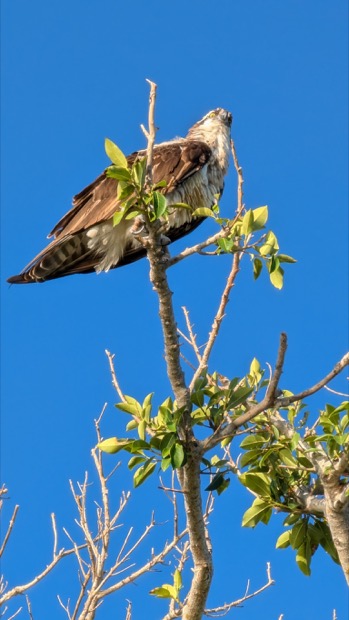
The catch is the young ones. A juvenile bald eagle is mottled brown and white all over and doesn't grow that clean white head until it's about five years old, which is why people sometimes mistake one for an osprey. The tell: an osprey is smaller, has a white belly and a dark line through the eye, and bends its wings into an M. An eagle is bulkier, darker underneath, and flies on straight planks.
Where and when to see them
Eagles want two things: tall perches and water full of fish. The estuary behind the barrier islands gives them both, and we regularly see them staked out on dead snags and pine tops along the edges of Rookery Bay and the back bays of the Ten Thousand Islands. Nesting season runs roughly October 1 through May 15 here, which lines up beautifully with snowbird season — the cooler months are both the best eagle window and the best boating weather.
You don't need a special trip to find one. We keep an eye out on every dolphin and wildlife tour, and a perched eagle is one of those bonus sightings that turns a good day into a great one. Florida holds one of the densest eagle populations in the United States, so while we never promise a particular animal, the odds in season are real.
Those giant stick nests
Once you know what an eagle nest looks like, you'll spot them everywhere. Bald eagles build the biggest tree nests of any North American bird — a mounded platform of sticks several feet across, wedged in the crown of a tall pine or snag. Pairs reuse and add to the same nest year after year, so an old one can grow to the size of a small car. When you see that dark mass capping a lone pine near the water, scan it: there's a good chance a white head is sitting on top.
| Bird | Underside in flight | Quick tell |
|---|---|---|
| Bald eagle (adult) | All dark, white head & tail | Flat wings, huge size, yellow bill |
| Osprey | White belly, dark wrist patches | M-shaped wings, eye-line, smaller |
| Juvenile eagle | Mottled brown & white | Bulky, dark, no clean white head yet |
Want the best shot at one? The cool, clear winter mornings are prime — check our wildlife-by-season guide to time your visit, then come ride the estuary with us.
From the Helm: Bald eagle watches from the pines above Gullivan Bay
It's almost always a guest who sees it first — a white flash way up in the pines above Gullivan Bay, easy to mistake for a gull until the whole bird tips into view. When someone at the rail calls it out, our captains ease off the throttle and hold the boat bow-into-the-wind so nobody has to brace against a rocking deck to get binoculars up. We keep a spare pair clipped near the helm for exactly this moment, because most guests never think to pack their own, and passing a pair hand to hand down the rail has become its own little ritual on these trips.
Once we've got eyes on the tree, we hold well back rather than nose in for a closer look — an eagle will sit tight on a perch a long while if you give it room, but crowd the tree line and it lifts off before anyone gets a real look. Cooler months are when we watch hardest, since that's when we tend to see adults working the same stretch of pines day after day rather than just passing through on a longer flight up or down the coast.
From a distance you'll usually catch one of two things: an eagle holding dead still on a high snag, scanning the flats for a mullet showing itself, or a long, unhurried glide out over open water on a thermal, wingtips barely moving. We don't chase the stoop — the moment an eagle actually drops on a fish happens fast and rarely lines up with wherever the boat happens to be, so we treat any glimpse of it as a bonus, never the plan for the morning.
What surprises most guests is the size up close through the lens — that hooked yellow bill looks almost too big for the head, and the white feathers run brighter against dark pine than any photo prepares you for. We'll idle a beat longer than usual if the light's raking in low and gold, because a backlit eagle on a bare snag is the kind of look that's worth losing a few minutes elsewhere on the run.
If the pines above Gullivan Bay are quiet, we'll swing the run out toward the open water of the Ten Thousand Islands instead, since a soaring eagle is often easier to pick out against open sky than tucked into a tree line. It's part of why a slower dolphin tour through this water tends to turn up more than just dolphins — the same idle-speed pace that lets you watch for a dorsal fin also gives you time to scan the canopy.
Sightings stay a matter of timing and luck rather than a promise, but running this same stretch of coast trip after trip is how our captains have learned which mornings are worth watching hardest. Check our wildlife guide for the other birds sharing that same tree line.