
🐬 At a glance
- Scientific name
- Elanoides forficatus
- Size
- Body about 2 ft; wingspan around 4 ft, with a deeply forked, scissor-like tail
- Season here
- Late February to early September — a spring-and-summer-only Florida bird
- Tell-tale
- Bright white head & underparts, glossy black wings & tail, barely flaps while soaring
- Where
- Nests in tall pines & cypress near Big Cypress, Fakahatchee & Picayune Strand; hunts over Ten Thousand Islands mangroves
- Rule
- A lucky-day sighting on tours — never guaranteed
What Is a Swallow-Tailed Kite?
Look up over the mangroves on a clear spring morning and you may catch the most graceful flier in North American skies. The swallow-tailed kite (Elanoides forficatus) is unmistakable once you've seen one: a crisp white head and underside, glossy black wings and back, and a tail that splits into two long, scissoring points — the “swallow” in its name. It rides thermals and sea breezes with barely a wingbeat, tilting that forked tail like a rudder to bank, dive and reverse direction in a single fluid motion. Where an osprey labors with heavy, purposeful wingbeats and a bald eagle soars on flat, broad wings, a swallow-tailed kite looks like it's playing. Birders call it one of the most beautiful raptors on the continent, and once you clock that black-and-white pattern and forked tail against a Ten Thousand Islands sky, you won't mistake it for anything else. The species used to nest across a much wider swath of the southeastern United States; today its range has pulled back mostly to Florida and a handful of Gulf Coast states, which is part of why a Southwest Florida sighting carries a little extra weight. This entry in our Wildlife Guide covers when to look, where to look, and what else you might see overhead while you're at it.
When Do They Show Up in Florida?
Swallow-tailed kites are a spring-and-summer bird here, not a year-round resident. Our captains start watching for the first arrivals in late February and early March, when kites ride cold-front tailwinds up from South America to reclaim their Southwest Florida nesting timber. Numbers build through April and May as pairs settle into nests, and the birds stay visible into summer while they raise young and hunt the long days over the backwater canopy. By late July and August, adults and newly fledged juveniles start gathering into pre-migration groups over wetland roost sites before pushing south, and by early September nearly all of them have cleared out for wintering grounds in South America, principally Brazil. That tight window is exactly why we treat a kite sighting as a genuine bonus rather than something you can pencil into a trip — miss the six-month season and you're waiting until next spring. If you're building a trip around birds, our wildlife-by-season guide breaks down what's realistically overhead month by month, kites included.
Where to Spot Them Around Marco Island and the Ten Thousand Islands
Swallow-tailed kites need two things: tall nesting timber and open wetland to hunt over, and Southwest Florida hands them both. Pairs favor the mature pines and cypress fringing Big Cypress National Preserve, the Fakahatchee Strand and Picayune Strand State Forest, then fly out over the mangrove creeks and marsh edges of Rookery Bay and the Ten Thousand Islands to feed. From the water, that means you're most likely to spot one riding a thermal well up off the bow, or dropping low and fast over the marsh grass chasing a dragonfly, rather than perched — kites spend the overwhelming majority of daylight hours in the air and rarely sit still long enough for a good look. Trips that push into the backwater creeks and mangrove tunnels on our Ten Thousand Islands boat tours put you under exactly the kind of open sky and timber edge kites patrol, especially on calm, sunny spring mornings when thermals are building. We never promise a kite on any given run — wildlife doesn't punch a clock — but our captains know the stretches where they show up most often, and if you're specifically chasing birds, our bird-watching itinerary is built around exactly this kind of spotting.
What Do Swallow-Tailed Kites Eat?
A swallow-tailed kite does almost all its eating in midair, which is part of what makes it so much fun to watch. It specializes in flying insects — dragonflies, wasps, beetles, cicadas — snatching them out of the air with its feet and often eating on the wing without ever landing, tucking its head down to feed as it glides. It'll also swoop low over the canopy to snatch tree frogs, lizards, small snakes and nestling birds straight out of nests or off branches, then carry the catch back to its own nestlings in its talons. That combination of aerial insect-hawking and canopy raiding is unusual among Florida raptors, and it's a big reason kites cluster over open wetland edges like the ones bordering the Ten Thousand Islands — that's where the dragonfly hatches are thickest and the hunting is easiest. Watch one working a marsh edge for a few minutes and you'll see the pattern: long glides, a sudden dip, a shift of that forked tail, then straight back up to altitude without ever seeming to hurry.
Swallow-Tailed Kite vs. the Other Big Birds Overhead
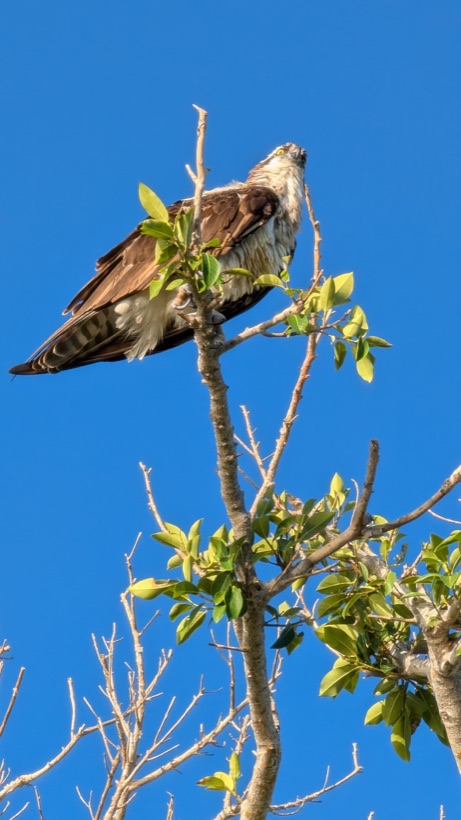
Southwest Florida skies get busy with raptors and it's easy to lump them together at a distance. The forked tail is your fastest tell for a swallow-tailed kite — nothing else overhead here has one. An osprey shows a bent-wing silhouette and a dark eye-stripe, hunts by diving talons-first into the water for fish, and sticks around year-round. A bald eagle is bulkier still, soaring on flat wings with a white head and tail only once mature, and it too is a year-round Southwest Florida resident. A red-shouldered hawk is smaller, reddish-shouldered as the name says, and more often perched on a snag than soaring. Here's a quick side-by-side for the water.
| Bird | Tail shape | Coloring | Season here |
|---|---|---|---|
| Swallow-tailed kite | Deeply forked, scissor-like | Crisp white head/underparts, glossy black wings & tail | Late Feb – early Sept only |
| Osprey | Fan-shaped, squared | White underparts, dark eye-stripe, brown-black back | Year-round |
| Bald eagle | Fan-shaped, squared | White head & tail (adult), dark body | Year-round |
| Red-shouldered hawk | Banded, rounded | Reddish shoulders & barred underparts | Year-round |
Swallow-tailed kites share that spring nesting timber with plenty of other hard-to-spot Southwest Florida birds — the secretive mangrove cuckoo among them — so a birding-minded trip through this country tends to turn up more than just one species if you know where to point your binoculars. If you want the best odds at any of it, book a spring or early-summer run on our dolphin & wildlife tours, where our captains are already watching the sky for dolphins, ospreys and, on a lucky day, that unmistakable forked tail carving circles overhead.