
🐬 At a glance
- Manatee
- Rounded snout, paddle tail, no dorsal fin, slow grazer (~10 ft)
- Dolphin
- Sleek body, curved dorsal fin, fast fish-hunter (~8 ft)
- Tell at a glance
- Fin on the back = dolphin; flat back & nose-tip surfacing = manatee
- Where & when
- Both on Naples Bay/Marco backwater tours; manatees favor warm, calm creeks
- Rule
- Look, don't touch or feed — both are protected
The quick tells
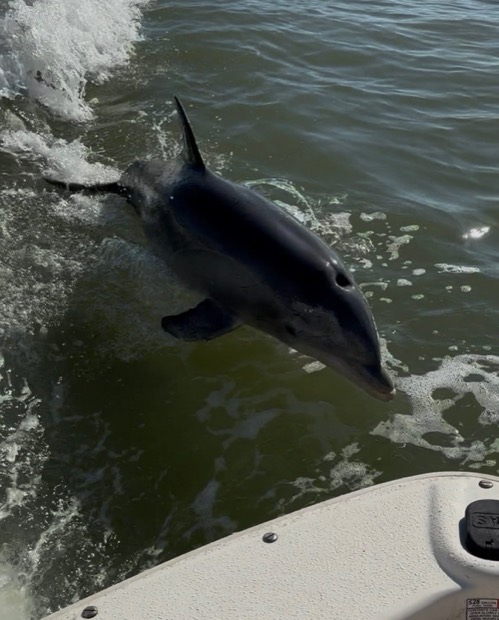
The single fastest test is the back. A bottlenose dolphin carries a tall, curved dorsal fin that breaks the surface first as it rolls forward — you see fin, then a glossy gray arc, then it's gone. A West Indian manatee has no dorsal fin at all. When a manatee comes up, you usually see just the tip of its whiskered snout poke up for a breath, then the broad curve of its back, flat as a wet boulder.
Color and size help too. Manatees are big and uniformly gray-brown, often dressed in a little algae or scars, and they move like they have nowhere to be. Dolphins are smaller, smooth, and built to sprint. And the tails are a giveaway: a manatee has a single rounded paddle, while a dolphin has a horizontal two-lobed fluke it pumps for speed.
How they behave on the water
Watch them for thirty seconds and they sort themselves. Manatees are gentle vegetarians — they hang in the shallows mowing seagrass and surface every three to five minutes in the same quiet patch. You'll often spot a swirl of muddy water, a “footprint” of smooth surface, before the animal itself. Dolphins are predators on the move, working bait schools, sometimes riding our bow wave or rolling through a tide line where fish stack up. If something's surfing the wake or porpoising in arcs, it's a dolphin, full stop.
That difference shapes the whole sighting. Dolphins come to you; manatees you come upon. On a dolphin and wildlife tour we read the water for both — nervous bait and diving birds for dolphins, calm warm creeks for manatees.
| Trait | Manatee | Dolphin |
|---|---|---|
| Dorsal fin | None | Tall, curved |
| Snout | Rounded, whiskered | Long beak (rostrum) |
| Tail | Flat paddle | Two-lobed fluke |
| Diet | Seagrass & plants | Fish & squid |
| Speed | Slow drifter | Fast, agile |
Where you'll see each near Marco & Naples
Both share our backwaters, but they pick different rooms in the house. We see dolphins year-round out in the open passes, along Naples Bay, and around Gordon Pass where tides funnel bait. Manatees prefer the calmer, fresher edges — the Rookery Bay estuary, the Gordon River, and the mangrove creeks near Caxambas — and they bunch up in winter when the Gulf cools. To plan around the seasons, check our wildlife-by-season guide. Either way, the rule is the same: enjoy them from a respectful distance and never feed or chase.
From the Helm: How We Tell a Manatee Slick from a Dolphin Bait Shower Near Rookery Bay
On a still morning near the mouth of Rookery Bay, before anyone on board has spotted a single fin, we’re already watching two different kinds of disturbance on the surface. A manatee gives itself away with a slow, oily-looking slick — a flat patch where its tail fluke just stirred the top few inches of water, spreading out and going glassy in a way wind chop never does. A dolphin gives itself away with commotion: a scatter of bait breaking the surface in a silver shiver, sometimes with a gull or two folding down onto it. We call the first a boil and the second a shower, and we watch for both before anyone reaches for a camera.
Once we mark a boil, we ease off well ahead of it and let the current carry us alongside rather than motoring straight at it — a manatee won’t bolt the way a dolphin will, but a sudden wake over a shallow flat can push one off its feeding line before you’ve even lifted your phone. Dolphins get the opposite treatment. We’ll idle in a wide arc and let them decide whether to close the gap, because a bait shower moving away from the boat means a dolphin working a school, not one looking for an escort. Guests are often surprised two animals that sound so similar from the dock get such different handling from the helm.
From the helm, the tell isn’t always the animal — it’s the birds working above it. A tight stack of terns or pelicans hovering and diving over one patch of water usually means a bait ball a dolphin is pushing up from below, and we’ll idle toward that stack rather than toward any fin we glimpse, since the fin comes and goes but the birds hold position. A single wading bird standing motionless over flat water, by contrast, is often just watching a manatee graze below the surface a few feet down, with nothing dramatic happening at all.
We often see manatees surface in twos, breathing in a loose sequence, a soft exhale you can hear across calm water before you ever spot the snout. Dolphins tend to announce themselves louder, a chuffing breath followed by a dorsal fin rolling through in one smooth motion. Most guests catch the dolphin first simply because it moves faster and stays visible longer, then need a captain to point out the quieter manatee working the grass flat off to the side. Neither shows up on command, but the backwaters give us a fair shot at both on most mornings.
If you want a real shot at both in one outing, our dolphin tours spend real time drifting the flats and passes where manatees and dolphins both feed, instead of running a straight line hunting one or the other. The same grass beds and shell-crusted edges that draw manatees in to graze are the structure that stacks bait for dolphins to work, which is part of why we cover oyster bars and seagrass on the way out. Bring polarized sunglasses — cutting the glare off the surface is half of spotting either animal before anyone else on board does.